Gardening & Farms

Local Flavors: Utah Fab Farm to Fork Regional Restaurants

. It’s hard these days to find restaurants that don’t lay some sort of claim to farm to table or farm to fork cooking. Well, here are a handful in our region that really succeed in that mission. 

|


Photos by Blake Peterson at The Lakehouse at Deer Creek.

The term “farm to table” has, in recent years, been replaced in some culinary circles by the more alliterative “farm to fork.” They both imply the same thing: cooking, and restaurant cooking in particular, that favors locally sourced, wholesome, organic and artisan (when possible) ingredients. The idea is that foods that are local are fresher and make, in theory at least, a smaller carbon footprint than foods that have to travel long distances. 

Of course, compromises are often made. You simply can’t get PEI mussels unless they come from Prince Edward Island, for example. And I don’t think pineapples are grown in Utah. So if you have a pineapple souffle on your menu, the pineapples will have to be brought from somewhere far away. 

Many food writers credit the Slow Food movement with introducing the notion of farm to table or fork. And yes, Slow Food certainly did light a freshness fire under many chefs, restaurateurs and home cooks. But in fact, the idea of farm to fork cooking dates back to renowned cooks like Pierre Franey, Julia Child, Jacques Pepin, and more recently, to Alice Waters, Jeremiah Tower, Eric Ripert, and a host of others, who have always been champions of the freshest, best ingredients in the kitchen. It’s hard these days to find restaurants that don’t lay some sort of claim to farm to table or farm to fork cooking. Well, here are a handful in our region that really succeed in that mission. 

When Provo’s Communal restaurant was opened in 2011 by Colton Soelberg and Joseph McRae, the emphasis was on family style (communal) dining with dishes composed largely of locally sourced ingredients something that was pretty new at the time. That is still the case under the ownership of Keven Santiago, who purchased the Heirloom Restaurant Group, including Communal, in 2019. There’s a heavy representation of locally sourced foods on the Communal menu ranging from local lamb t-bones and Amano chocolate pot de crème, to Snuck Farm spring greens, local heirloom carrot salad, home- and locally-made cheeses like feta and ricotta, regionally sourced bison, and much more. All of it is delicious. 

At Tupelo restaurant in Park City, Chef/Owner Matt Harris’ menu is chock full of dishes with ingredients sourced very locally from small-batch producers “who grow, distill, or raise” them, including from his and partner Maggie Alvarez’ own farm in Midway. The English Pea Salad is elevated by the inclusion of Park City Creamery feta, and the Creamy Pesto Tagliatelle Pasta is composed of local mushrooms, peas, squash blossoms and artichokes, while the Utah Lamb Chops are served with local sunchoke tostones, charred fennel and local mushrooms, and house made ricotta is the star of the House Made Ricotta Toast.
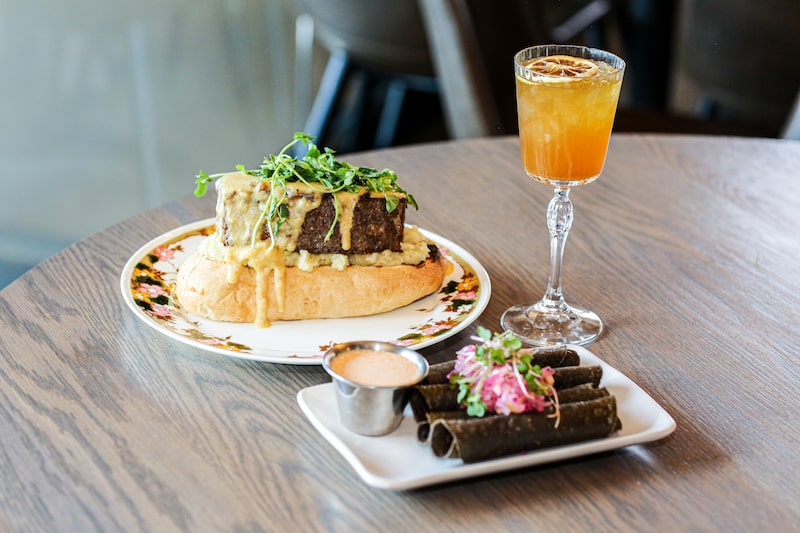
Tamara Stanger the Chef of The Lakehouse at Deer Creek calls the food she cooks there Utah Heritage Cuisine. At The Lakehouse, her knowledge of foraged ingredients and her foraging skills pepper the menu as does “the history of the pioneers and the native people who first lived along the Wasatch Front.” 

Chef Stanger also works with groups like the Blue Watermelon Project and the Department of Education to bring heritage food into schools. Sustainable, local and foraged foods pop up everywhere on The Lakehouse menu in dishes such as Elk Osso Bucco with Supai red corn grits and griddled greens; Ute Blue Corn Tostadas with ancient Utah Fremont beans; or Canyon Meadows Beef Ribs marinated in black walnut catsup; and drinks like the Deer Creek Sour, which features locally distilled High West Double Rye.

The fact that Galen Zamarra was chef/owner of the celebrated Mas Farmhouse in New York City tells you all you need to know about his commitment to refined cooking using responsibly sourced, seasonal ingredients. A strong supporter of neighboring farms and artisanal purveyors, Galen is now Executive Chef at The Lodge at Blue Sky’s Yuta restaurant in Wanship, where he works in tandem with Director of Farming, Lynsey Gammon utilizing ingredients from Blue Sky’s onsite Gracie’s Farm. 

Menu temptations like Grilled local Lion’s Mane Mushroom; Grass-Fed Wasatch Valley Beef Tenderloin; local Bison Tartare, and Baby Zucchini Blossoms with fig, chervil, seared chamomile cheese, and pomegranate molasses are a testament both to the Chef’s creativity and commitment to quality local ingredients.

utahbitested@gmail.com

RELATED CONTENT

New Roots SLC, Organic Vegetable Farm Supports Refugee Families to Continue Tradition of Gardening and Farming

The Freshness Factor: 8 Utah Farm to Table Restaurants You Will Love

The Freshness Factor: 8 Utah Farm to Table Restaurants You Will Love

From Farm to Table…..To YouTube

Best farm to table restaurants—separating the pretenders from the contenders

SUPPORT LOCAL JOURNALISM AND SUBSCRIBE TO PRINT MAGAZINE


Subscribe to Utah Stories weekly newsletter and get our stories directly to your inbox

* indicates required


, ,


Join our newsletter.
Stay informed.


  • Riverbed Ranch Utah: Cult, Commune, or Utah’s First Modern Homesteading Town?

    Driving out past the town of Delta on a gravel road for a couple of hours, we almost turned around. Following a rain storm, the road is wet and muddy but still decent. Jesse Fisher is worried we’ll get stuck, but we plow through giant puddles of water, and as the clouds lift, we reach the homestead community of Riverbed Ranch, consisting of 1250 acres of reclaimed desert.

    Almost like an oasis, Riverbed Ranch is home to 40 families who decided to depart city life, municipal taxes, congestion, air, light and sound pollution, and live in a place among chickens, goats and cows on self-reliant homesteads. 

    Describing Riverbed Ranch as “bucolic” would be inaccurate at this point. Sometimes there are purple flowers in the valley, but currently it is a desert — still beautiful, but most of the properties in the sprawling valley are still works-in-progress. But the scale of the valley and witnessing in person the first brand new town to break ground in Utah in 75 years is quite remarkable. 

    A few of the 2.5 acre plots consist of a trailer and a fence. Some plots have nice little homes that appear very homemade; others have more complete homes with nice fencing, with nicely organized pens for different animals, orchards and organization. 

    Some homes under construction even appear upscale and modern, where the inhabitants are indeed living as modern homesteaders, not seeking “luxury retreats” like so many other empty homes in Utah being built in hot tourist destinations such as Moab and Park City.

    We start by speaking with Tom and Kathy Barnes, whose homestead is a model for order and function. Turkeys walk around in their pen, excited for feeding time. Beside the turkey pen is another pen for chickens; one for goats, and another for pigs. All of the pens are connected to a large barn. By the look of their operation, the Barnes appear to be seasoned professionals.

    Indeed they are. Tom and Kathy raised their eight children “on a teacher’s salary,” homesteading in Payson, Utah on ten acres, reaching the point where the only store-bought items were toilet paper, shampoo, toothpaste and cashews. Most everything else, including fresh fruits, vegetables, milk and meat were raised themselves.

    Tom had just finished feeding his three hungry pigs when he took a moment to talk to me.

    “What are the advantages to living on a homestead?” I ask. 

    “Listen,” he says. “You can hear a pig eating … Once in a while we will hear a fighter jet pass over but that’s it.” 

    The Barnes are calm and content in their semi-retirement. They set up their homestead at Riverbed Ranch five years ago. They already knew homesteading and they realized even in retirement they could help the other inhabitants here, those with less experience, learn how to take on the demanding but satisfying lifestyle.

    “It’s basically like an extended family,” says Tom. “We are all like-minded out here. We are all going to help one another when our neighbors need help.”

    Tom says he and most of his neighbors are members of the LDS Church, and that most of the city’s LDS members are a part of a ward which makes up their “ward family.” “Out here,” he says, “everybody is our extended family. So we all know we are going to help one another and learn to get along … Like early pioneers in a small town. It’s very much the same thing.

    A wild goose chase?

    “We could live out here like it was 1849, but we have all of the conveniences of modern society, so why not take advantage of the best of both worlds?”

    I wonder how adaptable these modern pioneers are. Raised on a homestead, would these folks ever want to join the modern world again? The Barnes kids are mostly choosing city life, but their kids and grandkids love visiting them, running around free-range. Tom adds, “One of our sons is starting his own homestead in Piute County.”

    We drive around on the hard gravel roads and get a sense of how all of the residents here justify the hard-scrabble, off-grid life, which requires living off pumped well water, solar power for electricity, and propane for heat. 

    We are aiming to get a sense of the  bigger reason why all of these people are out here, far away from freeways and Walmarts. Are they all latter-day preppers?

    Continue reading and support independent Utah journalism with a purchase of Utah Stories (Digital + Print) or 3 month free trial (Digital).


  • The Perfect Girls’ Day in Park City: Brunch, Shopping, Spas & Nightlife

    After a week of work, grocery shopping, meal prep, driving the kids around, housework and last minute emergencies, a day of bonding and fun with our BFF’s is just what the doctor ordered. Fortunately, one of the best getaways is just a short drive away to Park City.


  • How to Start a Garden in Utah: Advice from Local Gardening Experts

    Creating and maintaining a home garden can be a daunting task for beginners. Whether it’s vegetables or flowers you want, starting the journey can seem overwhelming. Kim Clark, co-owner at Lambert Growers, and Heidi Orme, a manager from Millcreek Gardens, give advice to first-time gardeners who are ready to get their green thumbs dirty.


  • Can Utah Farms Survive the Corporate Food System?

    Local farms and restaurants battle similar economic pressures as they struggle to survive in a tight economy where slim profit margins and increased labor costs and conditions are often beyond their control.