Community Relations

From Farm to Table…..To YouTube

From farm to table … to YouTube. That’s what students at YouthCity’s summer and after school program have started through an ongoing partnership with neighboring Liberty Park Farmers Market.

|

From Farm to Table.....To YouTube

students at YouthCity
Photos by Claire McArthur.

YouthCity and Liberty Park Farmers Market

From farm to table … to YouTube. That’s what students at YouthCity’s summer and after school program have started through an ongoing partnership with neighboring Liberty Park Farmers Market.

“With the farmers market so close, it just made sense to use it as a learning opportunity,” says John Lyman, program manager for YouthCity in Liberty Park, one of five locations for the Salt Lake City government program.

Hands on YouTube

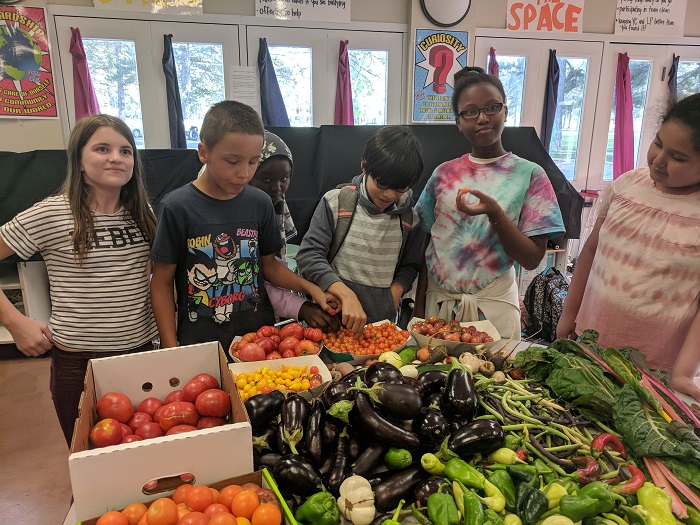
Last summer, the YouthCity students, ages 8-14, began venturing to the Liberty Park Farmers Market. Students interviewed the farmers, makers and market organizers on camera about their work and then shared their findings on social media, including YouthCity’s YouTube channel. The students also took produce from the market back to the YouthCity building in the park to experiment with healthy cooking in a format reminiscent of the TV show “Chopped.”

“One of the things that I value and want is for kids, as they’re growing up in this world of exponential technology, to be content creators, not just content consumers,” explains Lyman. “We started messing around with live streaming. We discovered through trial and error…a really easy way to produce live content similar to the things that I was watching when I was growing up on PBS, like “3-2-1 Contact”—kids teaching stuff to kids.”

Lyman has seen both their confidence speaking on camera and familiarity with farm-fresh produce grow with each broadcast and visit to the market.

A Healthy Education

“On Fridays, at the end of the day, parents come and pick up the kids, not at the building, but at the market, because it’s a way to get them there and stay there,” says Lyman.

It’s a culture that’s in line with Liberty Park Farmers Market’s own mission of building relationships and educating all ages on healthy eating. Their Market Buds program provides kid-friendly activities designed to engage kids under 12 in the local food system, and an opportunity to earn Produce Bucks—vouchers for fruits and vegetables sponsored by the Intermountain LDS Hospital.

“When it comes to healthy eating for kids, the Liberty Park Market builds an important connection beyond the food,” says Annette Shade-Accarrino, a market organizer. “More than the food, the Liberty Park Market is about community. Our focus at the market is about getting to know our local food friends—the farmers who grow our food; the neighbors who shop there; and the fresh foods that the changing seasons bring.”

Thanks to a $25,000 grant from National Recreation and Park Association, through their “Commit to Health” campaign, YouthCity was able to take additional steps to increase healthy eating opportunities for its students. At the Liberty Park location, that meant a new kitchen with increased cooking capabilities for the students.

It also brought about the Healthy Harvest event, which celebrated its second season on Aug. 30. All five YouthCity locations and their families got together for a cooking competition using produce from the farmers market.

The NRPA has since awarded YouthCity a gold standard for its work with the farmers market.

“It’s amazing for me to see their excitement about eating healthy food when they have access to it; they are taught how to prepare it and when they are given the resources to try new things,” says Lyman.


READ MORE ABOUT SUGAR HOUSE HERE.

, ,

Join our newsletter.
Stay informed.


  • How to Start a Garden in Utah: Advice from Local Gardening Experts

    Creating and maintaining a home garden can be a daunting task for beginners. Whether it’s vegetables or flowers you want, starting the journey can seem overwhelming. Kim Clark, co-owner at Lambert Growers, and Heidi Orme, a manager from Millcreek Gardens, give advice to first-time gardeners who are ready to get their green thumbs dirty.


  • The End of an Era? FanX and the Salt Palace Closure

    For more than a decade, FanX has called the Salt Palace home. With the convention center set to close for a massive renovation, founder Dan Farr is preparing for a new chapter while planning one final celebration in its longtime venue.


  • The Stratos Project and Corporate Power: Who Controls Utah’s Future?

    If we were all just consumers, Governor Cox, Mike Lee, Speaker Schultz, and Kevin O’Leary would have it easy. If we were just more concerned about money, jobs, and tech, and less concerned about raising our kids in communities (not in front of screens), culture, the environment, and water, those smart dudes would get exactly what they want — Stratos: a city of the future, buzzing with processors and transistors, making all of our AI dreams come true! 

    The world we could live in would be a dazzling, Mr. Wonderful kind of place. We would beat those pesky Chinese in the AI war; our AI robots could do all of our farming and ostensibly harvest the water we need for the Great Salt Lake out of thin air. But apparently, we just don’t get it. We haven’t yet reached the point predicted by Aldous Huxley’s vision in Brave New World, where we are completely distracted, dopamine-driven consumers who only need sex, drugs, and stuff to remain happy.

    Maybe Stratos will be an amazing marvel, and somehow, as Governor Cox claims, “. . . add more water to the Great Salt Lake.” But we aren’t sold. While this Stratos project has received considerable attention, it’s worth taking a step back to attempt to understand how corporate power appears to have usurped civic power.

    Civics is the practice of shaping our society through our collective voices and community involvement. Ask the residents in Tremonton, Utah how well that is working out for them. Can we still shape our world through our elected leaders? Does it matter who we vote for at the ballot box if organizations like UDOT, UTA, and MIDA can supersede our local government authority and citizen backlash? 

    The corporatization of our communities and the interests that impact our political leaders’ decision making processes are seen as far more of a concern than the average Utah resident’s concerns. Special interests and corporate power are shaping Utah’s future more than ever. 

    It’s worth asking: ‘How can we regain control over shaping Utah’s future in light of the growing power and billions that the technocrats now wield in shaping our world today?’ Amazon’s market cap exceeds the GDP of Canada. The “Magnificent Seven” tech stocks now have a greater market cap than the entire GDP of Europe ($23.6 trillion. EU countries have $19.3 trillion GDP). Will tech companies become their own nation-states and dominate their own chunks of various states? Will we become their subjects?

    There are two sides to this coin: We love Utah not just because we have the most outdoor wilderness playgrounds, but also because of Utah’s prosperity and job market. This is because Utah has become a tech hub. Our tech leadership has minted several billionaires and billion-dollar businesses. Utah offers a market and an educated workforce that more businesses and giant corporations want to be a part of. This is a benefit for even non-tech Utahns.

    The problem with this success is that as we dole out more money to attract more tech businesses, data centers, fulfillment centers, and big corporate retailers, it becomes more difficult to carve out our “sense of community.” As corporate sovereignty replaces local business sovereignty, we see that our voices and our votes matter less.

    Ask who our politicians work for, and nearly every Utahn believes they work far more for their corporate donors than they work for the average Utah citizen. So how do we best regain control over our communities?

    Continue reading and support independent Utah journalism with a purchase of Utah Stories (Digital + Print) or 3 month free trial (Digital).


  • What It Was Like at Weber State in the 1980s

    When Zeveloff arrived at Weber State in 1984, he entered a state that was far more isolated than the Utah most residents know today. The state was growing, but it had not yet experienced the population boom, national attention and influx of newcomers that would come in later decades. At Weber State, most professors were white, male and Mormon. Most either came from Utah or had received their graduate training there.

    Zeveloff was different in nearly every way.