
Healthy Utah

Utahns Love Their Essential Oils, but Can the Science Back Any of Their Claims?

Utah-based Young Living Essential Oils has boasted of having over 3,000 global employees, more than six million members, and of being the “world leader in essential oil research and development.” But in 2020 when the company was asked by the National Advertising Division about the science used to justify company claims about its products, the…

|


The following story was written and researched by The Utah Investigative Journalism Project in partnership with Utah Stories.

Utah-based Young Living Essential Oils has boasted of having over 3,000 global employees, more than six million members, and of being the “world leader in essential oil research and development.” But in 2020 when the company was asked by the National Advertising Division about the science used to justify company claims about its products, the company argued that it should not be required to provide “competent and reliable evidence.”

The NAD ruled against Young Living, who appealed the decision to the National Advertising Review Board, which also ruled against Young Living in November 2020. Since then the company has agreed to stop making claims about certain products’ ability to increase calm and energy and to remove the label “therapeutic grade” from all its products. Around the same time, DoTerra was also dinged by the self-regulating group and was asked to discontinue its use of the term “certified pure therapeutic grade” in describing its products. 

While Young Living promised to comply, a class action lawsuit filed in January of this year states the company continues to use misleading claims in its marketing.

Self-regulating… at first

Laura Brett is the executive vice president of the National Advertising Division, a National BBB Program. She says SC Johnson asked the division to investigate Young Living and DoTerra’s claims of therapeutic and health benefits from their essential oil products.

Brett says even though the NAD asks for voluntary compliance, it also works closely with the Federal Trade Commission.

“Ninety percent of companies agree to comply with our requests,” Brett says. And those that don’t, she states, are referred to the FTC. “The FTC has a strong track record of following up on these referrals,” she says.

The process then follows something very similar to court, with both sides able to present evidence and make oral arguments before the NAD. If they’re unhappy with the decision, they can appeal it to the NARB.

Both Young Living and DoTerra were challenged on numerous claims that included the products could help users sleep better, relax and alleviate anxiety, and gain focus and energy.

The “Therapeutic Grade” label was a major sticking point, with both companies claiming it didn’t necessarily mean that products had medicinal benefits, just that they were very pure. 

In the hearings, consumer surveys were commissioned by the multi-level marketers as well as S.C. Johnson to see what people thought of the use of the term “therapeutic grade.” The survey results commissioned by Young Living showed “therapeutic grade” had little impact on consumer perception. But the survey was also criticized by NAD for subpar standards. For example, it wasn’t a “double-blind” survey and certain questions were crafted in a way that may have influenced answers of respondents. Young Living’s survey also didn’t even ask respondents specifically about how they interpreted the meaning of “Therapeutic Grade.” 

The NAD found the double-blind survey conducted by SC Johnson to meet acceptable standards. SC Johnson’s survey actually asked respondents what “therapeutic grade” meant to them, and 59% of respondents in the test group said it meant the “oils have healing or medicinal powers.”

Young Living also provided research from nine separate clinical studies showing the health benefits of essential oil. 

The NAD’s official decision, however, notes that Young Living “did not submit any studies” conducted on the company’s own essential oils, but instead offered research on common essential oil ingredients. The NAD found that research unreliable since “essential oils are not uniform in composition.” 

It was in this argument that Young Living also objected to having to apply the “competent and reliable standard” of evidence. The NAD shot them down there as well.

Brett with the NAD says that standard is important as the division follows the same benchmarks as the FTC. 

“We’re not creating a standard based on our own opinions about what advertising should be, or what the standards are for truthfulness in advertising,” Brett says. “We rely on the FTC’s guidelines.”

When Young Living lost its appeal in November, the company issued a memo in December to members about the change, now apparently embracing the decision to stop using the misleading “therapeutic grade” on its labels.
“While other companies may not immediately follow this directive, we are leading the change to better protect your legacy and ours,” the company statement says.

The other company challenged its claims, and DoTerra did not fare much better. DoTerra also fought the scientific standard and pushed back against the idea that clinical trials would be needed to support their marketing claims. Instead, they provided testimony from a doctor as to the “generalized” health benefits of essential oil products. The NAD, and later the NARB, similarly noted that DoTerra lacked meaningful data to support claims of their products in denying the company’s claims.

Of the 70 scientific reports provided by DoTerra, only one tested one of the company’s own products, and even there the NAD “found several methodological flaws” with the study.

In a statement about the decision, DoTerra spokesman Kevin Wilson noted that “quality was never in question,” in regards to the hearings and that while DoTerra supports self-regulation they disagreed with the NAD decision.

“We firmly believe NAD misunderstood the law and applied the wrong legal standard,” the statement says.

Young Living stated that it had no comment about the NAD and NARB decisions.

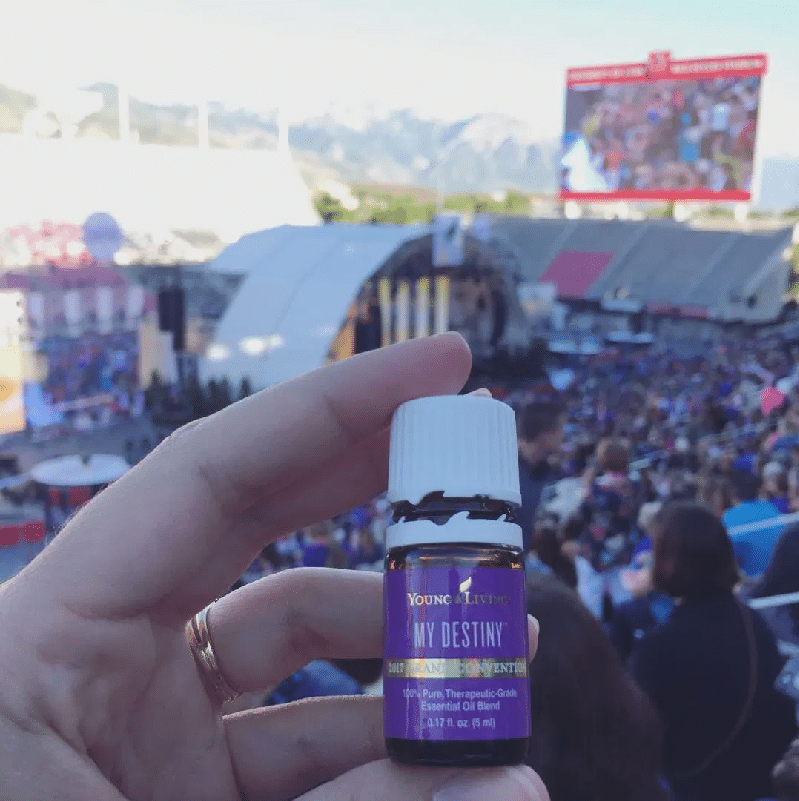
More than 25,000 members attending a Young Living Essential OIls conference in Salt Lake City

A “complicated challenge”

Critics have long pointed out that getting multi-level marketing companies to follow the rules is a challenge when they use armies of contractors or “members” who sell products in one-on-one settings where they can often literally say whatever they want about the products.

“It’s a complicated challenge,” says Peter Marinello, vice president of the Direct Sales Self Regulatory Council. “These companies have battalions of sales members, so getting your arms around what these enormous sales forces are doing — it’s difficult.”

MORE STORIES ON ESSENTIAL OILS

The validity of evidence of Young Living’s case against doTERRA.

Young Living Farms receiving a warning letter from the FDA

Gary D. Young Fabricates Lies About Somalian Native 

Young Living: Successfully Suppressing the Facts
Lavender Fields of Deceit?

Subscribe to Utah Stories weekly newsletter and get our stories directly to your inbox

* indicates required


,

Join our newsletter.
Stay informed.


  • A Stand-Up Wheelchair Gives Paralysis Patients Greater Independence

    After a cycling accident left him paralyzed, Bill Winchester had to relearn how to navigate daily life from a wheelchair. A stand-up wheelchair later gave him the ability to rise, move more independently, and regain parts of the active life he once knew.


  • Echocardiogram for Active People: What You Should Know About Your Heart Health

    Most active people track performance, pace, and recovery—but rarely look at the one organ driving it all. Understanding how your heart is actually functioning can reveal early warning signs long before symptoms appear.


  • Utah Official’s $36K Travel Reimbursements Raise Questions About Use of Taxpayer Funds

    The trek into the office is a necessary evil for many employees; unpaid time that could be spent elsewhere. But some state employees are able to cash in on their commutes.

    That includes one member of Gov. Spencer Cox’s cabinet who heads the Utah Department of Cultural & Community Engagement. The department oversees a number of civic and social programs ranging from museums, libraries and the state historical society, to volunteerism efforts and multicultural affairs. 

    The employee’s in-state travel expenses made up a large chunk of the department’s employee reimbursements in recent years, according to documents obtained by The Utah Investigative Journalism Project obtained through a public records request. 

    The UIJP reviewed spreadsheets detailing the reimbursed expenses of the department’s 17-person leadership team over the 2024 and 2025 fiscal years. 

    The analysis showed one employee, Executive Director Donna Law, accounted for nearly a third of the team’s reimbursements in 2024 and 43% in 2025. Law, who lives in Cedar City, spent more than 11 times the average amount spent by all other employees included in the analysis. 

    The majority of Law’s expenses were categorized as in-state travel, which includes mileage and lodging. Between the two years, she spent $21,607.94 on lodging, $10,135.42  on auto mileage, and $1,455.00 in miscellaneous travel expenses and meals for a total of over $33,000. 

    The next highest amount spent on in-state travel was $3,385. Law’s overall spending far exceeded any other employee.

    The nearly $36,000 Law spent on travel and other items wasnearly three times that spent by the employee with the second highest amount in reimbursements. His expenses, in contrast, were largely out-of-state travel.

    Continue reading and support independent Utah journalism with a purchase of Utah Stories (Digital + Print) or 3 month free trial (Digital).


  • The $7 Million Recruit: How NIL Changed College Athletics Forever

    In 2012, Jabari Parker, a top high school prospect and member of the Church of Jesus Christ of Latter-day Saints, was facing his biggest decision to that point in his life: where to play college basketball. 

    Fans of BYU athletics hoped and perhaps prayed that Parker would pick the school owned by the church he was raised in. BYU was listed as one of his final choices. But he ultimately chose to spend his college years at Duke before attempting a career in the NBA. BYU fans were disappointed, but no one was truly surprised. Duke over BYU was the best choice for a young prospect in 2012. 

    A.J. Dybantsa.

    What changed between 2012 and 2024 when A.J. Dybantsa, the number one high school prospect, chose BYU over every other school? The answer is roughly $7 million dollars. That is what Dybantsa is reportedly making to play basketball at BYU. 

    The deal was supported by Utah Jazz owner Ryan Smith, who met multiple times with the Dybantsa family in multiple attempts to bring the young player to Provo. 

    According to Smith, he had no financial role in bringing Dybantsa to BYU, but the influence of Utah’s most famous billionaire acting as a “booster” or unofficial recruiter certainly swayed the decision.

    Prior to 2021, boosters acting as recruiters was taboo to the NCAA governing body. It was called improper recruiting. But in 2021, California began the modern era of NIL, or the ability of a college athlete to benefit from their name, image, or likeness, when they passed the “Fair Pay to Play Act.” 

    This new law gave college athletes in California the ability to benefit from their NIL, something that was banned in the rest of the country to that point. The NCAA saw that this law would create an unfair advantage for California schools that could now give young athletes the chance to make money off their talent and image while still in college. 

    The NCAA knew they needed to do something quickly, so they rushed through a policy that opened up NIL to all college athletes in the country, and it has been expanding and evolving over the last four years. 

    Grant Duff, who has coached at the University of Utah, Weber State University, and is now the defensive coordinator for Idaho State University, says, “The best part of NIL is that athletes have an opportunity to make good money. The downside comes with the free-for-all that money causes.”

    Dybantsa confers with BYU Head coach, Kevin Young.

    One of the biggest current examples of what a school can do when the boosters are willing to pay for success is Texas Tech University. From 2020-2024, Texas Tech had 34 wins, which works out to 6.8 wins per year with a low of 4 wins and high of 8. Then Texas Tech’s boosters got involved, led by Cody Campbell, an oil industry businessman and Chairman of the Texas Tech board. The football program was given 28 million dollars for NIL with a simple message attached to the large pile of money: Win. And win now. And win they did. 

    By signing NIL deals with athletes in the transfer portal, Texas Tech went from a middle-of-the-pack school in their conference to one of the top 12 teams in the country. They didn’t just win games in 2025, they made many of their opponents look like they didn’t belong on the same field, including the University of Utah and BYU twice. That is what money can buy.

    Continue reading and support independent Utah journalism with a purchase of Utah Stories (Digital + Print) or 3 month free trial (Digital).