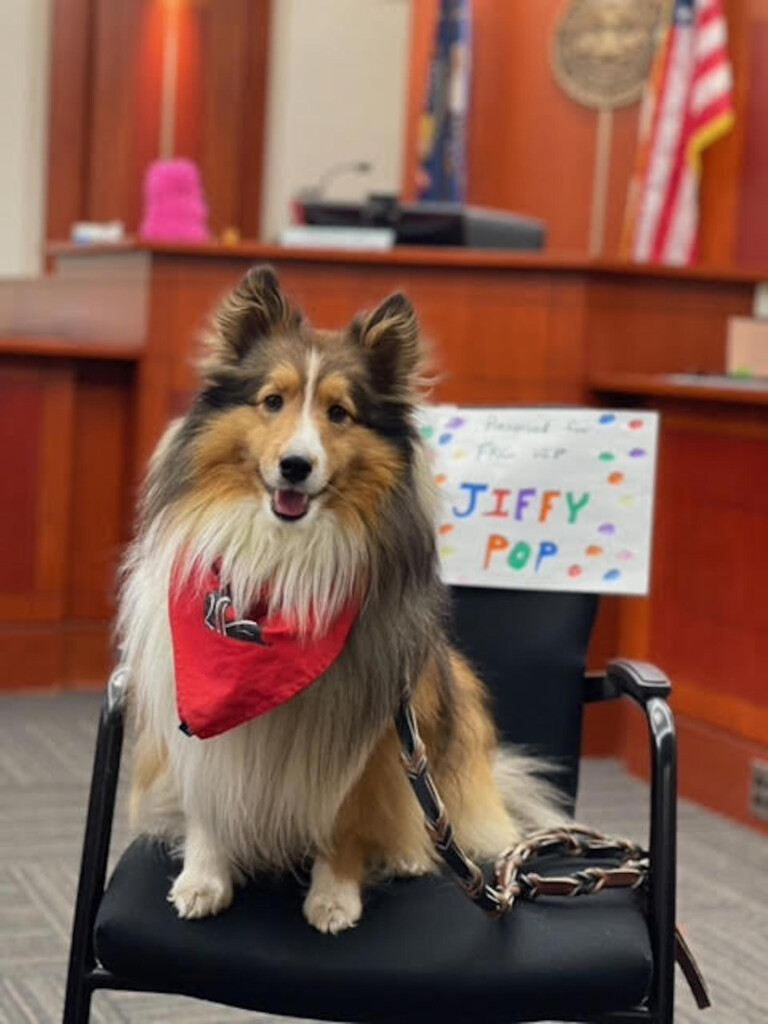
Not just any dog can walk in the doors. These dogs are part of ITA (Intermountain Therapy Animals) and are screened, trained and licensed for the privilege of service. These unique dogs are naturally drawn towards humans, adults and children alike. ITA ensures each dog can handle surprises, human touch, loud noises and new environments.
Shane Kibler, Specialty Courts Program Administrator for Juvenile Court District 3 has been working for 23 years, but dogs have only been coming to his work since the beginning of 2023.
“Nothing can replace the dogs in court. They’re a one-of-a-kind experience,” Kibler said.
During one court case, two young children were mauling a huge St. Bernedoodle named Teddy. One child hung from the dog’s neck, the other had the dog’s face in their hands while the parents and judge were talking. “The dog gave the kid a big lick in the face,” Kibler said.
Janice Frost, former judge for Juvenile Court District 2, had dogs in her courtroom for two years before retiring in 2018. She now has her own therapy dog she takes to a residential treatment center for juvenile boys.
“The dogs have to be people oriented, and not care for other dogs,” Frost said.
While not all kids and families respond or even like a dog for a comfort companion, when the dog is wanted, the entire atmosphere of the proceedings can change.
Frost worked with an extremely hostile teenager who refused to have a conversation. When a therapy dog approached her, the animal knew what she needed and the teenager’s demeanor changed. “It was the only time I saw her calm down,” Frost said.
A courtroom is a stressful place. Often the cases are based around traumatic events for children, and the whole process is overwhelming and intimidating. “There are a lot of emotions in court. A lot of trauma. They lower the stress levels. They’re helpful for everyone, it’s a wonderful experience,” Frost said.
The dogs are not only helpful for the children, but for anyone who is there, including the staff, family and judges.
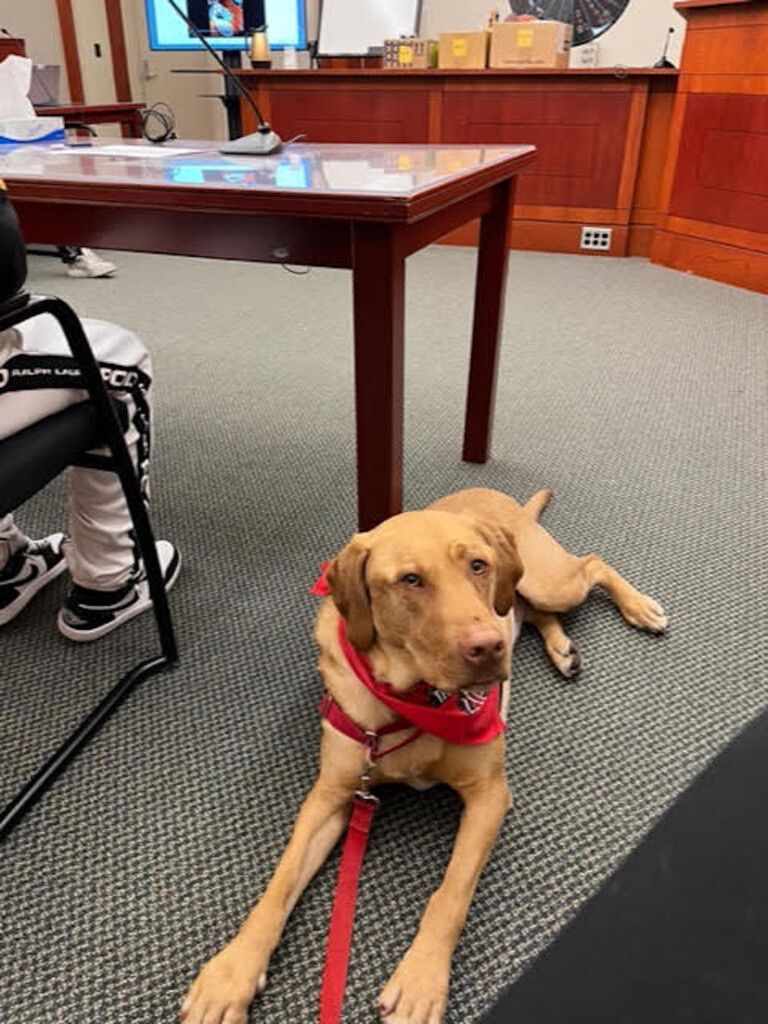
Kibler has benefited from them himself. He and his coworkers flock to the room where the dog is stationed. Every person involved in juvenile cases is vulnerable to what he calls ‘secondary trauma’. “We see the toughest of the tough,” he said. A dog’s simple attention and affection can instantly change the environment of the room.
ITA was founded 30 years ago. They visit 170 facilities in Utah and Montana with 325 volunteers. While courtrooms only see dogs, ITA supports many animals, from cats to rabbits. ITA started supporting juvenile courts a few years ago when an ITA volunteer named Linda Webster stepped in.
Karen Burns, co-executive director for ITA, retold Webster’s story. “Lisa was a CASA (Court Appointed Special Advocate) volunteer and had one child whom she couldn’t get to talk or interact. She had a registered therapy dog at the time so she asked if she could bring her dog to meet this child and just see if that might help him open up. She said it was a world of difference. The child spoke to her; interacted with her as they were playing with the dog. That’s how the vision came to be. Obviously, the judges saw it too.”
In the Salt Lake Juvenile Court 3rd District there are five judges who regularly have a dog in their courtroom. Judges go through several cases in an hour; the dog hangs out for each meeting and will attend to any person who wants attention.
“They’ll sit with that family or they’ll go up to the podium,” Burns said. “They have us come early and visit with anyone in the waiting room and visit before anyone goes into court to de-escalate.”
There are eight teams for the 3rd District and 7 teams for the 2nd District. If the dog isn’t already on site, an attorney, probation officer, a guardian ad litem can request a therapy dog be with a specific juvenile. If a dog makes a connection with a specific juvenile, they’ll be with that child through all the court hearings that could go on for several years.
At a volunteer appreciation event, a judge recounted a story about a boy who could hardly talk because he was so nervous.
“He shared a story about a child who was stuttering and couldn’t carry a conversation,” Burns said. “They brought a dog in with him and as he was petting the dog, his blood pressure was lowering. Everybody was a little more relaxed. He could carry on a conversation for the first time.”
A therapy dog is born, not made. They need training to understand basic commands such as ‘sit’, ‘stay’, ‘leave it’, etc., but their love for humans cannot be taught. There are companies who profess to be able to turn any dog into a therapy dog, but they don’t have the authority to license, nor do they have programs where you can volunteer. Burns warned against these “scam companies who make promises.”
If you are interested in becoming a therapy animal handler with your pet, visit therapyanimals.org to read a questionnaire to see if your animal may qualify for volunteer duty.
Feature Image: Jiffy Pop is one of the therapy dogs working for 3rd DistrictJuvenile Court.