
Nate was a splendid raconteur, and we shared many conversations and laughs. He once took the time to inform me about the significance of the various medals and ribbons on my dad’s World War II jacket. As we honor those who have served, I want to tell the story of what Nate did, especially those in the military.
The Fightin’ Hebe
In 1941, Nate was a 29-year-old salesman in Philadelphia when he joined what was then the U.S. Army Air Forces. (The U.S. Army Air Corps had changed its name to the U.S. Army Air Forces just a month earlier.) As one account tells it, when his commanding officer asked him what he knew about guns, Nate answered in his characteristic wise-guy fashion that he had once traded vacuum cleaners for them. “You’re an armorer now,” the officer said.
He was assigned to the ground echelon of the 384th Bomb Group, the so-called “ground pounders.” Ground crews were not required to fly, and most of their members never did. The losses of our aircraft over Europe were staggering; whole squadrons could be wiped out in an afternoon. Nate kept on volunteering to go with them.
Because he was not an official crew member, he often had to sneak aboard. Major General Dale O. Smith later called him the greatest stowaway in the history of the Eighth Air Force. By the end of the war, Nate had flown in many combat missions and earned an Air Medal with an Oak Leaf Cluster.
For a Jewish airman, those flights carried an additional danger. Dog tags were stamped with an “H” for Hebrew, and the men around Nate feared he would not survive in a German prison camp if he were to be shot down. So they gave him a new name, “Mike O’Mazer,” and made him a set of tags identifying him as a Roman Catholic.
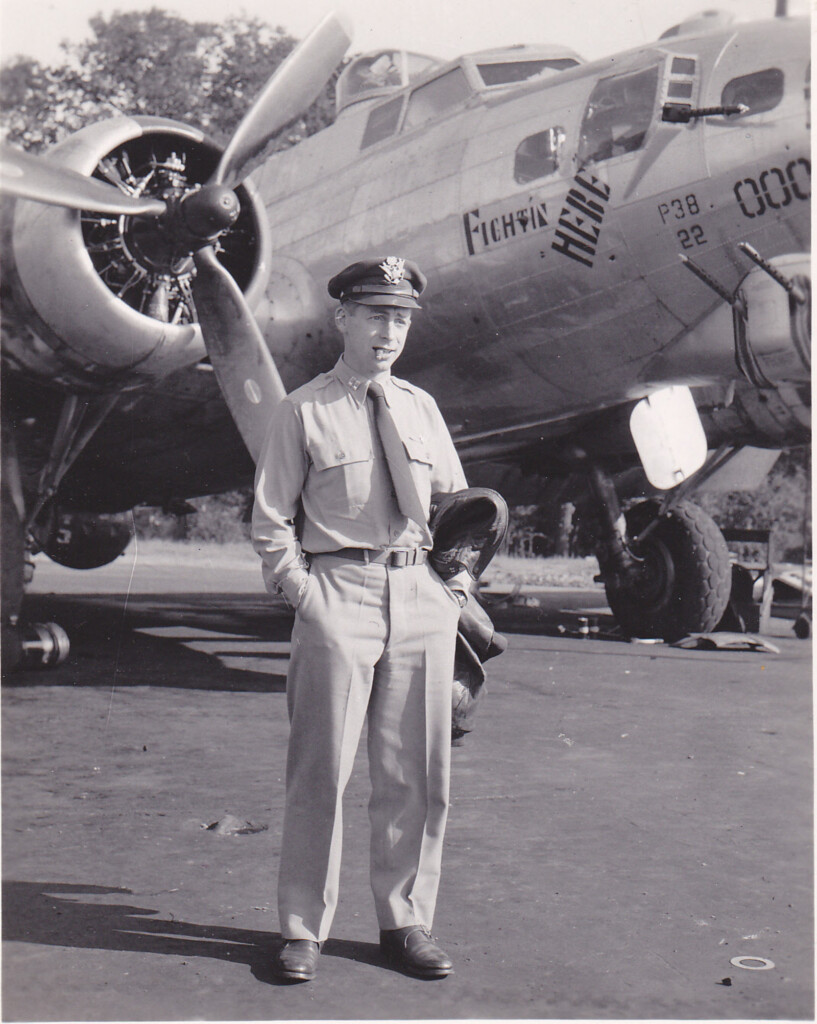
Nate’s squadron ultimately named a B-17 Flying Fortress the Fightin’ Hebe in his honor. The term “Hebe” for a Jew is of course a slur, and it is thus jarring to imagine it painted on the nose of a bomber. Yet, Nate told me that he was fully in favor of this and even considered it to be a compliment. Indeed, at a dinner one night at Ogden’s Timbermine steak house, Nate handed out ashtrays with the “Fightin’ Hebe” logo on them. Inside the squadron, this moniker was viewed as an act of defiance aimed at Nazi Germany.
Nate’s courage was not limited to the air. At Grafton Underwood, England, a cluster of live fragmentation bombs once fell from a plane onto the concrete, leaving a firing pin exposed. A hundred ground crewmen ran but Nate ran toward it. He ordered a jeep, picked the live bomb up in his arms, and drove it to a safe area, where he defused it. He was awarded the Bronze Star for his heroic act that day.
Building Up Northern Utah
Nate retired from what became the U.S. Air Force as a colonel in 1964, and he and his family decided to make Ogden their home. For the next forty years he worked to build up Weber County. As the Executive Director of the Weber County Industrial Development Bureau, he helped bring businesses and jobs to the Ogden area.
In 1969, when the nation turned its attention to Utah for the 100th anniversary of the completion of the first transcontinental railroad, Nate was the Executive Director of the Golden Spike National Centennial Celebration and coordinated the reenactment of the driving of the Golden Spike at Promontory. John Wayne attended this event, along with some 28,000 spectators.
Faith, Veterans, and the Museum
Nate was an active member of Congregation Brith Sholem; he brought so much warmth and wisdom to our historic synagogue. He stayed close to other veterans through the Jewish War Veterans of America organization.
Even in his 80s and 90s, one could find him at the Hill Aerospace Museum, talking with its visitors. He kept history alive, he said, not to glorify war but to argue for peace. One of his tangible gifts to our state is in the museum’s chapel: Nate led the effort to secure funding to create and install a stained-glass window in the chapel. It is a replica of the one in the English parish church near his old airfield, which features a B-17 flying alongside doves, under both a Celtic Cross and a Star of David. “To me, this window is really a peace symbol,” he told the Salt Lake Tribune in 2003. In 2011, the chapel was named the Col. Nathan H. Mazer Memorial Chapel in honor of his service in World War II and to the Hill Aerospace Museum.
Nate is buried at Arlington National Cemetery with full military honors. He ultimately came to our state from his beginnings in Philadelphia, the birthplace of our country. Ogden, Utah, and our nation are all better places due to the service and heroism of this remarkable man, my friend, Nate Mazer.
Photo courtesy of 384th Bombardment Group Museum.