
On the night of July 4, 1776, the Continental Congress had just approved the words that would sever the American colonies from British rule. Thomas Jefferson hurried a handwritten manuscript across town to John Dunlap’s print shop, along with an almost impossible request: 200 copies ready before sunrise. Dunlap and his crew worked through the dark hours, inking and pressing history into being.
Two-and-a-half centuries later, that same midnight urgency found a new home in a Utah shop.
Rob Buchert, an adjunct professor at Brigham Young University, and a professional artist devoted to paper and printing, spent four months bringing that frantic evening back to life. He set out to create what he calls the most historically accurate reproduction of the Declaration of Independence ever made.
Most people are familiar with the version of the Declaration of Independence that displays all the signatures, but this was actually a more formal copy created later. The original document, created by the Dunlap Broadside sent out on the night of July 4, 1776 — was the original document, essentially the birth certificate of our nation — marking the moment the colonies officially declared their independence.
“In February I learned that the history interpreter portraying George Washington at Mount Vernon couldn’t find 18th-century style paper,” Buchert said. “Researching a solution led me to the Dunlap Broadside and a question no one seems to have tried to answer in 250 years: could the Broadside be completely recreated, just as it came off the press on the night of July 4, 1776?”
His background made him a natural fit for the work. As an artist whose career centers on paper, printing and bookmaking, Buchert brought a rare mix of technical skill and deep reverence to a document most people have only ever seen behind glass.
“It would take a uniquely broad set of lost arts,” Buchert explained. “I spent five months building the papermaking equipment and making the paper, remaking the type and setting it exactly as the original, then letterpress printing it by hand. It took me 1,300 hours; so many early mornings and late nights.”

For Buchert, the project reached far beyond a simple copy. Every element of his reproduction is as historically accurate as possible, right down to the paper itself. He studied original printing methods, chased down period-appropriate materials, and refined every detail until it felt true to the era.
“I had to search out really good examples of the typeface that was used and then from that I was able to design a typeface,” Buchert explained. “I then took the original document, and I digitally set the type exactly where the type was in the original document. It may sound easy, but when they printed that document, they were in a rush, and so the lines were not straight. Each word has to be set by itself. It took three days to set the type.”
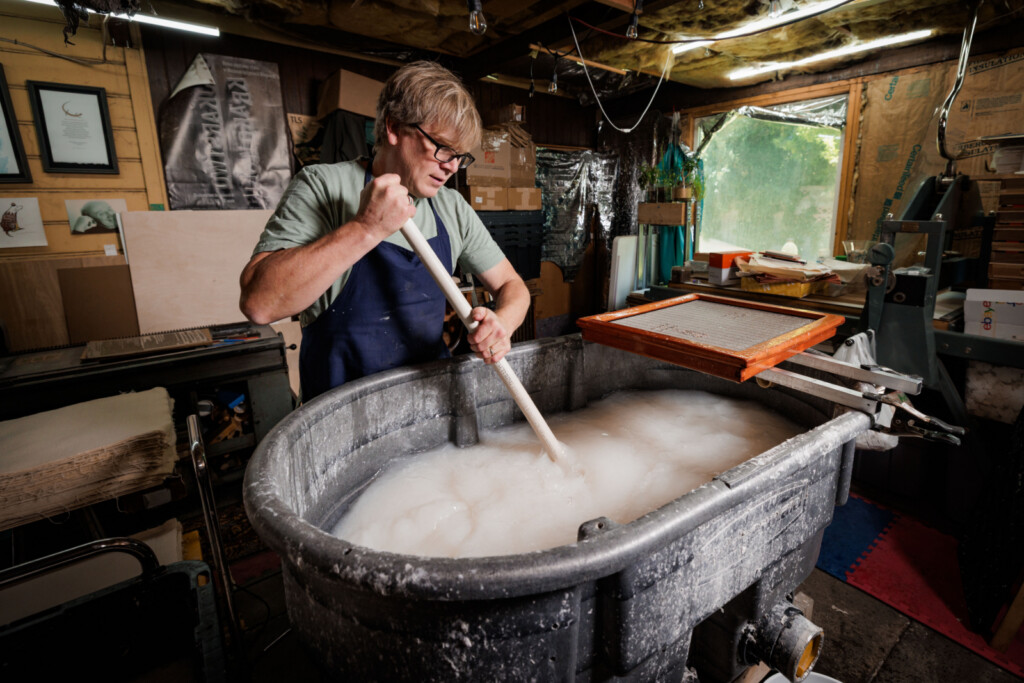
As for the paper, Buchert used raw plant fibers most likely common to the era, such as flax, hemp or cotton. Buchert ran the material through a bedplate machine to beat and bruise the fibers until they could bond. From there, the fibers moved into a vat of water, where he dipped a handmade screen, custom-woven to recreate the original watermarks, to pull out an even layer of the mixture.
Once drained, the fibers were stacked onto wool felts, pressed 40 to 50 layers deep to squeeze out remaining moisture, then hung to dry. That process alone takes about four days, and Buchert can produce 150 to 200 sheets a day on his own — not counting prep and finishing. The paper he created will last another 250 years.
“I grew up in a house where books were really important. At some point, I found out you could actually make one of those,” Buchert quipped. “I latched on to that and went down all the different rabbit holes of book making. That is how I ended up being a paper maker and in making the equipment to do it professionally.”
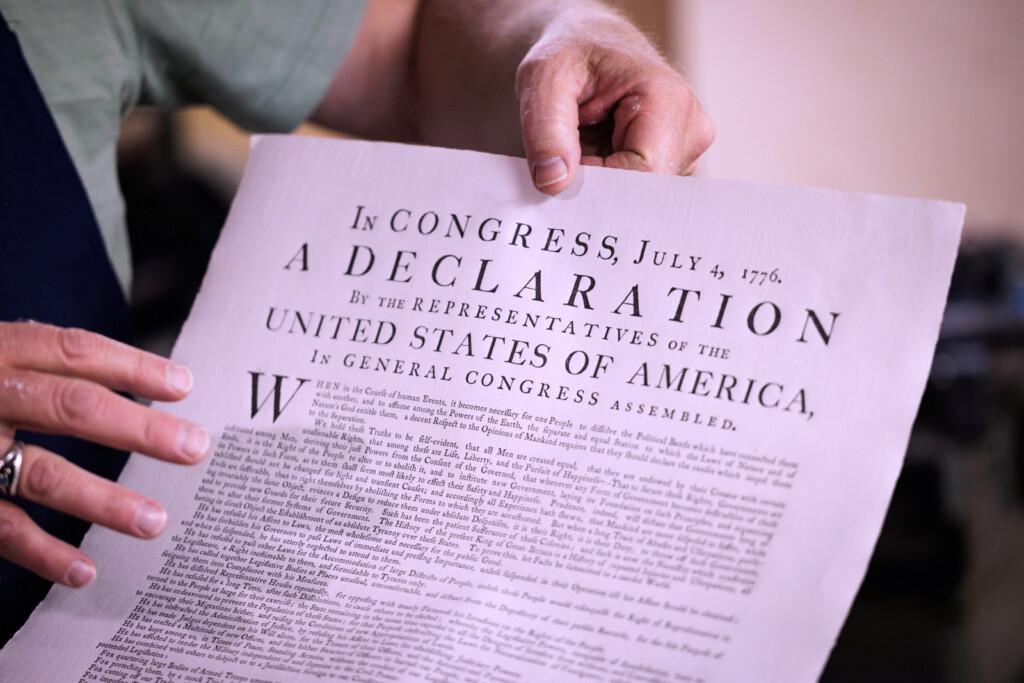
With the nation marking 250 years since that pivotal summer, Buchert’s reproduction offers a fresh way to connect with a story that helped shape the country. It’s a reminder that the Declaration wasn’t just signed and celebrated — it was printed, distributed and read aloud in towns across the young nation, all thanks to the speed and skill of working printers.
“This project has been interesting. I consider myself somewhat patriotic, but when you get this close to a document that is this important, your perspective changes a little,” Buchert shared.
“I hope that if people buy a copy, they will read it and consider where we all started. Maybe that can help us in some of the struggles that we have with our nation today.”
Feature Image: Rob Buchert creating paper for his historically accurate reproduction of the Declaration of Independence.
Photos courtesy of Rob Buchert.