Community

An “Avoidable Murder”: What Happened at Salt Lake City’s Phillips Plaza

Hoffman was brutally murdered by blunt-force trauma and asphyxiation in his own apartment at Phillips Plaza by Bentley Estelvin Scow. He admitted to the murder shortly after he was detained for shoplifting, believing police were detaining him for the murder he had recently committed.

|


Mainstream local media has been reporting on the strange murder of a man they call RJ. What they have not been reporting is where this man was murdered, or how and why it happened.

Police officers have complied with requests to withhold certain details, and as a result, the name of the apartment complex where the man was murdered under very unusual circumstances has received little attention until now.

RJ is Ralph Hoffman. “He was a sweetheart,” says Shar, longtime friend and fellow tenant. “But he had the intellect of an adolescent.”

Hoffman was brutally murdered by blunt-force trauma and asphyxiation in his own apartment at Phillips Plaza over Memorial Day weekend by Bentley Estelvin Scow. He admitted to the murder shortly after he was detained for shoplifting, believing police were detaining him for the murder he had recently committed.

Scow is described as Hoffman’s much younger, gay, drug-addicted lover. Tenants at Phillips Plaza were not surprised by the murder. Every tenant we spoke with agreed that “it was completely avoidable,” if only the red flags and management problems had been addressed.

Prior to the murder, Utah Stories had been covering complaints against Phillips Plaza management and its operator, the Salt Lake City Housing Authority.

Complaints were numerous, but the most serious involved the lack of wellness checks and the ability of homeless drug addicts to enter the building with impunity. According to tenants, these complaints were raised repeatedly but were falling on deaf ears with the manager at the time, Daniela.

Shortly thereafter, a community meeting was held at Phillips Plaza, and Daniela was transferred to another Salt Lake City Housing Authority property and replaced with a new manager.

Tommy Candelaria and Joe Lucero came forward to tell us that the lack of attention to tenants by management was unacceptable at Phillips Plaza. They said homeless drug addicts were stealing lawn ornaments, umbrellas, and personal belongings from residents and gaining access to the building by manipulating vulnerable tenants such as Ralph, the murder victim.

Candelaria and Lucero are lifelong friends who grew up in the neighborhood surrounding Phillips Plaza. Lucero’s mother, Marie C. Lopez, started the Community Action Program which helped juvenile offenders transitioning out of detention facilities.

“This neighborhood used to be so safe you could leave your car unlocked. This was a very nice neighborhood. Today, it’s full of drug addicts and crime. I just want to get out of [Phillips],” says Lucero.

Phillips Plaza in Salt Lake City.

Phillips Plaza is adjacent to Taufer Park, which has received significant media attention for the amount of drug activity occurring there.

“We used to see people having sex in the park all the time, defecating, using drugs. Luckily, that’s improved.”

Brandee Burnam has been managing security cameras at the park to alert police whenever drug trafficking or sex trafficking occurs. The park and surrounding area have improved significantly due to increased police presence. However, according to tenants we spoke with, Phillips Plaza has experienced increasing neglect due to poor management.

Shar is a 79-year-old tenant who isn’t shy about speaking up for the community. When we first met her, she was being threatened with having her kitchen key taken away. She believed this was an act of retaliation for speaking out about negligence by management.

Shar has organized hot dog and bingo nights at Phillips Plaza for the past five years.

“I was complaining about problems enough that they were going to take my key away so I could no longer have hot dog and bingo nights,” she says. 

Shar organized these events because she realized many seniors were not leaving their apartments often enough or socializing.

“Isolation is one of the biggest killers of senior citizens,” says Candelaria.

“The new building management wanted to remove that from us,” according to the twelve residents we spoke with at Phillips Plaza.

Residents said the building manager was rarely around to address their needs. Yet, tenants were somehow expected to tolerate the lack of attention to ongoing problems, including the absence of wellness checks.

Wellness checks are a standard practice in senior housing facilities to ensure residents are receiving appropriate care and attention.

“Hoffman should have had a case manager paying close attention to him and checking in on him regularly.”

Another person close to the situation, who wished to remain anonymous, said, “This death could have been completely avoidable had Hoffman been receiving the care he required, especially given his limited mental capacity.”

Utah Stories was told by an inside source that the Housing Authority has been actively attempting to save money and increase revenue. Utah Stories has reached out on numerous occasions seeking comment from the Housing Authority. Those calls have not been returned, despite Tasha, a manager, saying someone would speak with us.

What we did learn is that Housing Authority managers requested that police leave the name of the apartment complex out of reports provided to the media.

The same witness close to the situation said she believes there was an effort to minimize attention surrounding the death to avoid responsibility.

“This will happen again if nobody is ever held accountable,”

according to the witness. 

On a brighter note, tenants at Phillips Plaza appreciate the recent management changes, including the new Manager and the addition of nighttime security guards. However, residents believe additional changes are still needed and that their concerns deserve to be heard.

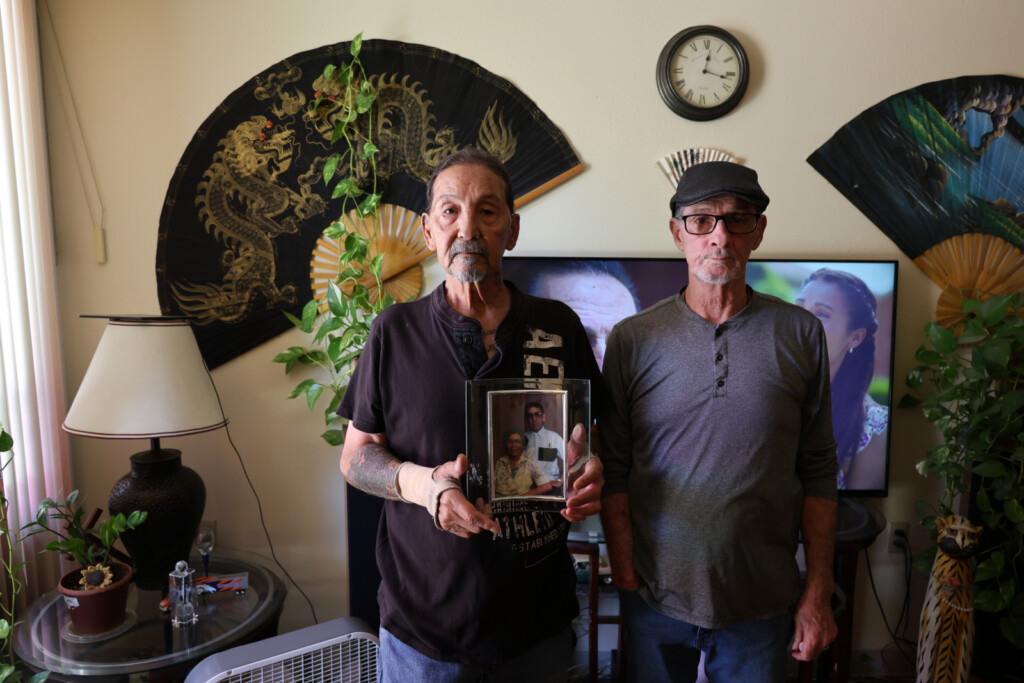
Feature Image: Joe Lucero and Tommy Candilaria hold a photo of Joe’s mother, Marie C. Lopez, who started the Community Action Program — a program designed to help juveniles in detention. Both men grew up in the neighborhood around Phillips Plaza.

Photos by Richard Markosian.

, ,


Join our newsletter.
Stay informed.


  • From $65K Homes to Million-Dollar Athletes: What Happened to Utah’s Middle Class?

    In March of 1979, the center of the NCAA sports world landed in Salt Lake City to witness history. Magic Johnson faced Larry Bird for the NCAA championship on the floor of the old Special Events Center — now the Huntsman Center.

    The game would help launch a new era of sports television money, branding, and big personalities. A modern American spectacle was born: Magic vs. Bird face-offs would be legendary. It was the beginning of a new era of celebrity basketball.

    Back then, the average Utahn wasn’t rich, but there was still a basic bargain in place: if you worked hard, got married, started a family, and lived somewhat responsibly, there was a decent chance you could still buy a home and build a stable life. A house in Salt Lake City cost around $30- $65,000. The average Utahn earned a fraction of that, but homeownership still felt like a ladder you could climb — not a luxury product reserved for the already connected or already wealthy. 

    Today, college basketball — like politics, housing, and much of American life — has become a marketplace where nearly everything is for sale. We are told this is progress because Utah is so much more famous and important today. As Salt Lake County tax payers, we are footing the bill to expand the Salt Palace in the name of “progress.”

    But what it increasingly looks like is a society where institutions that once at least pretended to serve ordinary people have been reorganized to serve money and elites first.

    That is not just true in sports and real estate. It is true in Utah’s government.

    In this issue, we look at a BYU basketball star reportedly commanding a seven-figure payday in the NIL era — a system that has turned college athletics into a cleaner, more legalized version of what used to happen in the shadows. The point is not to blame the player. If the money is there, of course he should take it. The point is to ask what it says about a culture that can somehow produce millions for a teenager to play basketball while telling young families there is simply no realistic way to make housing affordable.
    And that contradiction doesn’t stop with college sports.

    If you value independent, local analysis like this, support Utah Stories.
    Start your free 3-month trial.

    Continue reading and support independent Utah journalism with a purchase of Utah Stories (Digital + Print) or 3 month free trial (Digital).


  • Utah Homelessness Crisis: Tyler Clancy Challenges ‘Housing First’ Failures

    “It’s not normal to see someone sleeping on the sidewalk in a sleeping bag with a needle sticking out of their arm.”

    That sentence should not be controversial. In a sane society, it would barely need saying. But in Utah — where politicians, nonprofits, consultants, and bureaucrats have spent more than a decade congratulating themselves for “addressing homelessness” while the streets of Salt Lake have become more dangerous, more drug-soaked, and more morally disorienting — it lands like an indictment. And it came not from a crank, a talk-radio host, or a downtown business owner at the end of his rope, but from Tyler Clancy, Utah’s newly appointed homeless coordinator.

    That matters because if Clancy is serious — and after sitting down with him, he appears to be — then he represents something Utah’s homelessness system has not had in a very long time: someone willing to say the obvious out loud. The old script is dead. Everybody knows it, but almost nobody in power has wanted to admit it. 

    For years, Utah’s homelessness policy has been built on a polite fiction — that if we build enough units, distribute enough funding, and avoid being too “judgmental,” the crisis will gradually resolve itself. That story was easier to maintain when Utah was receiving national praise for “solving chronic homelessness.” It is much harder to sustain now, when the conditions on the ground tell a very different story.

    Magnolia Apartments opened to help alleviate homelessness, but the results were not all positive.

    Part of that failure became painfully clear over the last four years. By most accounts, former homelessness coordinator Wayne Niederhauser was a decent man and a very nice guy. But one person close to him described his tenure as that of “a tiger without stripes”— someone with the title, but not the appetite to challenge the sprawling network of nonprofits and service providers receiving millions in taxpayer dollars. That lack of accountability has had real consequences. Multiple former and current residents have told Utah Stories that of the roughly 60 original tenants who moved into Magnolia when it opened, about 20 have since died — most, they say, from accidental drug overdoses. 

    If those accounts are even close to accurate, they should have triggered a public reckoning. Instead, the system kept moving, protected by good intentions, insulated from scrutiny, and largely unbothered by outcomes that would be considered a scandal in almost any other context.

    That is the machine Clancy is stepping into, and unless he is willing to confront it directly — not just coordinate around it — his role risks becoming one more layer of management over the same failures. The reality he inherits is not complicated in the way policymakers like to suggest. It is visible, immediate, and increasingly impossible to explain away. 

    Open drug use, fentanyl addiction, untreated mental illness, rising disorder, and a growing sense among both the public and the homeless themselves all indicate that the system is not working. Complexity exists, but it has also become a convenient shield for cowardice. It is the language people use when they want to avoid saying what is plainly in front of them: Utah has spent years managing visible human collapse while calling it compassion.

    The Lie Utah Told Itself

    For years, Utah’s approach to homelessness rested on a narrative few in power were willing to question. It sounded compassionate. It polled well. And it avoided uncomfortable truths.

    Continue reading with a Utah Stories subscription. Start your 3-month free trial.

    Continue reading and support independent Utah journalism with a purchase of Utah Stories (Digital + Print) or 3 month free trial (Digital).


  • Utah Official’s $36K Travel Reimbursements Raise Questions About Use of Taxpayer Funds

    The trek into the office is a necessary evil for many employees; unpaid time that could be spent elsewhere. But some state employees are able to cash in on their commutes.

    That includes one member of Gov. Spencer Cox’s cabinet who heads the Utah Department of Cultural & Community Engagement. The department oversees a number of civic and social programs ranging from museums, libraries and the state historical society, to volunteerism efforts and multicultural affairs. 

    The employee’s in-state travel expenses made up a large chunk of the department’s employee reimbursements in recent years, according to documents obtained by The Utah Investigative Journalism Project obtained through a public records request. 

    The UIJP reviewed spreadsheets detailing the reimbursed expenses of the department’s 17-person leadership team over the 2024 and 2025 fiscal years. 

    The analysis showed one employee, Executive Director Donna Law, accounted for nearly a third of the team’s reimbursements in 2024 and 43% in 2025. Law, who lives in Cedar City, spent more than 11 times the average amount spent by all other employees included in the analysis. 

    The majority of Law’s expenses were categorized as in-state travel, which includes mileage and lodging. Between the two years, she spent $21,607.94 on lodging, $10,135.42  on auto mileage, and $1,455.00 in miscellaneous travel expenses and meals for a total of over $33,000. 

    The next highest amount spent on in-state travel was $3,385. Law’s overall spending far exceeded any other employee.

    The nearly $36,000 Law spent on travel and other items wasnearly three times that spent by the employee with the second highest amount in reimbursements. His expenses, in contrast, were largely out-of-state travel.

    Continue reading and support independent Utah journalism with a purchase of Utah Stories (Digital + Print) or 3 month free trial (Digital).


  • The $7 Million Recruit: How NIL Changed College Athletics Forever

    In 2012, Jabari Parker, a top high school prospect and member of the Church of Jesus Christ of Latter-day Saints, was facing his biggest decision to that point in his life: where to play college basketball. 

    Fans of BYU athletics hoped and perhaps prayed that Parker would pick the school owned by the church he was raised in. BYU was listed as one of his final choices. But he ultimately chose to spend his college years at Duke before attempting a career in the NBA. BYU fans were disappointed, but no one was truly surprised. Duke over BYU was the best choice for a young prospect in 2012. 

    A.J. Dybantsa.

    What changed between 2012 and 2024 when A.J. Dybantsa, the number one high school prospect, chose BYU over every other school? The answer is roughly $7 million dollars. That is what Dybantsa is reportedly making to play basketball at BYU. 

    The deal was supported by Utah Jazz owner Ryan Smith, who met multiple times with the Dybantsa family in multiple attempts to bring the young player to Provo. 

    According to Smith, he had no financial role in bringing Dybantsa to BYU, but the influence of Utah’s most famous billionaire acting as a “booster” or unofficial recruiter certainly swayed the decision.

    Prior to 2021, boosters acting as recruiters was taboo to the NCAA governing body. It was called improper recruiting. But in 2021, California began the modern era of NIL, or the ability of a college athlete to benefit from their name, image, or likeness, when they passed the “Fair Pay to Play Act.” 

    This new law gave college athletes in California the ability to benefit from their NIL, something that was banned in the rest of the country to that point. The NCAA saw that this law would create an unfair advantage for California schools that could now give young athletes the chance to make money off their talent and image while still in college. 

    The NCAA knew they needed to do something quickly, so they rushed through a policy that opened up NIL to all college athletes in the country, and it has been expanding and evolving over the last four years. 

    Grant Duff, who has coached at the University of Utah, Weber State University, and is now the defensive coordinator for Idaho State University, says, “The best part of NIL is that athletes have an opportunity to make good money. The downside comes with the free-for-all that money causes.”

    Dybantsa confers with BYU Head coach, Kevin Young.

    One of the biggest current examples of what a school can do when the boosters are willing to pay for success is Texas Tech University. From 2020-2024, Texas Tech had 34 wins, which works out to 6.8 wins per year with a low of 4 wins and high of 8. Then Texas Tech’s boosters got involved, led by Cody Campbell, an oil industry businessman and Chairman of the Texas Tech board. The football program was given 28 million dollars for NIL with a simple message attached to the large pile of money: Win. And win now. And win they did. 

    By signing NIL deals with athletes in the transfer portal, Texas Tech went from a middle-of-the-pack school in their conference to one of the top 12 teams in the country. They didn’t just win games in 2025, they made many of their opponents look like they didn’t belong on the same field, including the University of Utah and BYU twice. That is what money can buy.

    Continue reading and support independent Utah journalism with a purchase of Utah Stories (Digital + Print) or 3 month free trial (Digital).