
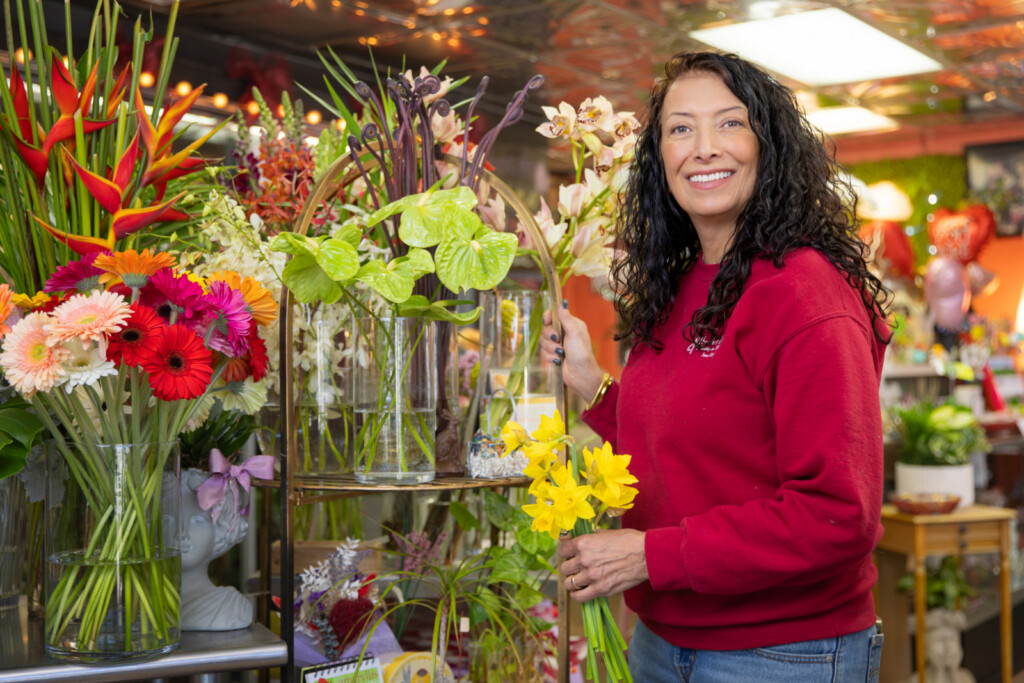
At 580 East 300 South in Salt Lake City, The Art Floral stands as one of downtown’s most enduring family businesses. In an era of overnight startups and short-lived storefronts, three-quarters of a century feels almost radical. Once inside, the air shifts, greenery mingles with fresh flowers, while tissue paper rustles, and shears snip rhythmically.
This story begins in 1951, when Mike B. Sergakis founded the shop. A World War II veteran, he came from a generation marked by war and
Instability. After serving 31 tours over Germany, “He wanted to surround himself with light and beauty and love,” says his daughter, Stefanie Wedemeyer. “He didn’t want to be surrounded by war, death and destruction.”
That philosophy shaped everything. His wife, Vasi, arrived in 1956 aboard the Queen Elizabeth, speaking no English. She was sponsored by a host family in Logan. The father was a professor of ancient Greek studies at Utah State University, and Vasi was determined to work. At the time, immigrants needed sponsorship to build a life here in the United States.
Meeting at a church function, it was love at first sight and they were married the next year. Together, they built something lasting. Mike purchased the property in the late 1950s. It was a house once occupied by a great-granddaughter of Brigham Young, standing beside a shop built in 1927 that had been a meat market and grocery store. In the late 1960s, the family physically connected the house and storefront. It has been that way ever since.
“We live here, we work here, and we play here,” Stefanie says. “There’s an awesome community love that goes on in this shop. Between my customers and my crew and what we send out, it’s all about love and beauty.”
Born into flowers in 1969, Stefanie grew up watching the business serve Utah’s Greek community and generations beyond. “We’re the definition of a mom-and-pop shop,” she says. “My dad started it in ’51.
My mom joined when they got married in ’57.”

After a time in Los Angeles, Stefanie returned in 2000 as her mother’s health declined. When Vasi passed away in 2004, Stefanie became the sole owner. “It was rough,” she says. “But we’re blessed we survived it.” Her husband, Ryan, now handles delivery operations and specializes in the mechanics and framework construction of our large-scale funeral floral pieces, while their children, Micah and Sofia, represent the third Generation.
In the shop sits a laminate-covered countertop hiding the original design surface, once dotted with cigarette burns from Mike’s Lucky Strikes. “He never finished a cigarette,” Stefanie laughs. “There’s a million burn spots on that counter.” And yet she feels he never quite left. “If I’m having a hard day, I’ll smell a whiff of cigarettes,” she says. “And if customers are upsetting me, ribbons will go flying off the wall. His presence as well as Vasi’s is felt here by many, at least a few times a year.”
Every morning, Ryan can be seen from within the property feeding their twelve “COVID chickens” next to the shop. The nearby YWCA daycare brings the children to visit the chickens. It’s that sense of welcome that keeps the doors open.
Flowers from The Art Floral mark proms, engagements, weddings, funerals, apologies, anniversaries, and newborn arrivals.
“Every arrangement tells a story,” Stefanie says. “We’re part of people’s most important days, sometimes their happiest, sometimes their hardest. That’s something we never take lightly.”
From formal bouquets to airy, garden-inspired arrangements, the floral industry has continually evolved, embracing both changing design trends and new ways of connecting with customers.
But Stefanie measures success differently. “The reputation my parents established and the relationships we’ve built across the valley are why we’re 75 and strong,” she says. “It’s not because we have the newest computer system or the biggest delivery fleet. It’s because we show up and do a hard day’s work with a smile.”
Seventy-five years means surviving recessions, big-box competition, e-commerce, and a pandemic. It means earning trust again and again. What begins with a prom corsage often grows into a lifetime of traditions, as families return through every season of life to celebrate, comfort, andvconnect. Over time, flowers become woven into a family’s story, from weddings and anniversaries to sympathy tributes, with one generation introducing the next.
The arrangements remain balanced, lush but never chaotic, elegant without stiffness, roses and hydrangeas blended with seasonal textures and greenery. Each bouquet feels intentional. But what truly sets The Art Floral apart is not just beauty — it’s love. From a Greek American who chose light over war, to a daughter who still senses her father in the ribbon wall, to customers who continue walking through the same doors 75 years later. The Art Floral proves that when a business is built on love, it tends to bloom.
Feature Image: Stefanie Wedemeyer, owner of The Art Floral. Photos by Dung Hoang.