Staycations in one’s own town always sounded to me like something old, feeble, and tired couples do. For younger people, adventure has always seemed to inhabit the other side of the fence, right alongside the greener grass.
But sometimes extreme situations call for extreme measures.
We were trying out a new dog sitter before our upcoming trip across the ocean. We needed somewhere to stay for a night.
My husband suggested Little America.
“It’s just off Main Street,” he said. “We can walk downtown, and visit some cool bars”. “And see what our unsheltered population is up to,” I added in my mind.
I literally and figuratively shuddered.
Little America has been my in-laws’ favorite and only staycation destination for the past 25 years, and possibly longer. Still, I put on a brave face and a new dress. My daughter immediately informed me that the dress did not suit me, that the color clashed with my hair, and that I should probably give it to her.
I pointed out that she is only nine and might need to wait a little while before wearing it.
So the dog stayed with the dog sitter, my daughter (having sealed her fate with those comments) got dropped off with the aforementioned in-laws, and we headed toward what I imagined to be heaven for the old and feeble.
Oh man, was I wrong.
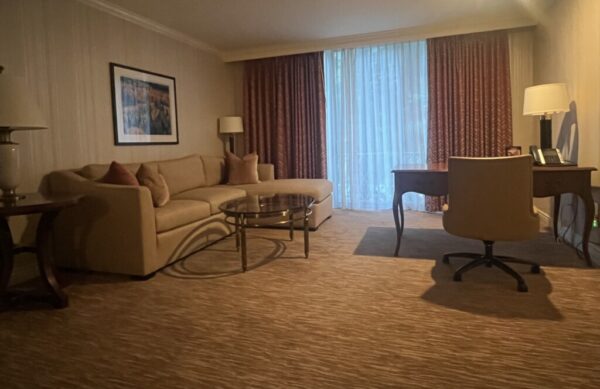
For less than $200 a night, I did not have particularly high expectations. But when I walked into the room, I realized it wasn’t really a room at all. It was more of a junior suite. Large. Nicely furnished. A big king bed, a comfortable sitting area with a couch, and a substantial writing desk. The bathroom was equally spacious, with double sinks and a huge shower. It appeared the rooms had recently been remodeled.
We dropped off our bags and headed to investigate the pools.
The outdoor pool sits between the buildings, and is surrounded by what appeared to be pergolas or covered seating. I did not linger long enough to study them because the soundtrack of enthusiastic children convinced me to continue my search of a quieter setting.
The second pool interested me more. It promised a more adult atmosphere. Half indoors and half outdoors, perched on the second floor and surrounded by lounge chairs, it would have been perfect if not for yet another collection of screaming children.
Since I already have plenty of those at home, I decided it was time to explore downtown.
The walk was pleasant on a June Thursday evening. We headed toward Beerhive Pub. Along the way, I noticed that many bars that once had sidewalk patios no longer do. Later, I learned that our city has found a unique way to support local businesses: by tripling the cost of renting sidewalk space.
I have noticed more boarded-up storefronts on Main Street lately, although not nearly as many unsheltered individuals as during the last summer.
We arrived at Beerhive. It was hopping. People were watching soccer while I studied the menu featuring a truly impressive number of beers.
My husband ordered one of Helper Beer’s local brews. I went international and ordered a Lambic, the beer for people who don’t actually like beer. I enjoyed it immensely.
Beerhive has managed to keep its small patio despite reportedly paying around $2,000 a month for the privilege. It was already packed, but we enjoyed sitting at the bar and chatting with a friendly bartender.
One of the nice things about local pubs with long bars is that people still talk to strangers. For a brief moment, you get a sense of community.
Then it was time for dinner.
We pocketed our phones and started walking toward STK Steakhouse. Along the way, we stopped at the gravesite of the historic Pantages Theater. Now furnished with artificial turf, it was hosting an event organized by BLOCKS. There was a stage, food trucks, and a beer tent. People were sipping Mountain West cider and Fisher beer while a surprisingly good band played on stage.
I never caught the band’s name because we were in a hurry, but the atmosphere was lively. The event was both kid- and dog-friendly, which is always a bonus in my book.
Now let’s talk about STK Steakhouse.
Full disclosure: We were invited to create an Instagram reel. Ted Scheffler has previously written about their prices and their surprisingly affordable happy hour.
For some reason, I expected a stuffy steakhouse filled with white tablecloths and aging waiters who consider grass-fed beef an abomination against the sacred art of steak.
Instead, I found something entirely different.
The space was modern and spacious, filled with interesting artwork and dramatic chandeliers. The staff were friendly, stylish, and energetic.
And instead of dinner, we were served a feast.
The first thing to arrive was bread and olive oil, but not just any bread. It was warm pull-apart sourdough topped with blue butter. I abandoned all caution regarding gluten and dug in.
It was worth it.

My husband ordered an Old Fashioned and declared it exceptional. He is notoriously picky about Old Fashioneds and has complained about many served in fancy establishments, so his approval is high praise indeed.

I took longer to decide. At $23 per cocktail, I wanted to choose carefully. Eventually I settled on the Unchained Passion. It sounded like the title of a romance novel and contained equally romantic ingredients: Don Julio Blanco tequila, Carpano Bianco vermouth, real passion fruit, and Chandon Brut.
It was worth every dollar.
In fact, it was so good that I ordered a second one, which made my later trip to the restroom a slightly disorienting experience. More on that later.
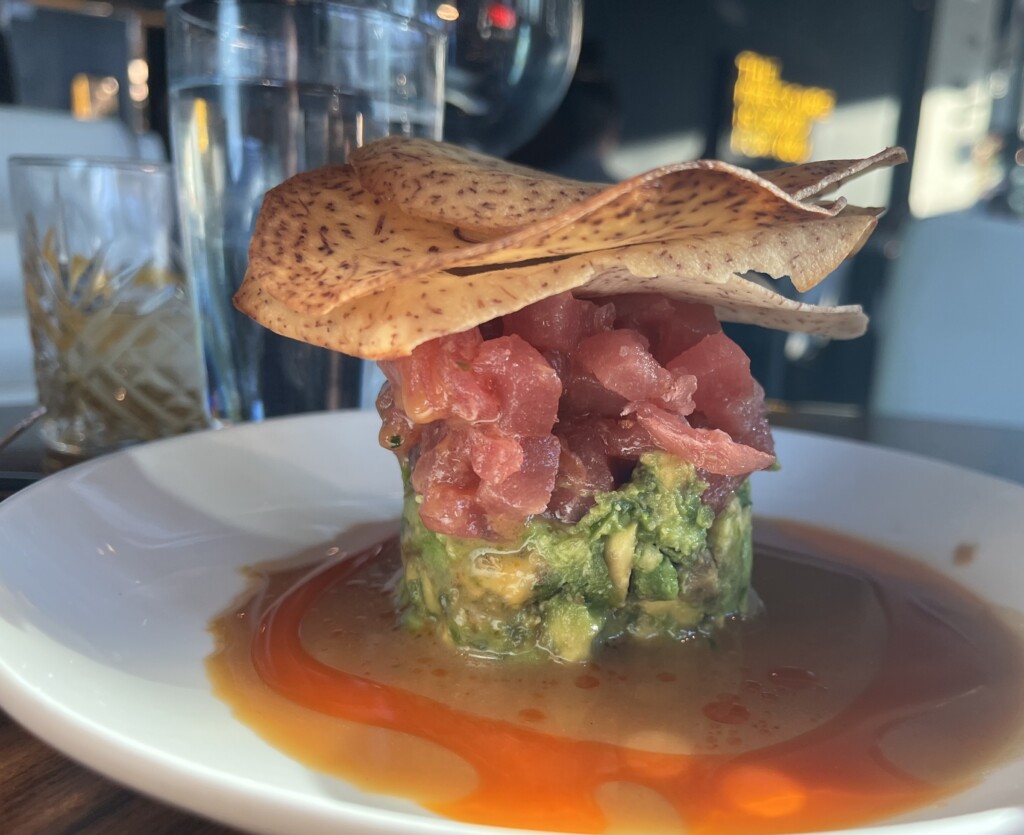
Then came the parade of appetizers: Mac Balls, Wagyu Potstickers, Tuna Tartare, and loaded fries topped with steak and Fresno peppers.
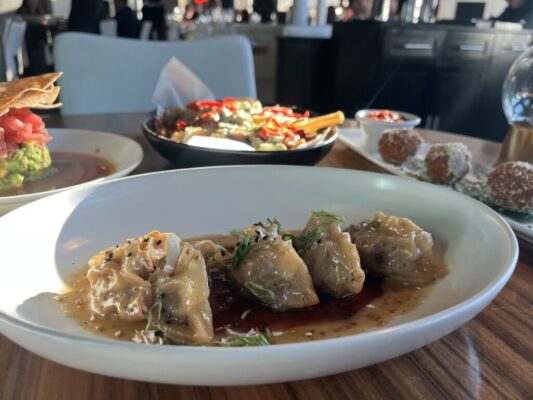
I usually dislike mac and cheese. I have never quite adapted to this particular American tradition. Yet I loved the Mac Balls so much that I ate one and then decided that two is company and ate another.
For the main course we were served filet steak, miso-glazed Chilean sea bass, an STK cheeseburger, and buffalo wings.
My favorite was the Chilean sea bass.

It was exceptional—tender, buttery, and practically melting in my mouth, with just enough spice to keep things interesting. I would return for that dish alone.
Mushroom pot pie and giant tater tots accompanied the entrees. The tater tots were not what I expected. Each one was roughly three bites in size. That side dish alone could probably feed a family of four.
For dessert we were served key lime pie.
Now, I generally abhor key lime pie with a passion. Yet this particular key lime pie made me question my convictions. I took a bite simply to say I had tried it. Then I took another. Then another.

My conscience tried very hard to find something wrong with this place.
After all, STK is a national chain owned by The ONE Group Hospitality, which also owns brands such as Benihana and Kona Grill. I usually tend to elevate local businesses and be suspicious of chains.
The first STK opened in Manhattan’s Meatpacking District, an area transforming from warehouses and nightlife venues into one of New York City’s trendiest neighborhoods. The concept proved successful and expanded to Las Vegas, Miami, Los Angeles, London, Dubai, and eventually Salt Lake City.
But I could not find fault with the food.
I looked around and found nothing to criticize about the atmosphere either.
Listening to the DJ made me feel younger than I am. I enjoyed seeing a younger crowd dining and socializing instead of the demographic that sometimes reminds me that I have more summers behind me than ahead.
Then I had to visit the restroom.
There was nothing wrong with it. Elegant, spotless, complete with beautiful artwork. My only complaint is that the stalls felt a bit tight. Granted, I had consumed two cocktails, already one more than my usual limit, but I still suspect that anyone with more generous proportions might find turning around somewhat challenging.
Now, the million-dollar question, as one of my professors would say: Would I return to STK Steakhouse?
Dinner there is not for the faint of wallet, and my wallet frequently becomes nervous around national chains.
But the answer is yes.
After patronizing five local businesses first, I would happily return for the Chilean sea bass and another Unchained Passion.
For my more frugal friends, I would recommend the happy hour. Small plates are priced in the single digits, making it an excellent way to enjoy the atmosphere, watch a game, and leave with your retirement account largely intact.