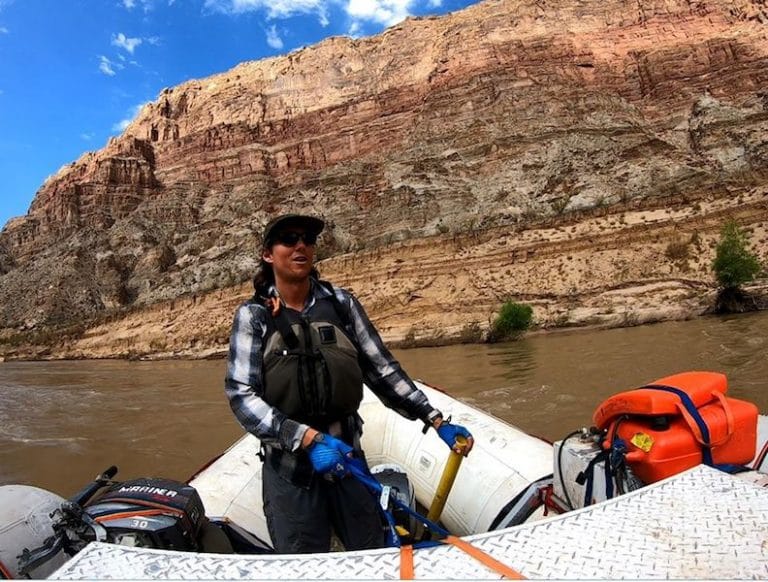
What does it take to become a river guide in Moab?
Most guides are Millennials in their early twenties, so a willingness to disconnect from the world of iPhones, and forfeiting social media one-upmanship and material pursuits is essential. River guides trade material comfort for a spiritual connection. Many are curious souls who quote prose and dabble in mysticism and Carl Jung. But what happens when they decide it’s time to establish some roots and settle down?
Christian Wright
As a child, Christian Wright’s father was an attorney in Atlanta, who took him on adventures every chance he had. “I was fortunate to have a father who spent all his free time doing something with boats or rivers,” he says. Wright‘s affection for guiding started early in life by doing things like guiding his mom from their backyard up the creek near their house when he was around nine or ten.
After graduation from high school and completing his college degree, Wright set off on a road trip headed west. While fishing in the Rocky Mountains, he punched a hole in his oil pan on a rock. As he waited at a Denver repair shop, he met a man who told him about the “Arches” in southeastern Utah. Wright should have ventured to Moab then and there, but he went on other adventures instead, working and living in other towns.
Finding the way to Moab
Wright eventually found his way to Moab and started work as a river guide, living out of the back of his truck. A couple of years later, he earned his Master’s Degree and worked five years full-time as a NPS Park Ranger and part-time as a river guide. He hung up his park ranger hat in 2018 and began river guiding full-time in 2019. In between all that, he said he was “adopted” by his girlfriend, and told a joke common among the guides around Moab. While it’s true that guides don’t make a lot of money, Wright acknowledges that it’s a fair trade. “How many people get THIS (arms stretched out, looking joyfully around at Moab’s grand scenery) for an office?”
Living and working in Moab
“At my company this summer, there were three of us who had a roof over our heads that didn’t have wheels,” Wright chuckles, explaining that it was “a combination of luck, support, and tenacity” that he and his girlfriend were able to purchase a home in Moab from friends who were willing to sell it to them below market cost. Thankfully, their families were able to help them with a down payment.
They enjoy a large yard that allows them to grow their own food in the summer, and they save money by hunting and making their own home repairs. Wright works the occasional odd job. His girlfriend has a year-round, full-time job, and because Wright is able to collect unemployment during the off-season (usually 4 months), they are able to live and work in Moab.
“Moab is my home and this is where I love to work,” says Wright, who enjoys river guiding on the Colorado River near Moab, and through the Cataract and Grand Canyons during tourist season. He has explored the Yampa River, Desolation Canyon, and the Green River near Dinosaur National Monument.
Useful skills
Wright continues learning new skills so he can further his experiences in rafting. He and his father have explored the lower, rarely run sections of the Chattahoochee, and Georgia’s Black Water Creek. In the spring or fall of 2020, Wright hopes to run the Coosa System (Alabama), Flint & Ocmulgee (Georgia), French Broad (North Carolina), and the Nolichucky (North Carolina & Tennessee) rivers.
Wright says guiding isn’t hard because it encompasses all types of people with varying personalities, goals, values, and vices. Aside from having valid CPR and First Aid Cards, there are skills and traits that are useful, like being energetic, agile, observant, having a desire to learn, being a self-starter, following instructions, managing groups and team leading, communicating well, being adaptive, having a great smile, performing excellent customer service, and the most important skill of all—being able to cook and make a great cup of coffee.
If you want to make yourself more marketable, expose yourself to the many aspects of rafting. It will make you a more capable, confident person and guide. Wright suggests taking a Wilderness First Responder course and earning your certification, or taking a swift water rescue course. Learn how to tie knots and downstream angle. Learn to raft in different seasons—including winter. Run as many rivers as you can. Paddle and hike everything, because the more you learn about all aspects of river rafting—guiding, nature, navigation, geography, wildlife, plant life, and the like—the more marketable you will be.
Wright admonishes that “if you see your fellow nature-deprived men and women out there, addicted to iPhones and social media, desperately seeking some kind of authentic connection to the natural world and to other human beings, try to empathize with their condition. If you can see something of yourself in their plight, and you are the kind of person who wants to take them with you and show them something better, then you might be a guide.”
RELATED STORIES:
Moab’s Affordable Housing—Is There Hope?
Moab—500 Tourists for Every Resident
Moab’s Identity Crisis: Will Moab Become a Town for Tourists, Locals, or NIMBYS?
Moab: Affordable Housing Meets Sweat Equity
Nik Hougen, Moab’s Local Hermit out of Hiding
and more Moab stories