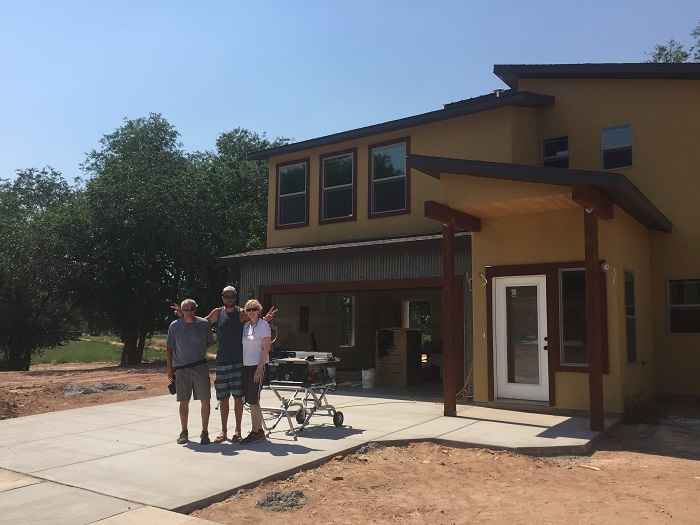
“I drive around Moab quite a bit and never see anyone building single family homes,” notes Ben Riley, Executive Director of the Housing Authority of Southeastern Utah (HASU). “And, if I do, it’s usually more upscale, selling in the $300,0000-plus range. I just don’t see any building that isn’t condos or hotels.”
It’s no news that tourism is a booming industry in Moab. Arches National Park, a proxy for overall visitation, hosted well over 1.5 million visitors in 2016, up from 833,049 visitors in 2006.
While this has led to a concurrent boom in the number of jobs in the tourism sector, these jobs are often low-paying and seasonal. Moab’s workforce struggles with housing as the area’s popularity has driven land prices skyward, and second homes and nightly rentals proliferate.
A multi-stakeholder group called the Interlocal Housing Task Force has compiled data to define the scope of Moab’s housing issues and identify solutions. Their website states that in 2015, the US Department of Housing and Urban Development (HUD) put Moab’s area median income at $55,300 for a family of four, which would enable the purchase of a home that cost $193,258. However, the median list price for homes that year was $290,000.
HASU already has one solution to mitigating Moab’s housing woes: the Mutual Self-help Housing program, which, to date, has constructed more than 150 homes for low-income families. Under the guidance of a licensed contractor, families gain “sweat equity” by participating in building their own homes for a mandatory thirty hours each week. They must also qualify for a 502 loan, which can have a fixed-interest rate as low as one percent.
Brian and Laura Hines, and their children, Charlie and Clara, started building their home in September of 2015. In July of 2016, they moved in.
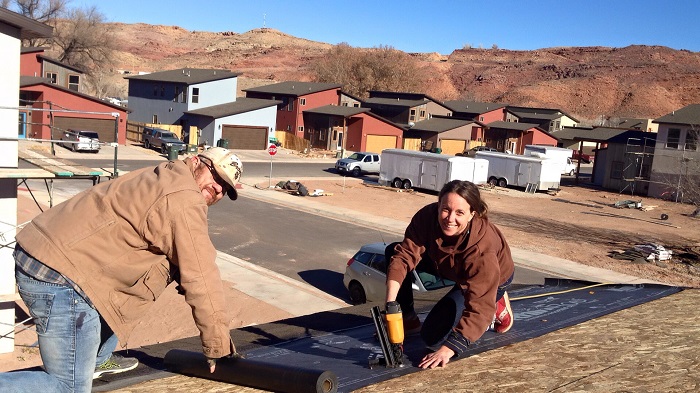 “It was fairly challenging,” said Brian Hines, of the sweat equity requirement. “But it was nice having the two of us fulfilling those hours. If you were a single parent, it would be hard.” He added, “It was a really good learning experience. Knowing that we built this ourselves makes it even more fulfilling to own our own home.”
As Hines alluded, the Mutual Self-help Housing program is not a good fit for everyone. The work requirement can be prohibitive, as can obtaining a loan. One requirement of the USDA loan is that the house not be sublet or rented out. This can be a deal-breaker for seasonal workers who do stints elsewhere during Moab’s off-season. In short, the Mutual Self-help Housing program is not a housing panacea. Addressing Moab’s housing troubles will require a multi-pronged, holistic approach, but it is making a big difference for those who participate.
“I’m just happy that they have this program here in Moab,” Hines said. “It’s allowing people with lower incomes the possibility of owning their own home, which I think is a great thing for the community.”
For more information contact the website.