Ben and Hannah Riley
Married couple Ben and Hannah Riley are both devoted rock climbers. They both have demanding full time jobs: he’s the executive director of a nonprofit that builds affordable housing and manages various complex housing programs; she’s a physician’s assistant at Moab Regional Hospital. But, they’ve both found time to train and achieve lofty climbing goals. Now Ben and Hannah are parents of a 7-month-old daughter, Skyler, but they still want climbing to be a central part of their lives.
Hannah grew up in Denver and learned to rock climb from her dad when she was a kid. It started out as a way to relax and spend time with friends and family outdoors, but eventually she started to push her athletic limits in climbing.
Ben grew up in Michigan and picked up climbing in college. After trying throughout his adolescence to gain weight through lifting and supplements, he finally went to a climbing gym and discovered that his tall, light build was ideal for the sport.
The two met in 2017. One of their first “dates” was a climbing trip in Zion National Park. A year or so later, Hannah moved to Moab, where Ben was already living. It had been a lifelong dream of hers to live in Moab, a place she remembered visiting with her dad. For both the Rileys, access to climbing is always a priority in considering where to live.
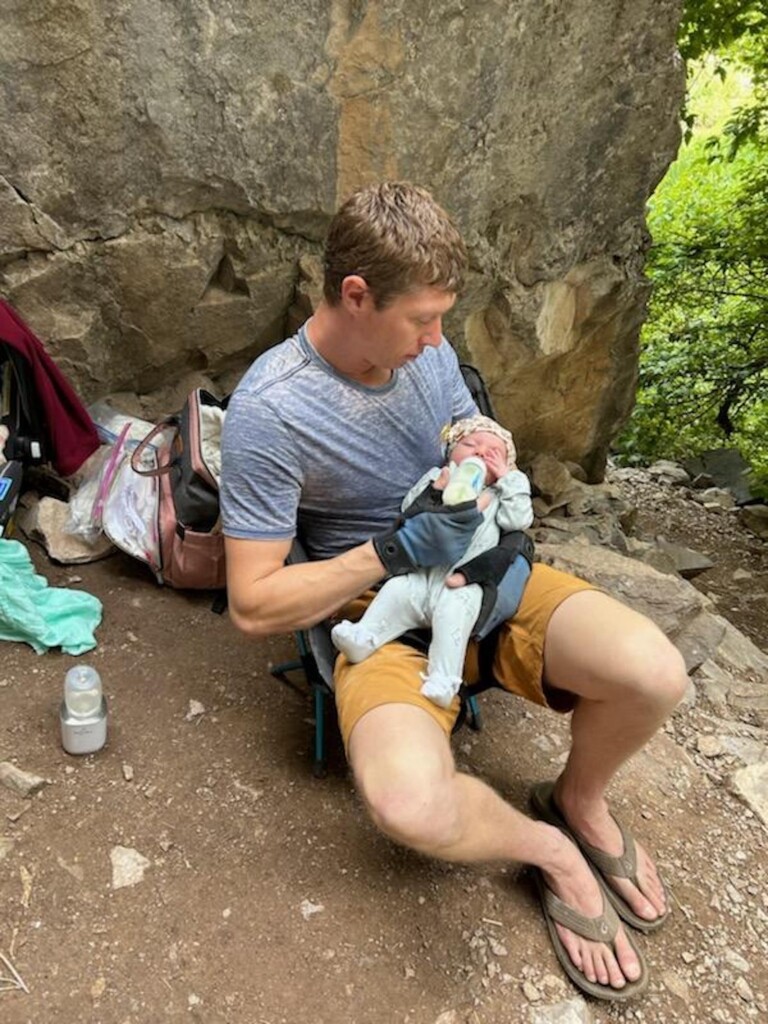
They would spend nearly every weekend at a crag where they had climbing projects — sometimes in the Moab area, sometimes a crag a few hours away.
“I’ve always liked climbing as an athletic endeavor,” Ben said. “I’m not having fun if I’m not improving.”
One of Ben’s most memorable climbing moments was sending a steep route called Pipe Dream, rated 5.14 — a very advanced difficulty. He’d made it a goal to complete the climb, and planned out a year-long training schedule to reach it. He even motivated himself by declaring he wouldn’t propose to Hannah or get a dog until he’d sent the project. When he finally did send — right on time, according to his schedule — Hannah was belaying him, and her dad was there too, cheering him on. (They now have a dog.)
One of Hannah’s favorite climbing memories was climbing 30 pitches at Indian Creek on her 30th birthday. Friends and family, including her dad and his friends, whom they called “sendy seniors,” put up routes for her to top rope, and she finished the long, exhausting day on a mini tower with Ben and her dad and champagne. Then she went to bed early while the crew had a party.
Hannah is also proud of sending one of her hardest projects, a route called Orgasmo, rated 5.12c — also a very difficult grade.
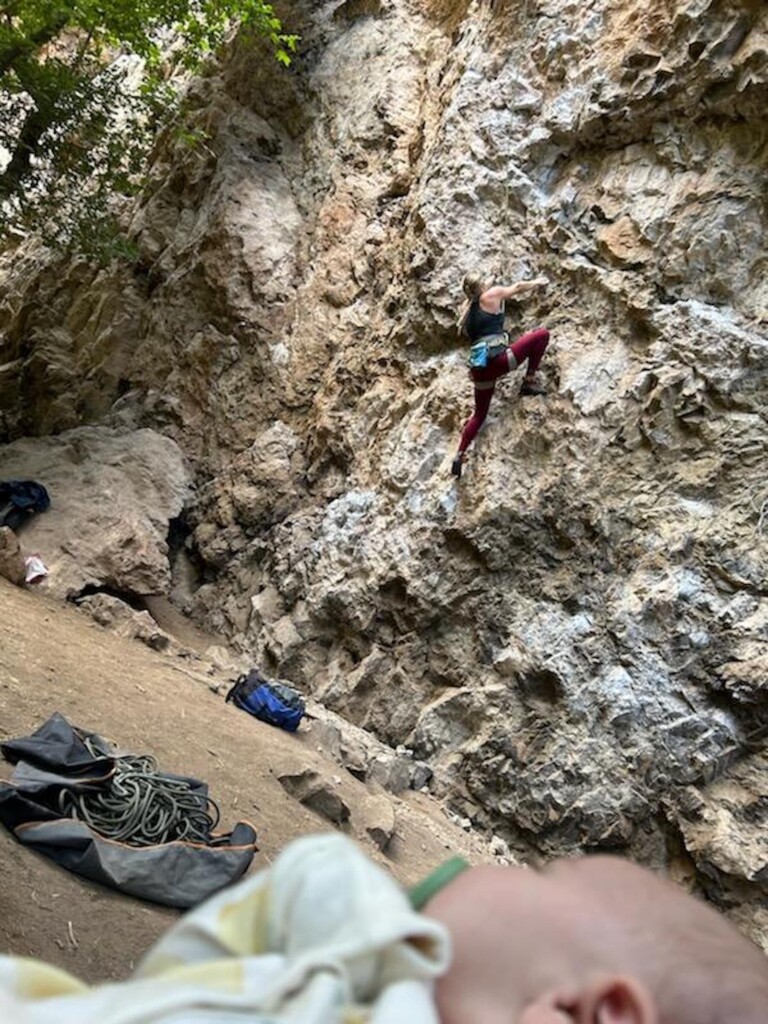
Being parents has meant they’ve had to change their climbing style somewhat — they bring the baby to the crag, and climb with friends so people can rotate watching her. But they still have challenging goals. Ben would like to put up more “first ascents” (meaning he is the first person on record to climb a route), while Hannah would like to someday ascend a 5.13.
They look forward to teaching Skyler to climb, but they’re prepared to accept that she might not love it as much as they do.
“She might be a theater kid,” Hannah said. “And that’s okay.”
Lisa Hathaway
Lisa Hathaway was a three-sport athlete while studying in a pre-med program in college. She didn’t get a chance to try rock climbing until after she graduated. She liked the sport, but it wasn’t until years later that she made it a big part of her life.
Hathaway did know that she wanted to move to the desert. She felt like she’d found her home when she spent time in the desert Southwest for a school project. As she considered post-college options, she weighed a local job in her Maine home against an opportunity to volunteer for a season with the National Park Service in Moab. She chose the internship, and while working in the Maze District of Canyonlands National Park, started to explore climbing more.
She met a tight-knit group of strong female climbers who were not only sending hard grades on par with what men were climbing in the area, but also putting up first ascents. She got really invested in climbing in the mid 1990s: her husband at the time was a competitive climber, which inspired her to also push herself; there was also a new crag being developed in the Moab area, with very hard routes. One of her standout climbing memories is sending a 5.13 route at that crag on a quiet day with no one else in the canyon other than her belayer.
“I really love movement, intricate movement,” Hathaway said in explaining the appeal of rock climbing. “I like problem solving: not being able to do something, then getting stronger, or better, or more clever.”
Hathaway loves Moab regardless of the climbing — she loves “the desert life,” she said, and the climbing is “the icing on the cake.”
In the 1990s, Moab’s blossoming tourist economy created niches that allowed people to carve out space to pursue their non-work passions. Hathaway worked in a Moab restaurant for a while, which was compatible with climbing; she could work in the afternoons and evenings and climb in the mornings. In the winter, when tourism slowed and businesses shut down, she could take a climbing trip somewhere warm.
She eventually got a job doing owl and raptor surveys for the Bureau of Land Management, which has a schedule similarly compatible with climbing, and she’s still doing that work now.
Hathaway is still finishing hard climbing projects, but there’s more to it than ticking the grades for her.
“It’s those special desert moments,” she said. “It’s the composite experience — there’s more, to me, than clipping the chains to my hardest send.”
Wade Plafcan
Wade Plafcan grew up and went to college in Minnesota. He didn’t know much about rock climbing, but he was interested in it, along with other outdoorsy activities like hiking and backpacking.
“I knew enough about climbing to know that I wanted to climb,” he said.
He spent summers working in Glacier National Park while studying environmental science during the school year. On one of his first trips to complete a contract environmental science job, he drove through Moab and “fell in love with it.”
Plafcan applied for a job with the National Park Service in Moab, was accepted, and moved to town in 2012. He started buying climbing equipment right away, even before he really knew how to climb. That reflects his personality, he said. If he’s sure he wants to do something, he’ll fully commit.
He worked seasonally, spending his off-time traveling or camping at climbing areas. For years, he spent each winter traveling to international climbing destinations. One of his favorite climbing memories is summiting the Totem Pole, a unique, 200-foot spire rising out of the ocean off the shore in Tasmania, and rated 5.12. He remembers hearing seals barking below as he sat on top, feeling the vibrations of the waves hitting the tower.
“Getting on top of cool things” — natural features like the Totem pole — is one of the things Plafcan loves about climbing. Reaching those summits often requires difficult climbing, and a lot of time and dedication to gain the skill and fitness necessary to do it. Plafcan’s seasonal work schedule allowed him to allocate a lot of time to climbing. He now owns an environmental consulting business, which still allows him the flexibility to pursue the things that bring him joy.
Lately, he said, his focus has shifted a little bit away from climbing and more toward other outdoor pursuits like biking, skiing and boating — though he expects he’ll get fired up about climbing again after a lull. He said he keeps his living expenses as low as possible so he can save for travel and outdoor equipment.
Plafcan said he would still choose to live in Moab even if he wasn’t a rock climber. The community and the access to all kinds of outdoor sports make it ideal. And, he said, “I’ve traveled a lot around the world, and Moab is still one of the most beautiful places.”
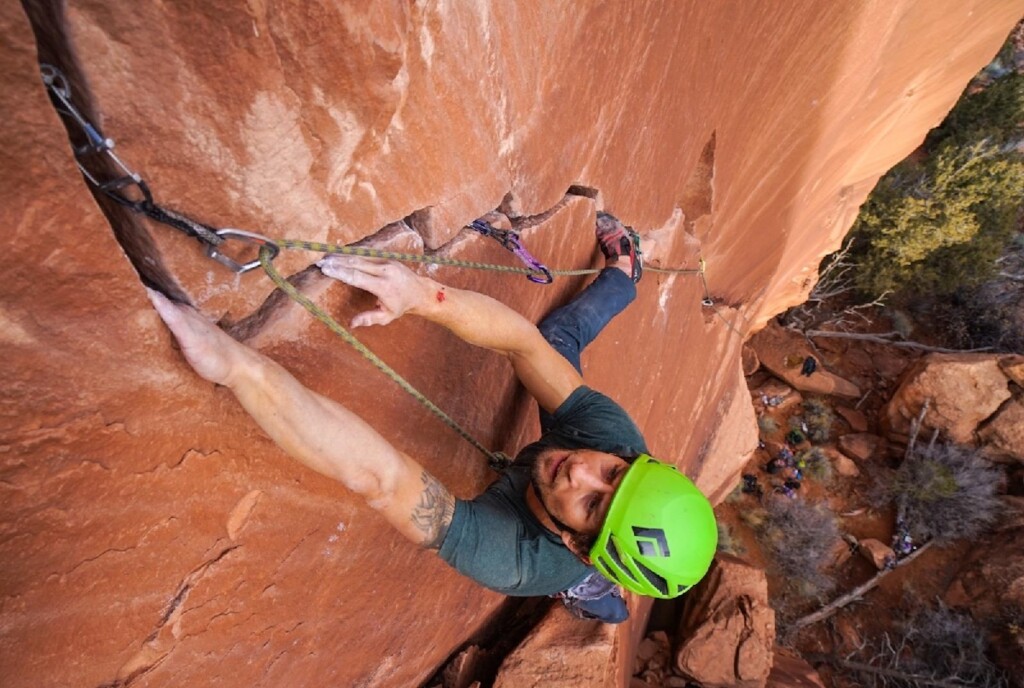
Feature Image: Moab climber Wade Plafcan on a route. Photo courtesy of Plafcan.