Fun Guide

The Most Romantic Hikes in Moab

As an alternative to candy and flowers take a hike in Moab among the many “romantic” features and formations.

|


Moab’s complex terrain generates a lot of names. Tagging features with a title helps orient people among the myriad canyons, towers, buttes, gullies, boulders, arches and knolls that texture the landscape. 

Some features are named after people; for activities that happened near, on, or in them; or for some attribute of the feature (such as Big Flat Mesa). Towers and arches are often named for their shape, or what that shape reminds people of — and that’s often when imaginations run wild. There’s an arch called ‘Paul Bunyan’s Potty’ in Canyonlands National Park, for example, and another was nicknamed ‘Klingon Bird of Prey Arch’ in reference to the classic television show Star Trek).

Despite cooler temps, shorter days and occasional snow, February is a great time to hit the trails. In fact, a holiday-themed objective may inspire you to get outside and enjoy the peace and quiet of the off-season. And the photo opportunities are amazing! 

In recognition of Valentine’s Day, here are some Moab-area features with romance-themed names that may prompt you to explore a new place on your own, with friends, or even with that special someone. 

Bride Canyon

A remote rock tower near Moab reminds some observers of — you guessed it — a bride, complete with a veil and bouquet, and wearing a full-skirted gown. Its hues, however, are sandstone-buff and desert-varnish black instead of the white of a conventional wedding dress. 

The tower, along with Bride Arch, is located in Bride Canyon. They’re all accessible from the four-wheel-drive Gemini Bridges Road, and there are dispersed camping sites (managed by the Bureau of Land Management) in the canyon. Hikers, bikers, climbers and motorized recreation enthusiasts all use the area. 
Wedding Ring Arch

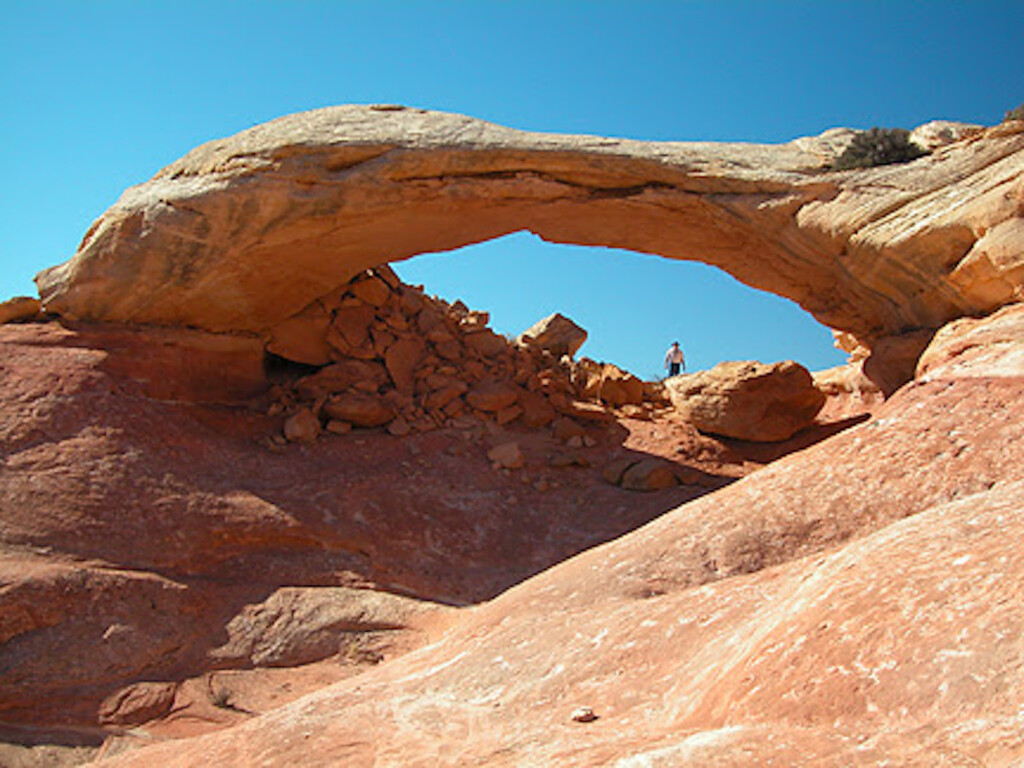
A narrow band of sandstone forming a rounded arch reminded someone of a wedding ring — maybe the person also had a marriage proposal on their mind. Perhaps they even got married there. 

The arch is in the remote Salt Creek Canyon within the Needles District of Canyonlands National Park, south of Moab. Access to the trail is by dirt road.

Kissing Turtles 

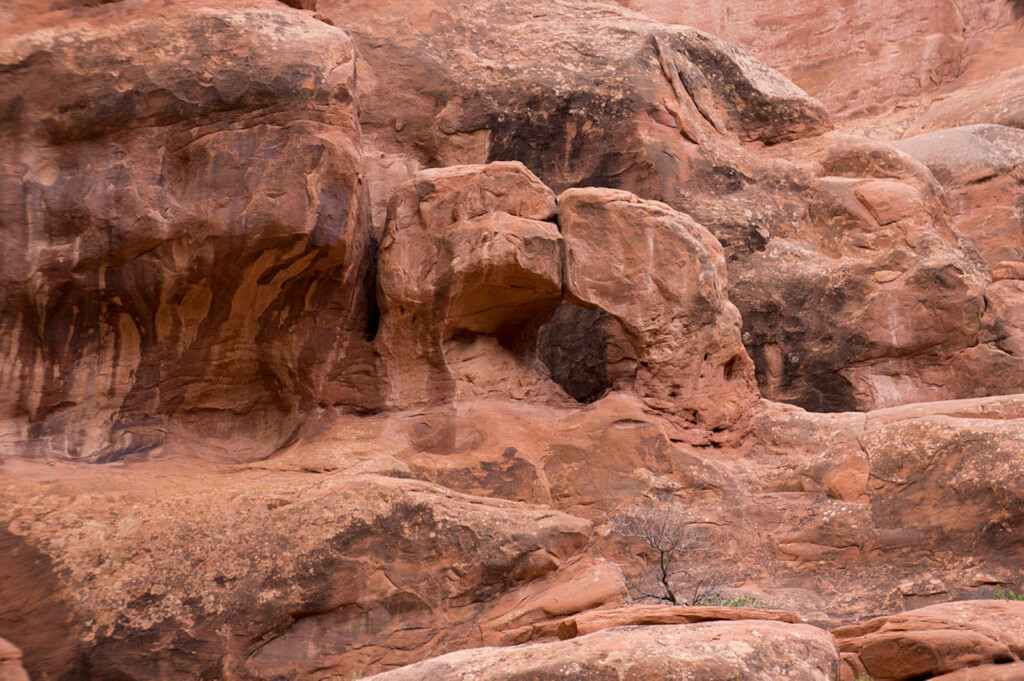
A permit is required to explore the Fiery Furnace within Arches National Park, a labyrinth of fins, slots and gullies where visitors may happen upon an arch feature called the Kissing Turtles. Its resemblance to two dome-shelled turtles sharing an intimate gesture is remarkable. 

Hand Hold Arch

This arch may be named for its resemblance to a ladder rung, or maybe the type of handhold you would look for while rock climbing — but for Valentine’s Day, it could easily be interpreted as a symbol of affection. The arch is in Lavender Canyon, a remote area of the Needles District of Canyonlands National Park and accessed by four-wheel-drive roads. 

Anniversary Arch (North and South) 

This pair of arches in the Marching Men area of Arches National Park is named for a sweet story rather than the shape of the feature itself. Roby “Slim” Mabery was a head ranger in Arches National Park during the 1960s, and he and his wife Juanita “discovered” and named the arches on their wedding anniversary. (Of course, the arches had likely been seen by many people before, but the Maberys’ names have been used on maps.)

 The Marching Men and surrounding features can be seen from the Tower Arch trail, accessed by unpaved roads inside Arches National Park. 
Matrimony Springs 

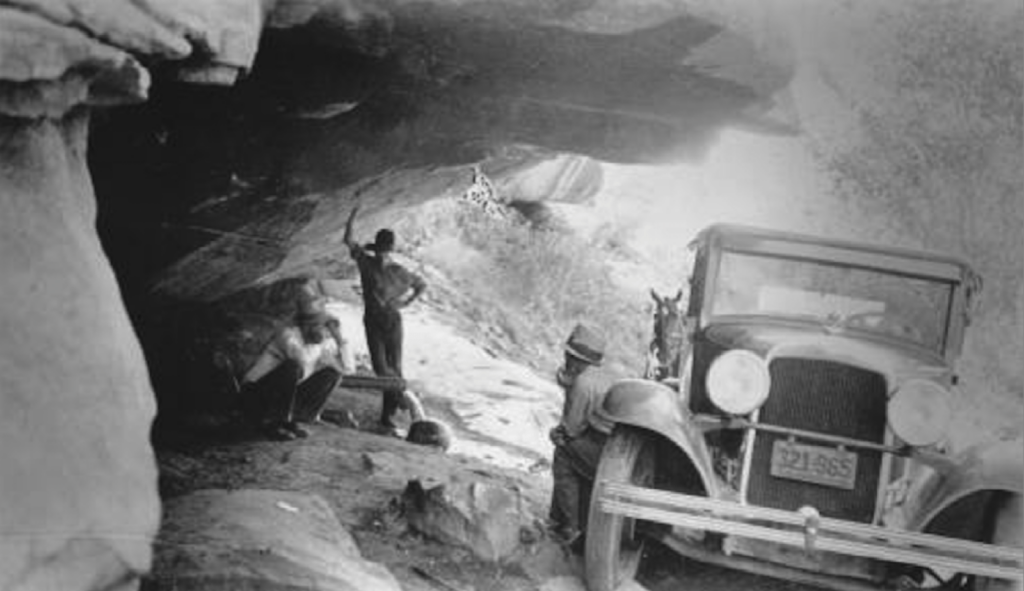
This freshwater spring trickles out of the bottom of a sandstone cliff along River Road. Locals and visitors have drunk from the spring for decades, and many people still pull over and fill up bottles and jugs (though the spring is not necessarily recommended for drinking by the health department or the Division of Water Quality. It was closed for a time in the 2000s when tests detected coliform). 

The origins of the name are unknown, but some local legends surround it. One bit of lore claims that anyone who drinks from the spring will always return to Moab; another predicts that couples who drink from the spring will get married. 

Valentine’s Day doesn’t have to be about traditional couples or marriage, and these sites don’t either. Maybe you’ll visit one of these features and come up with your own name or interpretation. Your alternative name won’t be used on maps, but it can be a personal waypoint to help you recall your visit (romantic or otherwise) to the Moab landscape.

Feature Image from Natural Atlas of Kissing Turtles.

, ,


Join our newsletter.
Stay informed.


  • Inside Moab’s Political Divide: Land, Tourism, and the Future of Grand County, Utah

    In the late 1950s, Edward Abbey took a job as a park ranger at Arches National Monument, just outside Moab. What he found there, and what he watched happen to it, would shape the rest of his life. Roads were being cut into the canyon country. Cars were replacing foot traffic. The National Park Service, in the name of accessibility, was engineering a kind of industrialization of the wilderness he’d come to love. Abbey wrote about it in Desert Solitaire, published in 1968, and the anger in that book wasn’t abstract. It came from watching something specific be changed by people who either didn’t understand what they had or didn’t care.

    Grand County has long been the most reliably left-leaning county in the state, a fact that puts it in sharp contrast to nearly everything around it. To understand how that happened, and where things stand now, I spoke with longtime residents and politicians who’ve watched it from the inside, people who’ve served in local government and lived through the shifts firsthand.

    Robert Greenberg.

    Bob Greenberg came from New York in 1976, took a job at the community mental health center, and never left. He went on to chair the Grand County Democratic Party and serve on the county council. When he arrived, he said, “the Democratic Party was said to be able to meet in a phone booth” — and even then, its members were a contradictory bunch. Yellow Dog Democrats from the oil patch were fiscally conservative but surprisingly open socially, allowing different demographics to feel safe moving to the county. 

    “The town fathers were desperate to have new people come to town,” Greenberg recalls. “They just didn’t want the people who actually showed up. They wanted some other people.”

    What followed was a demographic shift nobody planned. The people who filled the gap left by the bust were river guides, federal agency workers, artists, and eventually waves of outdoor recreationists discovering that southeastern Utah was among the most spectacular landscapes on earth. Tourism ended up being the only economic development avenue that actually worked. Manufacturing never had the labor force or market access, sewing factories came and went. The people the tourist economy attracted tended to be younger, more outdoor-oriented, and more liberal.

    Kevin Walker.

    Kevin Walker, a former Grand County commissioner who moved here in 1990 for the landscape, puts the county’s diversity in context. “Moab [is] a pretty diverse place since, I think, at least the 1950s with the uranium mining boom,” he says. “So it’s not a typical Southern Utah town.” 

    Part of what makes Grand County distinct is self-reinforcing. Federal agencies like the Park Service, the Forest Service, the BLM, have large presences here and pull in a different demographic than surrounding counties. People looking to live in Southern Utah with certain values gravitate toward the place where those values already have a foothold. Over time, that critical mass has made Grand County what it is politically, while neighboring counties went in very different directions.

    The defining conflict in Grand County has always been over land.

    In the 1970s and 80s, it was extraction versus preservation in the starkest terms. County commissioners floated toxic waste incinerators. A plan emerged to site a high-level nuclear waste repository at the entrance to Canyonlands National Park. 

    “It really, really galvanized environmentalists everywhere, but particularly in Grand County,” Greenberg says. Activists put up signs at the park entrance, watched them get chainsawed down, and came back with steel reinforcement. That stubborn, physical, unglamorous persistence became part of the local political character.

    Continue reading and support independent Utah journalism with a purchase of Utah Stories (Digital + Print) or 3 month free trial (Digital).


  • Utah Summer Events Guide 2026: Festivals, Concerts, Farmers Markets & More

    June through August Concerts at Brigham Young Historic Park. Concerts will be held every Friday evening (with the exception of July 24) starting at 7:30 pm at the park located at 100 N State St., Salt Lake City. The concerts are free and open to the public.  June 11 Yappy Hour at Fairmont Park. Dogs…


  • 5 Lesser-Known Utah State Parks Worth Discovering

    Utah’s five national parks often steal the spotlight, but the state’s lesser-known parks can offer something just as memorable, offering easier access, fewer crowds and a more personal connection to the landscape. 


  • Moab Trail Closures: The Fight Over Public Land Access and Off-Roading

    Trail closures threaten livelihoods and slowly limit access to ordinary families, says Dave Hellman, owner of Xtreme 4×4 Tours in Moab. Wilderness advocates argue that stronger protections are necessary to preserve fragile landscapes. As lawsuits reshape trail access across southern Utah, Moab increasingly sits at the center of a growing conflict over who public lands are really for.