

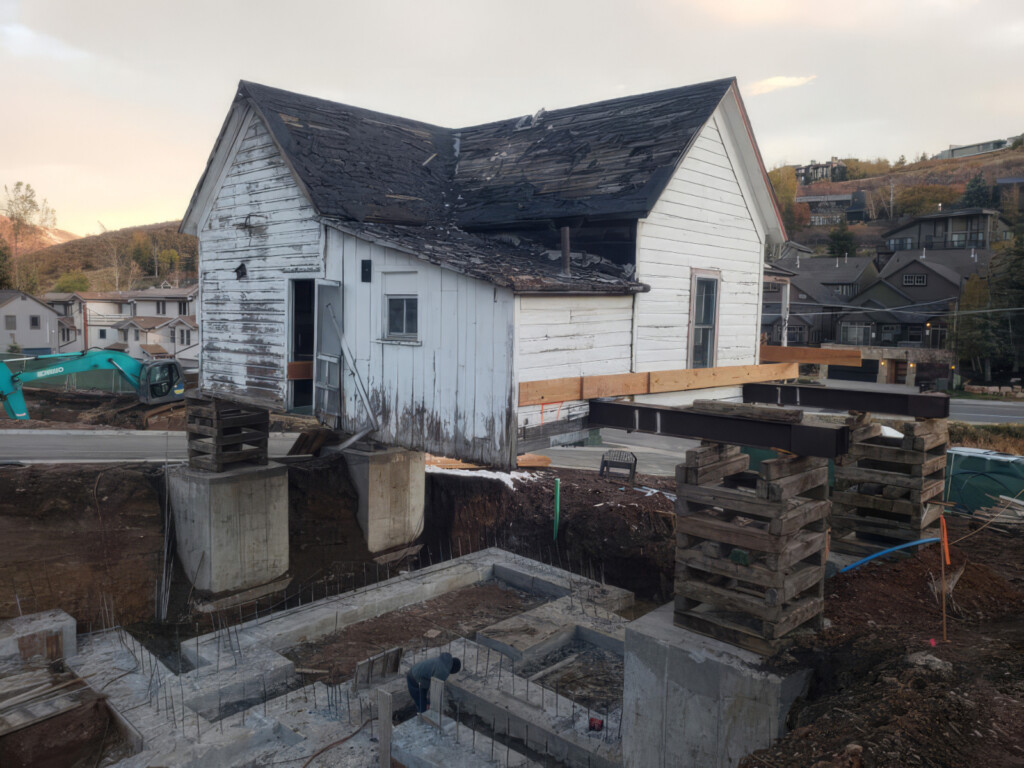
A house is suspended high above the ground on what appear to be stilts. The entire structure is perched above its foundation like a sandhill crane balancing perfectly on its long spindly legs. At first glance, the home appears out of place, but as you wander down the historic street, you notice another home in the same precarious position.
This once unusual sight has become quite common along the corridors of Park, Norfolk, and Woodside Avenues in Old Town, Park City. The homes in this district are historic landmarks from days gone by. Each one is a remnant of the town’s mining years, back when silver flowed from the mountains, miners crowded the streets, and a new community was growing and flourishing.
During the late 1800s, the new settlers built themselves small, simple homes, complete with modest furnishings. These affordable, wood-framed structures were predominantly humble cabins built close together on the steep mountain slopes. The architectural style that dominated the local neighborhood was stark and utilitarian. There were three home designs that were most common during this time — the hall-parlour homes, featuring two front-facing rooms, the T/L cottages, which added a front wing to form a “T” or “L” shape, and the shotgun houses that aligned all their rooms from front to back.
“Park City’s identity is rooted in its mining-era past, and the structures in our Historic District are a tangible link to that history,” said Parker Malatesta, Strategic Communications Specialist for the Park City Municipal Corporation. “The City is home to more than 400 historic sites designated Landmark and Significant on Park City’s Historic Sites Inventory and two National Register Historic Districts.”
Today, many of these historical sites can still be seen as you approach Park City’s Main Street. Of course, over time, wear and tear have caused these old miner homes to require restoration and renewal. As the architectural integrity of each house must be maintained, all renovations require that no change be made to the exterior layout. Any type of remodeling needs strict oversight to ensure it does not just preserve the past but also maintains functionality and beauty for future generations.
As Malatesta explained, “Any renovation on a designated historic site, including foundation work, goes through a Historic District Design Review (HDDR) with our Historic Preservation Board, a citizen board that includes a licensed architect, representatives from the Park City Historical Society and Preservation Utah, and residents of the Historic District.”
This is where the process of lifting the entire structure and placing it on stilts has become a part of the renovation procedure. Over time, homes may settle unevenly or become compromised by moisture which causes severe structural issues. By elevating the building, workers can then excavate the ground and build a proper foundation beneath the original structure.
This creative operation is impressive to watch. As one onlooker explained, “The workers cut and slid steel I-beams through openings in the bottom of the home. Then jacks were placed underneath the steel beams. Every jack lifts the house at the exact same time, as the workers build temporary support towers. They repeatedly jack up the house and stack more blocks until the house is about 15 feet above the ground. Then heavy steel stilts are set into the ground and anchored to the blocks.”
By lifting the home, the renovation team is able to dig basements, shore up hillsides, and update plumbing. Furthermore, lifting the home prepares it for future climate-related risks and it ensures the structure meets current building codes and standards.
“Additionally, we lift houses so the property can maintain the same square footage,” said Kathleen Whiteley of JWW Excavating. “In Old Town, when a historic house is demolished, the lot lines revert to new standards instead of matching the original lot. So if a house sits between two lots, you have to lift it to keep it in the same spot.”
According to Whiteley, once the house has been lifted, it stays elevated until the contractor can get footing and foundation crews on site along with carpenters to install the new floor of the house. On average, a home in Old Town will stay on stilts for one to two months.“Then,” said Whitely, “once the new foundation is poured, we set the house down.”
After the house has been hoisted, the foundation has been overhauled, and the structure has been returned to the ground, further restoration and safeguarding can take place. This strict adherence to historic renovation guidelines are what has allowed Park City to retain the iconic, modest charm of the 19th-century silver mining era that defines its Old Town streetscapes.
These modern techniques will ensure that Park City’s historic architecture remains authentic for at least another century, reminding future generations of a time when the West was still wild, miners lived modestly, and silver still flowed in Park City’s veins.