Kate Kilpatrick, a fine art painter and muralist, loves to paint big. “It’s probably because I’m short,” she quipped.
Her first opportunity to paint really large came when she was asked to paint a sign for her local grocery store, R&A Market in Helper, Utah. Kilpatrick’s initial excitement only grew, and she began to work with murals.

“As hard as it is to paint outside, I like it, especially during the summer,” Kilpatrick said. “Plus, it’s fun when you’re painting in public like that and people come by and want to see what you’re doing. There are people who give you opinions you may not want to hear, so you’ve gotta have pretty thick skin. I’ve always kind of been that way though: I want you to tell me to my face if you don’t like me, rather than behind my back.”
Painting a mural definitely requires being vulnerable. Kilpatrick hand-draws her designs on a large scale, and once the major elements of the composition are planned out, she sketches with markers directly on the wall she’ll be painting.
“Once,” Kilpatrick said with a laugh, “I had someone say, ‘I’m glad you’re working on that, it looked like crap before.’ Well, it’s layers, and what I saw and what you saw were two different things.”
The flip side, though, is that those passers-by can also be the source of crucial information, especially when the mural has a historical subject. This was often the case for Kilpatrick’s largest mural called the Bookcliffs Mural, named for the workwear store whose side serves as its canvas.
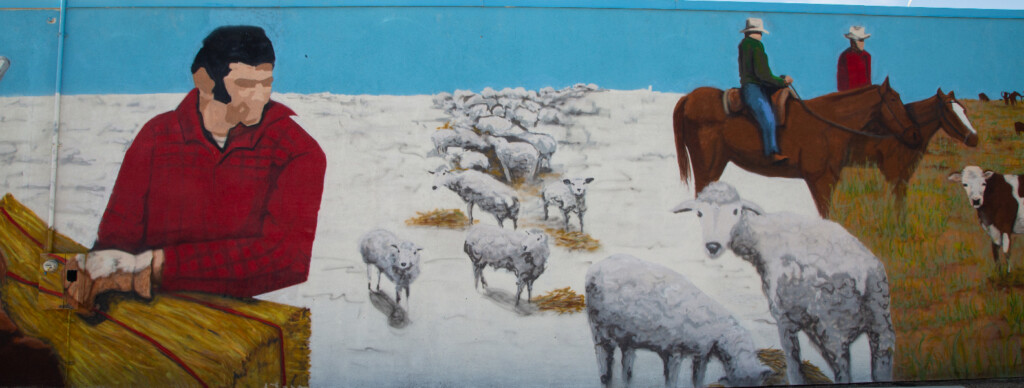
Commissioned by the city of Price, it shows scenes from the history of Carbon County, reaching from the early establishment of its coal mining towns to the present day.
“There were enough paintings of particular people who’d come into the area and founded the towns in Carbon County,” said Kilpatrick, “so we decided to focus on the industries and what went on in daily life. We end with the eagle, because no one knows what our industries will be in the future, but we know education will be an extremely important part of it.”
One of the industries featured is the growing of sugar beets. Kilpatrick had learned that the harvesters were mainly Native Americans, but she couldn’t find out what tribe, so she sketched them in and kept working. One day, a couple walked by and commented. They were able to tell Kilpatrick that it had been the Navajo. They provided details for the painting and shared stories. “I was helped quite a bit by the people who watched me work,” she said.

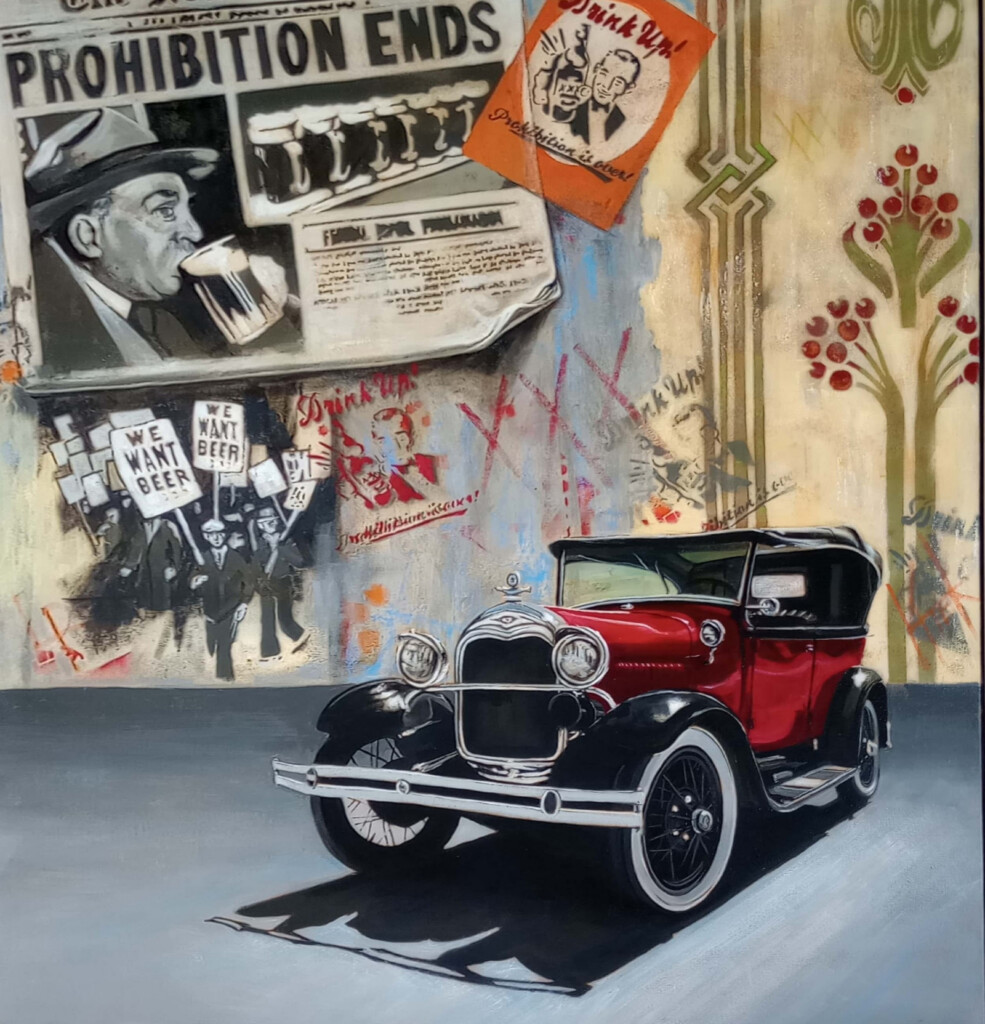
At the same time that she was working on murals, Kilpatrick was also painting vintage cars. People loved these paintings, especially when one of the subjects happened to match a car they had previously owned and loved. “It was kind of like they were shopping for a shirt,” said Kilpatrick. “They’ll say, ‘I had a blue one of those, that ‘69 Mustang. Do you have a blue one?’ So I wondered, how do I open this up to people so that more people will connect with them?”
Though she did some commission work, Kilpatrick wasn’t satisfied with painting a car that would be meaningful to only one person. “I want my work to have multiple meanings. It may mean one thing to me and I hope it means something different to someone else, because that gives the painting a longer life, and lets it speak to more people. And I like to tell stories — all my paintings have a storyline to them.”
In this pursuit, murals started creeping in. Kilpatrick began picking cars which were icons of major cultural events, and painting backdrops which contextualized them. She leans heavily on the street art style, using stencils and airbrushing. “I’m not a street artist,” she said, “but I’m trying to pay homage to them … I don’t think they have any fear.”
One favorite painting from this series is Where Were You?, focused on the assassination of JFK. His ’61 Lincoln Continental takes center stage, and on the wall behind, a newspaper announces, “Kennedy Assassinated.” Around the paper float stenciled scenes, reminiscent of the way images might mix together in the memory of an observer.
This painting was inspired by Kilpatrick’s father. “He had MS, and when I was a teenager he couldn’t walk, couldn’t remember things. He was losing his ability to talk, and I had the idea of recording his voice. He had two favorite stories, and really they were the only stories he could remember at that point, and those were how he met my mother, and where he was when JFK was shot. That’s why I did this painting: he was ill, couldn’t read anymore … but he could remember where he was, so I thought it must’ve been pretty important.”

In this way, her paintings succeed in telling many stories at once: not just JFK’s, but also her father’s, and that of every viewer.
“I think we’re all interconnected; as individuals as well as societies,” Kilpatrick notes. Her work showcases those connections exuberantly, and whatever scale she’s working on, you can bet that in terms of energy and spirit, she’s painting large.
Images courtesy of Kate Kilpatrick.