Sundance Film Festival

Hit Man On The Loose, Sundance Film Review

Hit Man follows Gary Johnson, a part-time philosophy professor and undercover cop posing as a hitman. to allow people who hire him and incriminate themselves. Everything goes well until he meets a beautiful woman.

|


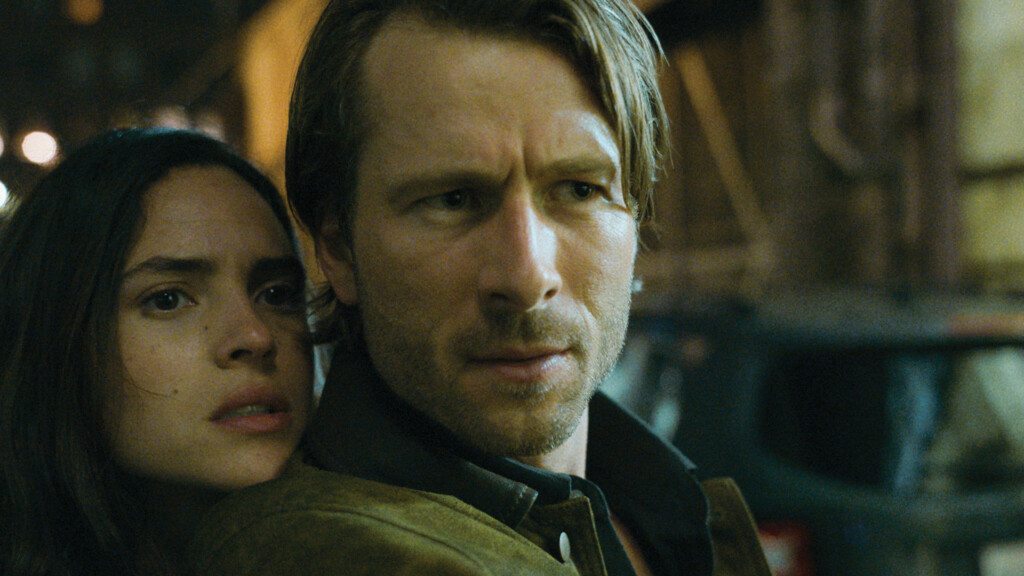
Hit Man follows Gary Johnson (Glen Powell), a part-time philosophy professor and undercover cop. Gary lacks confidence and seems to be drifting through a life without meaning. One day, on the job as an undercover police officer, Gary is given the opportunity to pose as a hitman to allow people who hire him and incriminate themselves. He finds his confidence and puts on a convincing front as a hitman. Gary proceeds to cycle through disguises and personas as this whole ‘fake hit man’ act gives him confidence.

Things get complicated when he meets a beautiful woman named Madison (Adria Arjona). She asks Gary to kill her husband because she’s in a horrible marriage and she thinks it’s her only way out. The tale gets even more twisted, ridiculous, hilarious, and dark from there.

I attended the Saturday evening press screening and got to chat with fellow members of the press before and after the film. 

The press audience was highly anticipating director Richard Linklater’s film and it did not disappoint. Roars of laughter, applause, and visceral reactions were plentiful throughout the film. Those reactions are typically unusual at press screenings, as film journalists tend to be more reserved. I was impressed with how Linklater threaded the needle of humor and dark themes that unravel as the film unfolds. 

This is my second favorite of the festival so far, only to Freaky Tales, and is sure to thrill audiences when it debuts on Netflix later this year.

Linklater actually made his feature directorial debut at Sundance way back in 1991. An Austin, Texas native, Linklater was never embedded with the Hollywood system and embodies what Sundance is all about: empowering independent filmmakers.

The exciting parts of Sundance, besides the fanfare, celebrities, and theater audiences, are seeing brand new films for the first time. It’s exciting to not know what you’re going to get in terms of quality filmmaking. Putting down your phone for two hours is refreshing, and being immersed in the experience of new art and new cinema is exciting for me. Exploring new ideas and discovering new filmmakers gives Utah an interesting facet that many people aren’t aware of. They think of skiing and national parks, but the arts are often forgotten.

I highly recommend Hit Man, and if you’re looking to catch it before the festival ends, you can watch it online or attend in person. Tickets are still available! If not, it will be available on Netflix later this year.


, ,


Join our newsletter.
Stay informed.


  • Salt Lake City Newcomers Club: Finding Friendship and Belonging Since 1948

    Moving away from your hometown can come with many blessings. But for some, it also comes with just as many bouts of loneliness. That ache of not knowing where to meet people, or grieving the friends you left behind, comes in waves. Workplaces and churches can sometimes provide ready-made communities, but what happens when they don’t? Where do you go to find true belonging?


  • Highway 6 and the Midland Trail: Utah’s Transcontinental Highway History

    From Price Canyon to Delta’s desert stretch, Utah played a central role in building the Midland Trail, one of America’s earliest transcontinental highways and the foundation of today’s Highway 6.


  • A Stand-Up Wheelchair Gives Paralysis Patients Greater Independence

    After a cycling accident left him paralyzed, Bill Winchester had to relearn how to navigate daily life from a wheelchair. A stand-up wheelchair later gave him the ability to rise, move more independently, and regain parts of the active life he once knew.


  • Whiskey, Bullets & a Buried Town: Archaeologists Reveal Alta’s Wild Past

    Before Alta was known for powder days and lift lines, it was a silver mining town clinging to the side of a narrow canyon. In the late 1800s, men lived at 8,000 feet, went underground each day, and endured winters that regularly buried buildings in snow. This past summer, that mining town resurfaced — literally — during construction at the Alta Ski Area.

    To understand what Alta really looked like, you don’t begin with legend. You begin with its trash — and this time, that happened almost by accident.

    Alta Ski Area was installing underground water reservoirs to support snowmaking. Because the project sits on Uinta-Wasatch-Cache National Forest land, an archaeologist was required to monitor the excavation. No one expected the trench to produce much.

    But, It did.

    Artifacts began surfacing almost immediately. Enough that the Forest Service contacted the Utah State Historic Preservation Office for help. Lexi Little, who coordinates the Utah Cultural Site Stewardship Program, helped mobilize nearly 30 volunteers to assist with what quickly became a focused two-week excavation.

    Winter deadlines were approaching. The pipes for the reservoirs had to go in the ground. There wasn’t time for a slow, extended dig.

    “It was two weeks of digging in the dirt and helping figure out exactly what we were looking at,” Little said.

    Most of the people screening soil weren’t professional archaeologists. They were trained stewards from around Utah — part of a statewide volunteer network that now approaches 500 people. They poured dirt through shaker screens, scanning for fragments that could piece together a town long buried.

    “Archaeology is human trash,” Little explained. “Archaeologists are very into trash.”

    Alta had left plenty behind.

    https://youtu.be/hzIHzx3OGoo?si=dKcl2CEz-t6FZzYw

    Victorian-style ceramics appeared first — the kind typically used in hotels. Medicine bottles followed. Ink bottles. Hand-blown glass. A porcelain doll’s foot surfaced from the soil, a small detail that shifted the mental image of the town. Families were here. Children were here. This wasn’t only a camp of miners.

    The bottles helped establish time. Manufacturing details — whether glass was hand-blown or mold-made, whether a maker’s mark appeared on the base — allowed archaeologists to date many of the artifacts to the 1870s through the 1890s, when Alta was booming as a silver mining town.

    “That gives you that range of dates for when Alta was really booming,” Little said.

    One reusable soda bottle clearly stamped “Salt Lake City” connected the canyon to the valley economy below.

    Then something unusual rolled out of a dirt pile.

    A corked bottle. Intact. Liquid still inside.

    Continue reading and support independent Utah journalism with a purchase of Utah Stories (Digital + Print) or 3 month free trial (Digital).