Moab

Moab Sculptor Carves a World in Wood

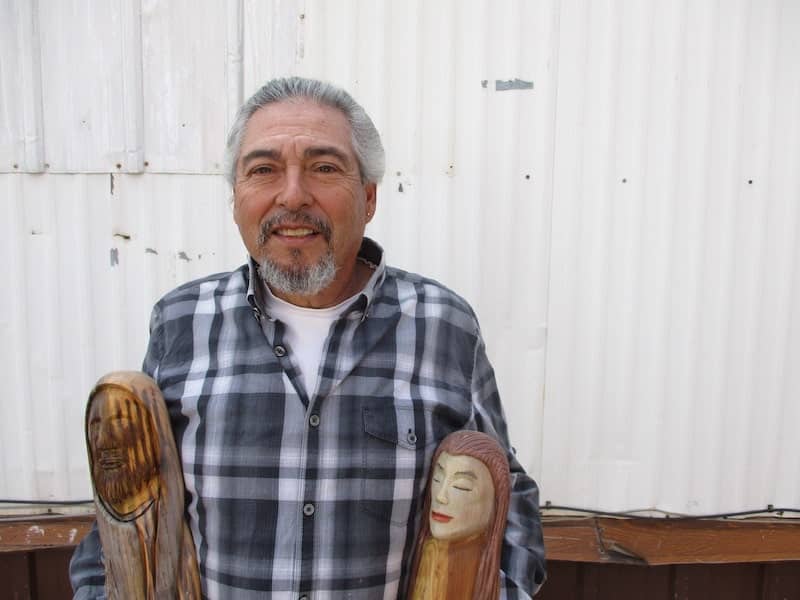
Herman Herrera is a Moab sculptor with a passion in wood carving. He carves fantastical creatures in unusual wood such as branches and roots.

|


Herman Herrera with two of his carved figures. Photos by Rachel Fixsen.

Sculptor finds personality in the woods he carves.

He hecho un mundo 

Forests of characters populate shelves and tabletops in Herman Herrera’s home. Faces and figures carved from both raw wood and dimensional lumber peer out and suggest a range of personalities and stories, wearing blissful smiles, drawn brows, or stoic gazes. One long face, sprouting a huge nose formed from a natural branching of the wood, looks like it’s in mid-sneeze. 

Herrera, a self-taught artist, grew up in New Mexico and traces his interest in wood carving to his grandfather and great uncles who built cabinets as a hobby. They’d take logs to be milled into boards and rub them with wood ash to give them an antique look. 

Herrera took his woodworking in a more creative direction. He likes to use branches, roots or burls with character, and allow the natural shape of the wood to guide the pieces he carves. 

“You want to work with what is there,” he said, holding out a branch and pointing out knots and curves he would try to incorporate into a piece. In a carving he calls “Man Without a Cross,” the swoops and intersections of the natural wood are still visible in the Christ figure with outstretched arms. There’s no cross; Herrera prefers the less literal representation. 

“I didn’t want it to be just another crucifix,” he said. 

Herrera has lived in Moab for the past 20 years but still feels a strong connection to his hometown. 

“It feels strange, but the most amazing thing is I still miss New Mexico,” he said. “Even the wood seems to be better there.” 
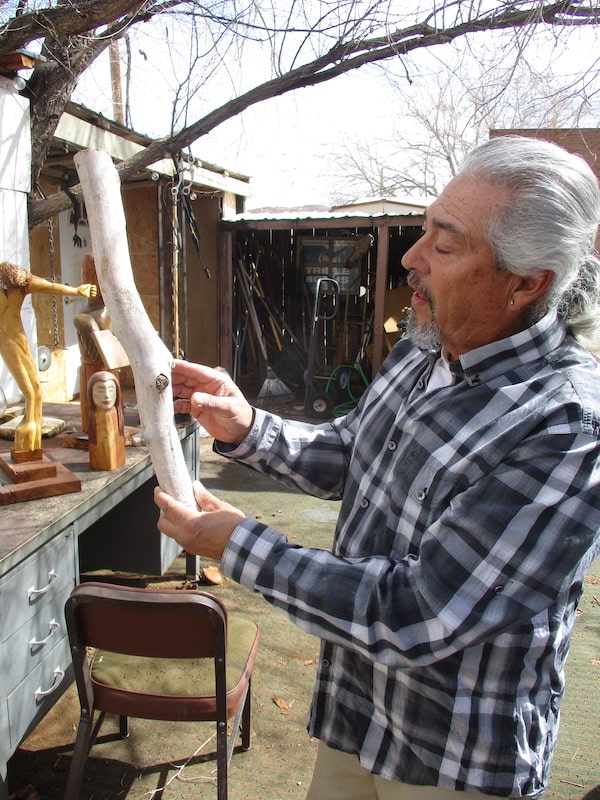
Herrera points out a knot that he will try to incorporate into a carving.

He displayed a sculpture he’s making from a twisting piece of wood his brother brought him from New Mexico. It’s a fantastical creature with a gnarled tail and humanoid face—something like an eerie mermaid crossed with a seahorse. 

New Mexico is not only Herrera’s childhood home but also where many of his family members still live, including his three adult daughters, Misty, Joni and Heather. But Moab is home for him too — he’s established a sense of community and is proud of the home he shares with his wife and his son, Tyler. 

Herrera carves at a desk outside his house, equipped with a vise and drawers full of cutting and carving tools. He’s working on outfitting a small outbuilding as an indoor woodshop. His pieces are for sale at the Trading Post in Moab on south Highway 191, and this past winter, he exhibited his work at the Moab Arts and Recreation Center. 

At the exhibit opening, he read an excerpt from a book he’s writing: the working title is Ángel Mío. Herrera’s first book, El Coyote Pinto, is a lyrical memoir of his early years in New Mexico and is available through online booksellers and at stores throughout Moab. He’s 13 chapters into his second book, which will also explore his ancestry, as well as introduce people he’s met over the years and what they’ve shared with him. He’s not sure when he’ll be done writing it. 

When he’s not writing or carving (or working his full-time job at the Community Recycle Center), Herrera hosts a radio show, Entre Las Piedras, playing a variety of music on local station KCYN. He DJ’d on the radio for nine years in New Mexico, and for another 12 at Moab’s community radio station, KZMU. He’s a musician himself: he sings, plays guitar, and writes songs. He’s often asked to play at family weddings and funerals, and he’s submitted some of his compositions to a local musician who plans to bring them to Nashville. He said he writes mostly about love and betrayal — classic country music themes. 

“Love is easy, and betrayal is even easier!” he quipped. 
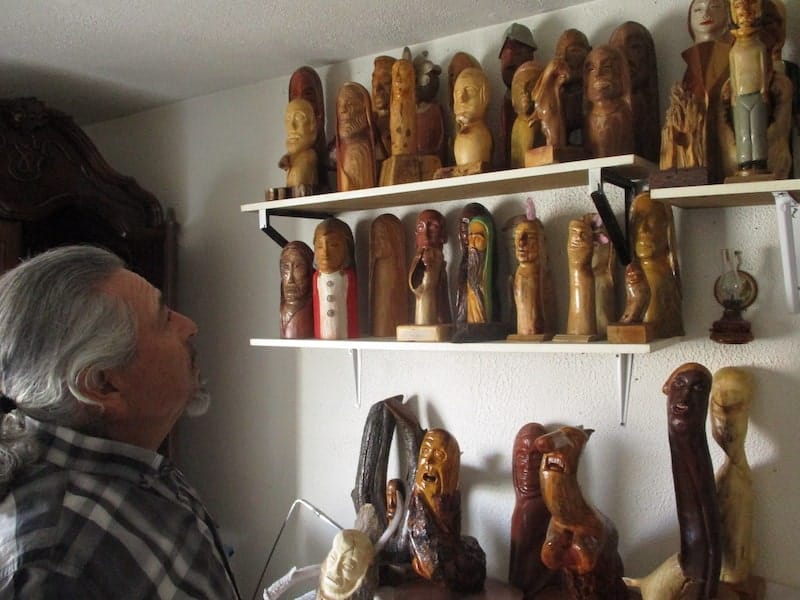
Herrera with a selection of his carvings.

While Herrera misses New Mexico, he also loves Moab. He remembers an uncle who would say “Han hecho un mundo,” or, “They’ve created a world,” to describe people who have built their communities and surroundings to facilitate a content and productive life. That’s how Herrera feels about his home in Moab — he’s surrounded himself with the tools and venues for his creative outlets. Lately he’s been especially inspired to carve.  

“I just want to see what my next creation will look like,” he said. 

If you’re not local to Moab and are interested in Herrera’s sculptures, books or music, you can contact him at emiomine@gmail.com or 435-280-7639.

,


Join our newsletter.
Stay informed.


  • Inside Moab’s Political Divide: Land, Tourism, and the Future of Grand County, Utah

    In the late 1950s, Edward Abbey took a job as a park ranger at Arches National Monument, just outside Moab. What he found there, and what he watched happen to it, would shape the rest of his life. Roads were being cut into the canyon country. Cars were replacing foot traffic. The National Park Service, in the name of accessibility, was engineering a kind of industrialization of the wilderness he’d come to love. Abbey wrote about it in Desert Solitaire, published in 1968, and the anger in that book wasn’t abstract. It came from watching something specific be changed by people who either didn’t understand what they had or didn’t care.

    Grand County has long been the most reliably left-leaning county in the state, a fact that puts it in sharp contrast to nearly everything around it. To understand how that happened, and where things stand now, I spoke with longtime residents and politicians who’ve watched it from the inside, people who’ve served in local government and lived through the shifts firsthand.

    Robert Greenberg.

    Bob Greenberg came from New York in 1976, took a job at the community mental health center, and never left. He went on to chair the Grand County Democratic Party and serve on the county council. When he arrived, he said, “the Democratic Party was said to be able to meet in a phone booth” — and even then, its members were a contradictory bunch. Yellow Dog Democrats from the oil patch were fiscally conservative but surprisingly open socially, allowing different demographics to feel safe moving to the county. 

    “The town fathers were desperate to have new people come to town,” Greenberg recalls. “They just didn’t want the people who actually showed up. They wanted some other people.”

    What followed was a demographic shift nobody planned. The people who filled the gap left by the bust were river guides, federal agency workers, artists, and eventually waves of outdoor recreationists discovering that southeastern Utah was among the most spectacular landscapes on earth. Tourism ended up being the only economic development avenue that actually worked. Manufacturing never had the labor force or market access, sewing factories came and went. The people the tourist economy attracted tended to be younger, more outdoor-oriented, and more liberal.

    Kevin Walker.

    Kevin Walker, a former Grand County commissioner who moved here in 1990 for the landscape, puts the county’s diversity in context. “Moab [is] a pretty diverse place since, I think, at least the 1950s with the uranium mining boom,” he says. “So it’s not a typical Southern Utah town.” 

    Part of what makes Grand County distinct is self-reinforcing. Federal agencies like the Park Service, the Forest Service, the BLM, have large presences here and pull in a different demographic than surrounding counties. People looking to live in Southern Utah with certain values gravitate toward the place where those values already have a foothold. Over time, that critical mass has made Grand County what it is politically, while neighboring counties went in very different directions.

    The defining conflict in Grand County has always been over land.

    In the 1970s and 80s, it was extraction versus preservation in the starkest terms. County commissioners floated toxic waste incinerators. A plan emerged to site a high-level nuclear waste repository at the entrance to Canyonlands National Park. 

    “It really, really galvanized environmentalists everywhere, but particularly in Grand County,” Greenberg says. Activists put up signs at the park entrance, watched them get chainsawed down, and came back with steel reinforcement. That stubborn, physical, unglamorous persistence became part of the local political character.

    Continue reading and support independent Utah journalism with a purchase of Utah Stories (Digital + Print) or 3 month free trial (Digital).


  • Moab Trail Closures: The Fight Over Public Land Access and Off-Roading

    Trail closures threaten livelihoods and slowly limit access to ordinary families, says Dave Hellman, owner of Xtreme 4×4 Tours in Moab. Wilderness advocates argue that stronger protections are necessary to preserve fragile landscapes. As lawsuits reshape trail access across southern Utah, Moab increasingly sits at the center of a growing conflict over who public lands are really for.