Community Relations

Utah’s Heroes: Nurse Saves Man’s Life on the Baseball Field

Knowing CPR is of utmost importance and can make a positive change in someone’s life

|


It was an ordinary day until Danya Topham’s husband, Mike, began to prod her about attending a baseball game at Murray Park. Danya, an R.N. by trade, had just gotten off a long shift at the hospital and was ready for a nice relaxing evening at home. It was out of the norm for her husband to strongly encourage her to attend the ballgame, but this night was different. She didn’t know it yet, but that evening wouldn’t be just any night at the baseball game. 

Tonight, unbeknownst to either Topham or her husband, would be one for the books one where she would end up saving a man’s life. 

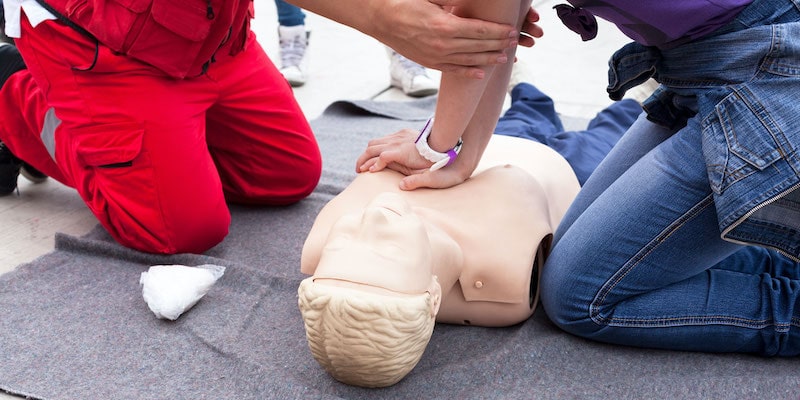
As a registered nurse, saving people’s lives isn’t something that happens on a daily basis, but it does happen. Her repetitive CPR training that is required by the Intermountain Medical Center, kicked in immediately when she heard someone off in the distance shouting “call 911!” and with that, she ran across the field with her husband and son, Chase, in tow. 

There lay a man, 57-years-old without a pulse. He had just suffered a massive heart attack which would take four stents to heal, but without the quick action of Topham, he may not have lived to tell his story. 

A video of Topham performing CPR on the man went viral and was picked up by Inside Edition, who stressed the importance of performing CPR. The video tells Topham’s chilling story about how terrified she was that this man wouldn’t survive. The key, quick thinking and performing CPR, made all the difference in this case. 

Dr. Kris Justesen at Alpine Wellness Center, has her own stories about CPR ‘what-if’ situations, “but one thing we have learned about life-saving techniques,” she stated in an interview, “is that “part of something is better than all of nothing.”

Most of us as adults have come in contact with someone who has had a life-threatening situation, whether it be a car accident, a stroke or heart attack, or a myriad of other ailments that could occur. Ask yourself:

  • Am I CPR certified?
  • Am I comfortable performing CPR?
  • Why or why not? 

The results of this small survey were rather interesting. I learned that 1 in 10 people is afraid of being sued if they do something wrong, and 7 in 10 are afraid of doing something wrong. Only 2% of people stated that they felt comfortable performing CPR on anyone, let alone a stranger. 
Many states including Utah have a “Good Samaritan Law”, which states in Utah Code #78B-4-501 that:

 “A person who renders emergency care at or near the scene of, or during, an emergency, gratuitously and in good faith, is not liable for any civil damages or penalties as a result of any act or omission by the person rendering the emergency care, unless the person is grossly negligent or caused the emergency.”

So, as Gary Sorenson, an EMT in the Salt Lake Valley stated, “It’s not as hard as you think it is, you won’t get in trouble if you try, and it’s better to do something instead of nothing.” 

While speaking to Topham, Dr. Kris, and Sorenson, it became evident that CPR is the key to survival when a patient doesn’t have a pulse. The American Heart Association recently released their latest statistics on stroke and sudden cardiac arrest, stating that these ailments are a public health crisis. 

“There are more than 356,000 out-of-hospital cardiac arrests (OHCA) annually in the US, nearly 90% of them fatal. The incidence of EMS-assessed non-traumatic OHCA in people of any age is estimated to be 356,461, or nearly 1,000 people each day. From survival to hospital discharge after EMS-treated cardiac arrest languishes at about 10%.” 

When hearing the low survival rates after experiencing a massive heart attack, it is important to remember that knowing CPR is of utmost importance and can make a positive change in someone’s life. 

So, where do you get certified or take a class? There are lots of options available, many for a small fee. Below you will find several links to get you started in the right direction:

American Red Cross 

CERT Basic Training

CPR Training Utah

LifeSavers CPR 

Wilderness First Responder Training

Looking back at the evening events at that baseball game, Topham recalls being slightly irritated that her husband parked somewhere other than where he usually parked. But for whatever reason, whatever you call it; God, the universe, extensive CPR training, luck, etc., this man was supposed to live, and he is here to tell the story about how a regular person, who just happened to be a nurse and just got off work, saved his life. 

Subscribe to Utah Stories weekly newsletter and get our stories directly to your inbox

* indicates required


,


Join our newsletter.
Stay informed.


  • A Salt Lake City Gym Uses Fitness and Community to Support Addiction Recovery

    “What I think is really special about that place is that doing hard things is a way that we can become proud of ourselves,” said nursing student Vince Minutello, who has started exercising at the gym in Salt Lake City as a requirement for one of his courses.


  • Has Utah’s Soft-on-Crime Justice Reform Made Communities Safer?

    Has this “soft-on-crime” approach resulted in safer streets?

    SALT LAKE CITY — A decade has passed since former Utah Governor Gary Herbert signed a massive justice reform bill into law in hopes that the state could reduce its prison population and manage low-level offenders through rehabilitation programs instead of incarceration. Has this reinvestment resulted in lower crime and recidivism rates?

    According to the Utah Department of Corrections, that landmark Justice Reinvestment Initiative aimed to “continue holding offenders accountable and securing our communities, but in a way that considers individual risks and treatment needs.”

    Are communities really safer when mental health and substance use needs are addressed through programs administered outside prison walls? The idea was to treat criminals differently based on their mental health needs and backgrounds. But at least one retired Adult Probation and Parole Officer, believes this “soft-on-crime” approach hasn’t resulted in safer streets.

    LOOKING BACK

    State Senator Todd Weiler, in that legislative role since 2012, helped drive the passage of the Justice Reinvestment Initiative (JRI), a massive bill that enjoyed broad-based approval among state officials and the Legislature as a whole.

    In November 2014, Weiler attended the national summit on the issue in San Diego, an event hosted by Pew Charitable Trusts. 

    “I was very involved in it. We had a lot of high hopes,” Weiler, a Woods Cross Republican, said in a recent interview. “That was about the time we were finalizing plans for the new prison. And we actually said that because of JRI we don’t need as many beds because we’ll be incarcerating fewer people. So that new prison was designed with this idea.”

    A key part of JRI dealt with adjusting sentencing for crimes related to addiction, dividing offenders into two basic groups: dangerous criminals who are a threat to society (that group goes to prison), and low-level offenders who get help kicking addictions through state-sponsored programs or private-sector rehabilitation.

    “The ultimate goal was if we have an otherwise good person who got caught up in an addiction, and as a result committed crimes, they need to be punished for their crimes,” Weiler said. “It’s not that we’re going to overlook what they did, but we wanted to focus primarily on helping them overcome their addiction and [that means] getting them back to their job and their family.” 

    Before JRI, low-level drug offenders with felonies would spend years in prison, which wreaked havoc with their lives and future prospects. Addressing the root cause of their theft and property crimes through supervision and treatment made sense. 

    “We’re all imperfect people,” Weiler said. “So we want people working their jobs, paying their bills and raising their kids rather than sitting in jail and watching TV or playing cards.”

    To access this post, you must purchase Utah Stories (Digital + Print) or 3 month free trial (Digital).


  • Salt Lake City Newcomers Club: Finding Friendship and Belonging Since 1948

    Moving away from your hometown can come with many blessings. But for some, it also comes with just as many bouts of loneliness. That ache of not knowing where to meet people, or grieving the friends you left behind, comes in waves. Workplaces and churches can sometimes provide ready-made communities, but what happens when they don’t? Where do you go to find true belonging?


  • How I Lost 120 Pounds and Changed My Relationship With Food

    Throughout most of my life, I used food to cope with chaos, depression, and pain I did not yet understand. By my early twenties, I weighed over 320 pounds and felt trapped in a body that limited every part of my life. This is the story of how learning about food, mental health, and habit-building helped me lose 120 pounds and rebuild stability.