Community Relations

Will Former Sugar House Sizzler Site Turn into a Gas Station? Sugar House Residents Kept in the Dark.

Gas Station proposed for corner property. In February earlier this year, Nathan Abbot, representing Galloway US, submitted a conditional use proposal to the SLC Planning Commission to build a Kum & Go convenience store and gas station on the parcel adjacent to the Sego Lily Plaza and the Draw at Sugar House Park (2111 South…

|


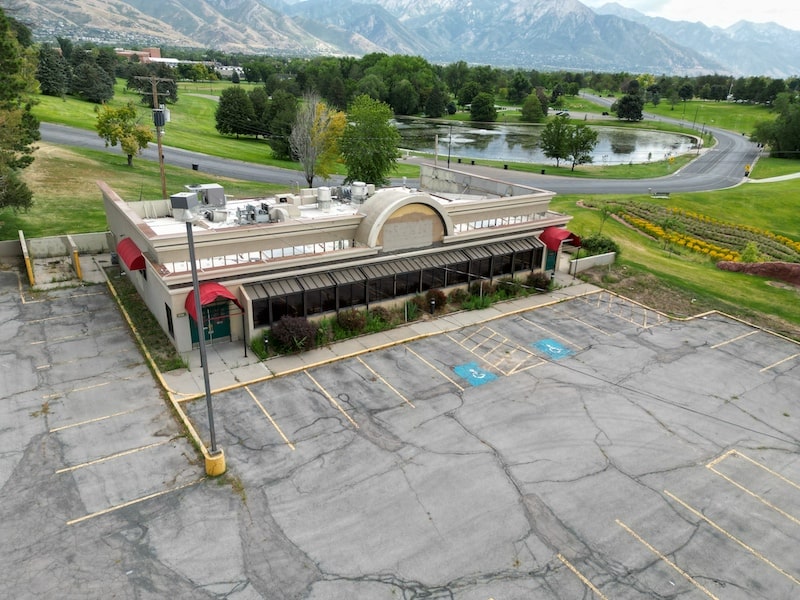
Drone Photo of Sizzler Property by Richard Markosian.

Gas Station proposed for corner property.

In February earlier this year, Nathan Abbot, representing Galloway US, submitted a conditional use proposal to the SLC Planning Commission to build a Kum & Go convenience store and gas station on the parcel adjacent to the Sego Lily Plaza and the Draw at Sugar House Park (2111 South 1300 East). If the proposal is approved, it is assumed that the property owner, Romney Farr, will lease or sell the property to the Kum & Go Corporation for development.

For those who aren’t familiar, the Draw at Sugar House is both an art installation and a corridor for pedestrians and cyclists connecting Hidden Hollow and the business district to Sugar House Park. Of equal or greater significance, it doubles as a spillway and highly-engineered earthen dam for flood water from Parley’s Creek. The public art installation, entitled ‘Sego Lily’ (also known as Sego Lily Plaza), was designed by world-renowned environmental artist Patricia Johanson, and was constructed on top of the earthen dam, ‘Draw at Sugar House’.

Some Sugar House residents hope that preserving the integrity of the dam will be of utmost importance to the leaders of the Sugar House Park Authority, which is jointly governed and funded by Salt Lake City and Salt Lake County. Building a gas station would involve digging to install several underground gas tanks, which are known to leak. And a leak would contaminate and degrade the water quality in Parley’s Creek as well as the downstream watershed the creek runs into.

Beyond protecting the dam and the purity of the water in Parley’s Creek, many residents are concerned that the Sego Lily art installation will be adequately protected as well. The artist and designer of ‘Sego Lily’, Patricia Johanson, wrote, “I would hate to see a gas station overlooking the ‘Sego Lily.’ It would be disruptive with cars and trucks pulling in and out all day and all night, and disturb the tranquility of the current scene. The [former] Sizzler site really should become part of Sugar House Park.”

Parley’s Trail board member, Lynne Olson, said, “Incorporating the corner lot into the park would honor the beautiful legacy of the people who decided the lot should become a special public park — the largest park in the area — after removing the prison.” Sugar House Park was developed in 1957 after the old State Prison, which formerly occupied that lot, was moved to the point of the mountain.

Lynne Olson, who is also a Sugar House resident, said, “There’s so much more at stake than additional green space. It’s about protecting the earthen dam and cherishing the beautiful environmental art. Few people grasp that the dam is an incredibly significant and important piece of public art and necessary infrastructure. The engineers and designers were brilliant. If you go around digging up the soil behind that earthen dam, it’s just common sense that’s a dumb thing to do.”

There has not been a public update since the call for public comment in March. Many Sugar House residents are wondering what is happening, particularly if the developer has progressed their plans. If changes are made to the conditional use proposal, they hope they will be publicized so there can be a public response.

Sugar House residents engaged on this issue want concerned Utah Stories readers to make phone calls to both the Salt Lake City and Salt Lake County Mayor’s offices letting them know the property should be incorporated into Sugar House Park and to preserve the integrity of the dam by not approving the gas station proposal. Below are links to contact their offices.

Salt Lake County Mayor Jenny Wilson: 385-468-7000

Salt Lake City Mayor Erin Mendenhall: 801-535-7704

Salt Lake City Planning Division: 801-535-7700

RELATED CONTENT

Sugar House Restaurant Site for Sale at 5.5 Million Dollars

Transformation of Sugar House and Its Impact on Small Local Businesses

Homeless in Sugar House

Sugar House Growing Pains

The Story of Sugar House

Sugar House Granite Mills

SUPPORT LOCAL JOURNALISM AND SUBSCRIBE TO PRINT MAGAZINE


Subscribe to Utah Stories weekly newsletter and get our stories directly to your inbox

* indicates required


, , ,


Join our newsletter.
Stay informed.


  • Ogden Valley City Incorporates as Voters Deliver a Surprising Mayoral Outcome

    Ogden Valley City has officially incorporated at a pivotal moment for northern Utah, just as growth pressures tied to the 2034 Winter Olympics begin to accelerate. Voters also delivered an unexpected mayoral outcome, setting the tone for how the new city will approach land use, local control, and the work of building a government from the ground up.

    To access this post, you must purchase Utah Stories (Digital + Print) or 3 month free trial (Digital).


  • An Argentine Food Tradition Finds a Home in Sugar House

    In Sugar House, Maria Florencia Farr makes empanadas that carry more than filling. They carry memory. Each one recalls suburban Buenos Aires, where families gathered late at night and meals were unhurried, familiar, and shared.

    “In Argentina, dinner doesn’t happen at five,” she says. Empanadas were a constant in her childhood, as ordinary and dependable as cookies in an American home. Learning to seal them, shaping the distinctive repulgue by hand, marked a small but meaningful rite of passage.

    When Florencia moved to the United States 18 years ago, food became one of the clearest reminders of what she had left behind. She missed the everyday tastes of home and kept searching for them. Over time, that longing evolved into something larger, shaping the decision to build a place rooted in tradition, meant to be shared.

    The remainder of this story is available to subscribers.

    To access this post, you must purchase Utah Stories (Digital + Print) or 3 month free trial (Digital).


  • Has Utah’s Soft-on-Crime Justice Reform Made Communities Safer?

    Has this “soft-on-crime” approach resulted in safer streets?

    SALT LAKE CITY — A decade has passed since former Utah Governor Gary Herbert signed a massive justice reform bill into law in hopes that the state could reduce its prison population and manage low-level offenders through rehabilitation programs instead of incarceration. Has this reinvestment resulted in lower crime and recidivism rates?

    According to the Utah Department of Corrections, that landmark Justice Reinvestment Initiative aimed to “continue holding offenders accountable and securing our communities, but in a way that considers individual risks and treatment needs.”

    Are communities really safer when mental health and substance use needs are addressed through programs administered outside prison walls? The idea was to treat criminals differently based on their mental health needs and backgrounds. But at least one retired Adult Probation and Parole Officer, believes this “soft-on-crime” approach hasn’t resulted in safer streets.

    LOOKING BACK

    State Senator Todd Weiler, in that legislative role since 2012, helped drive the passage of the Justice Reinvestment Initiative (JRI), a massive bill that enjoyed broad-based approval among state officials and the Legislature as a whole.

    In November 2014, Weiler attended the national summit on the issue in San Diego, an event hosted by Pew Charitable Trusts. 

    “I was very involved in it. We had a lot of high hopes,” Weiler, a Woods Cross Republican, said in a recent interview. “That was about the time we were finalizing plans for the new prison. And we actually said that because of JRI we don’t need as many beds because we’ll be incarcerating fewer people. So that new prison was designed with this idea.”

    A key part of JRI dealt with adjusting sentencing for crimes related to addiction, dividing offenders into two basic groups: dangerous criminals who are a threat to society (that group goes to prison), and low-level offenders who get help kicking addictions through state-sponsored programs or private-sector rehabilitation.

    “The ultimate goal was if we have an otherwise good person who got caught up in an addiction, and as a result committed crimes, they need to be punished for their crimes,” Weiler said. “It’s not that we’re going to overlook what they did, but we wanted to focus primarily on helping them overcome their addiction and [that means] getting them back to their job and their family.” 

    Before JRI, low-level drug offenders with felonies would spend years in prison, which wreaked havoc with their lives and future prospects. Addressing the root cause of their theft and property crimes through supervision and treatment made sense. 

    “We’re all imperfect people,” Weiler said. “So we want people working their jobs, paying their bills and raising their kids rather than sitting in jail and watching TV or playing cards.”

    To access this post, you must purchase Utah Stories (Digital + Print) or 3 month free trial (Digital).


  • Salt Lake City Newcomers Club: Finding Friendship and Belonging Since 1948

    Moving away from your hometown can come with many blessings. But for some, it also comes with just as many bouts of loneliness. That ache of not knowing where to meet people, or grieving the friends you left behind, comes in waves. Workplaces and churches can sometimes provide ready-made communities, but what happens when they don’t? Where do you go to find true belonging?