
Community Relations

The Story of Sugar House

Sugar House pays homage to an actual sugar factory that was ordered to be built by Brigham Young in a first attempt to produce granular sugar from sugar beets.

|


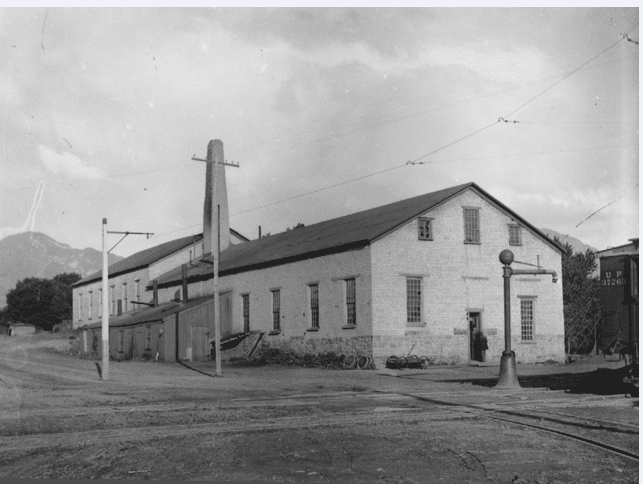
Sugar Mill in Sugar House
A Sugar House that never produced sugar: How initial attempts failed, but in the end produced a huge industry from which Utah would greatly benefit.

Sugar House is an area in Salt Lake City that is full of bungalow houses, parks, tree-lined streets and a community of mostly liberal, yuppie-types who drive their Subaru wagons to Whole Foods to buy overpriced organic goodies.

But the “Sugar House” name isn’t a marketing ploy to attract yuppies. The area offers a rich history dating back to one of the first Mormon Pioneer business endeavors.

Sugar House pays homage to an actual sugar factory that was ordered to be built by Brigham Young in a first attempt to produce granular sugar from sugar beets.

For the first 20 years the Mormons were in the Salt Lake Valley, sugar was a rare, expensive commodity approximately $35.81 per pound in today’s dollars.

In Pioneer times it would have been common knowledge that Napoleon Bonaparte began the world’s first sugar beet processing in 1811. Prior to this innovation, sugar had to be extracted from sugar cane. Other sweeteners were used in the form of molasses made from beets or sorghum.

The sugar beet production process required the use of CO2, lime and bone char to remove the impurities from beet juice. The French were the first to utilize a vacuum chamber that could lower the boiling temperature of purified syrup, making it possible to crystallize syrup into granular sugar.

This was a modern marvel in the 19th Century and the industrious Mormon Pioneers saw dollar signs when they considered what a benefit it would be to produce the first sugar in the quickly-growing Western United States.
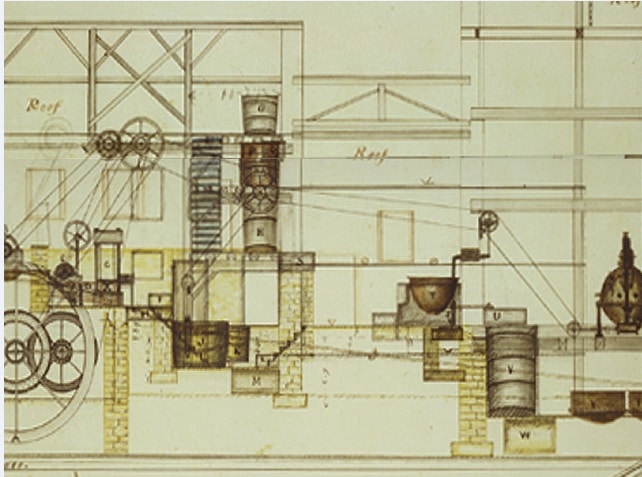
Sugar Mill plan

Brigham Young ordered John Taylor and Phillip DeLamore to head the Deseret Manufacturing Company (DMC), and sent them to learn sugar production in France. Taylor purchased the equipment in Liverpool and made arrangements to have it shipped across the Atlantic to New Orleans. They had to haul 10 tons of equipment, but found their wagons insufficient, so they bought a team of Santa Fe Prairie Schooners.

Young also ordered a building constructed that would be used to process the sugar beets. It was efficiently built beets go in one end, sugar comes out the other. Unfortunately, turning beets into sugar proved much more complex than anyone imagined.

First, there were problems hauling the enormous equipment over the mountains. The vacuum pan, which was estimated to weigh over six tons, had to be abandoned in Logan canyon over the winter.

Once the Mormons were able to move the vacuum pan, they began working on calibrating the process.

After months, sugar still wasn’t being made, and Young removed Taylor from the job and took over operations himself. Young moved all the equipment just outside of his estate near Temple Square so he could directly supervise the process. Wilford Woodruff cheered Young on and believed strongly that if anyone could make sugar it would be the Prophet. But Young also failed.

In the end, the Mormons produced a sugar that would “take the end of your tongue off.” Brigham Young would not live to see sugar produced in Utah, but his successor, Woodruff, re-established the effort thirty years later.
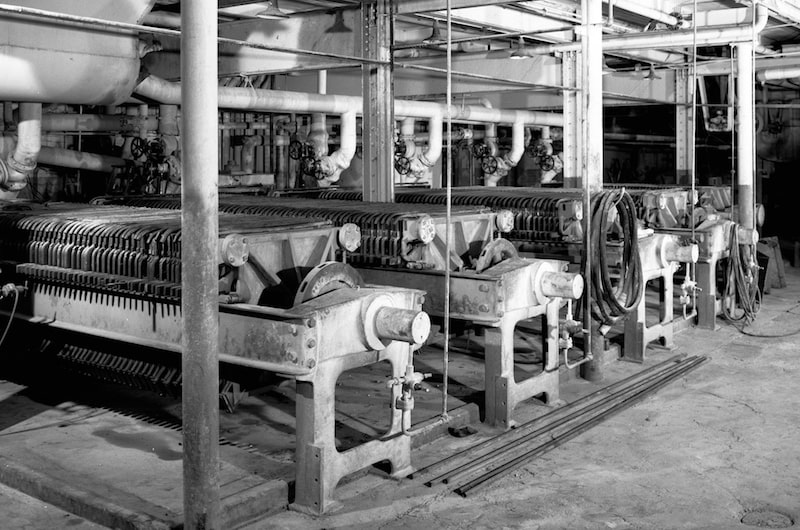
Sugar press in Garland, Utah.

Woodruff, along with Heber C. Grant, raised $100,000 a fortune at the time from the wealthiest Mormon businessmen to revive the sugar business. After hiring a sugar technology specialist, they built a $400,000 factory in Lehi, Utah. Known as Utah & Idaho Sugar, the new factory was capable of processing 1000 tons of beets into sugar per day. 

Later, U&I Sugar faced charges of price fixing and monopolistic practices by the U.S. Justice Department.

Over time, the LDS Church sold the majority of their interests in U&I sugar to church members. But for nearly 100 years, sugar beet farming became the perfect industry for sustaining LDS families with an abundance of children.

Read more about the Sugar Beet industry in Utah in Matthew Godfrey’s book Religion, Politics, and Sugar: The Mormon Church, the Federal Government, and the Utah-Idaho Sugar Company.

A version of this story ran in Utah Stories 2009.

Subscribe to Utah Stories weekly newsletter and get our stories directly to your inbox

* indicates required


, ,


Join our newsletter.
Stay informed.


  • The End of an Era? FanX and the Salt Palace Closure

    For more than a decade, FanX has called the Salt Palace home. With the convention center set to close for a massive renovation, founder Dan Farr is preparing for a new chapter while planning one final celebration in its longtime venue.


  • The Stratos Project and Corporate Power: Who Controls Utah’s Future?

    If we were all just consumers, Governor Cox, Mike Lee, Speaker Schultz, and Kevin O’Leary would have it easy. If we were just more concerned about money, jobs, and tech, and less concerned about raising our kids in communities (not in front of screens), culture, the environment, and water, those smart dudes would get exactly what they want — Stratos: a city of the future, buzzing with processors and transistors, making all of our AI dreams come true! 

    The world we could live in would be a dazzling, Mr. Wonderful kind of place. We would beat those pesky Chinese in the AI war; our AI robots could do all of our farming and ostensibly harvest the water we need for the Great Salt Lake out of thin air. But apparently, we just don’t get it. We haven’t yet reached the point predicted by Aldous Huxley’s vision in Brave New World, where we are completely distracted, dopamine-driven consumers who only need sex, drugs, and stuff to remain happy.

    Maybe Stratos will be an amazing marvel, and somehow, as Governor Cox claims, “. . . add more water to the Great Salt Lake.” But we aren’t sold. While this Stratos project has received considerable attention, it’s worth taking a step back to attempt to understand how corporate power appears to have usurped civic power.

    Civics is the practice of shaping our society through our collective voices and community involvement. Ask the residents in Tremonton, Utah how well that is working out for them. Can we still shape our world through our elected leaders? Does it matter who we vote for at the ballot box if organizations like UDOT, UTA, and MIDA can supersede our local government authority and citizen backlash? 

    The corporatization of our communities and the interests that impact our political leaders’ decision making processes are seen as far more of a concern than the average Utah resident’s concerns. Special interests and corporate power are shaping Utah’s future more than ever. 

    It’s worth asking: ‘How can we regain control over shaping Utah’s future in light of the growing power and billions that the technocrats now wield in shaping our world today?’ Amazon’s market cap exceeds the GDP of Canada. The “Magnificent Seven” tech stocks now have a greater market cap than the entire GDP of Europe ($23.6 trillion. EU countries have $19.3 trillion GDP). Will tech companies become their own nation-states and dominate their own chunks of various states? Will we become their subjects?

    There are two sides to this coin: We love Utah not just because we have the most outdoor wilderness playgrounds, but also because of Utah’s prosperity and job market. This is because Utah has become a tech hub. Our tech leadership has minted several billionaires and billion-dollar businesses. Utah offers a market and an educated workforce that more businesses and giant corporations want to be a part of. This is a benefit for even non-tech Utahns.

    The problem with this success is that as we dole out more money to attract more tech businesses, data centers, fulfillment centers, and big corporate retailers, it becomes more difficult to carve out our “sense of community.” As corporate sovereignty replaces local business sovereignty, we see that our voices and our votes matter less.

    Ask who our politicians work for, and nearly every Utahn believes they work far more for their corporate donors than they work for the average Utah citizen. So how do we best regain control over our communities?

    Continue reading and support independent Utah journalism with a purchase of Utah Stories (Digital + Print) or 3 month free trial (Digital).


  • What Happened to the Rose Garden at Sugar House Park?

    A rumor began circulating that the beloved rose garden in Sugar House Park was about to be ripped out. The person telling the story was upset, even angry that yet another beautiful feature of the park was supposedly on the chopping block. From there, the rumor traveled the way neighborhood gossip always does. It bounced between coffee shops, dog walkers circling the park’s paved path, and conversations on sidewalks throughout the Sugarhouse neighborhood.

    There was just one small problem:


  • Salt Lake City’s Billion-Dollar Dreams While Seniors Struggle to Eat

    Salt Lake City is dreaming big: new arenas, convention space and a billion-dollar downtown transformation. A few miles away, seniors are saving leftovers for tomorrow’s dinner and wondering how much longer they can afford their homes. What do those two realities say about our priorities?