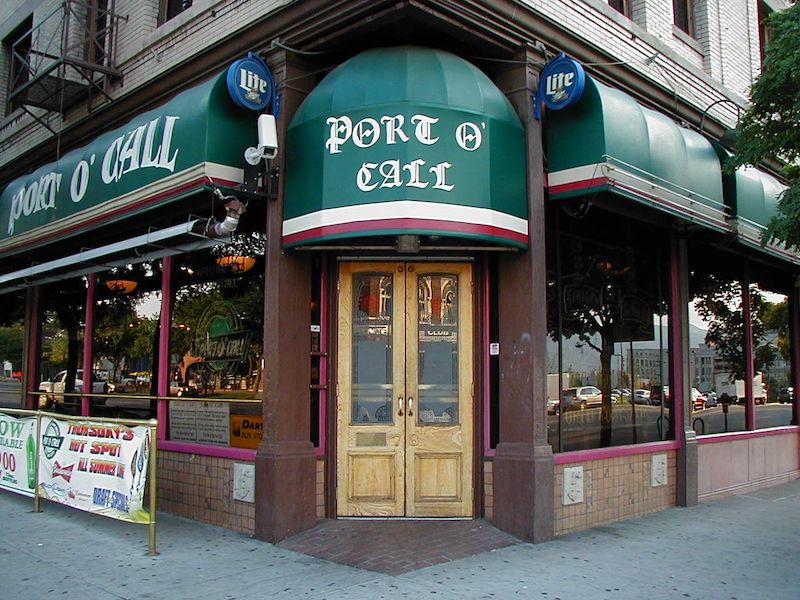
The hidden story behind why Salt Lake City’s most iconic bar of all time was replaced by a Borg cube.
The GSA (Government Services Administration) decided in September 2006 that they would demolish one of Salt Lake City’s most popular non-Mormon destinations to assemble a massive cube-like building: a Federal Courthouse that looks just like the Borg spaceship from Star Trek: the Next Generation.
Was this a little more than a subtle message to all non-Mormons that “resistance” is indeed futile? Or was it just an unfortunate coincidence?
Housed on that block was this historic Shubrick building, as well as the historic Odd Fellows Hall building, the buildings were home to local businesses like Bikini Cuts, The Galley, City Weekly, and the massively outrageous 4-story bar, Port O’Call.
Raging most nights with two live bands and a DJ on weekends, four bars churned out drinks at a dizzying speed using a staff of up to 50 people serving well over 2,000 customers on a big Friday night.
Port O’Call offered a night-life that partiers and music lovers would never forget: The Port O’ Call bar dominated downtown’s admittedly less than stellar nightlife. It was a babe magnet, a stud magnet, a dorky people-watcher magnet, and a celebrity magnet. Nobody could resist the pull of its tractor beam. But its shields would be no match for what was to come.
Throughout the 2002 Olympics, Port O’Call showed the world that Salt Lake City knew how to host a party. Under the temporary relaxation of Utah’s strict liquor laws, Olympians and corrupt IOC members’ kids getting free tuition at the UofU could get sloshed for three weeks. At Port O’Call and other Salt Lake City bars, private club laws were put on a temporary hold thanks to former Governor Jon Huntsman Jr.
Port O’Call was a place where Utahns could sail away to a far-off Neverland where drinking a beer no longer felt like a sin, but a sacrament.
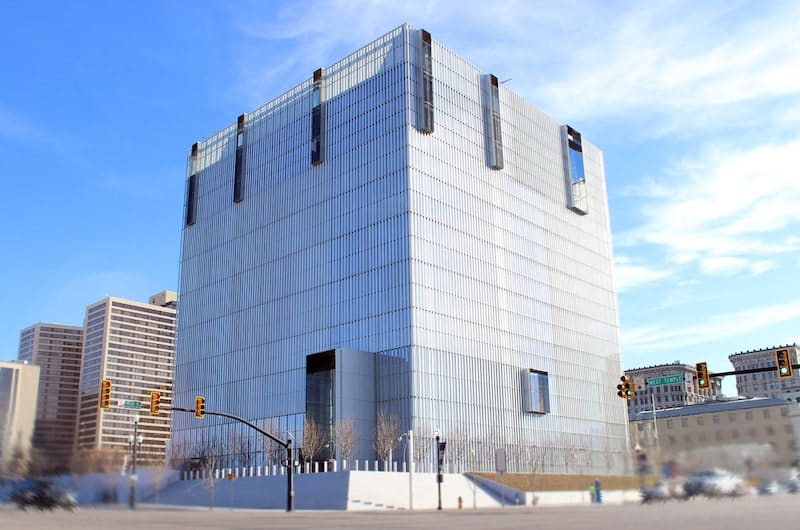
So why would it ever become the target for a new federal courthouse? Of all the places in downtown Salt Lake City, why would they choose the block housing by far Utah’s largest, most successful, most historic bar? Would even the aliens be so insensitive if they needed to park their spaceship directly atop the coolest bar in Utah? I doubt it. So how and why did this happen?
The owner of the Port O’Call, Kent Knowley, received a letter in the mail informing him that the building and business that represented their entire fortune and life’s work would be acquired by the federal government. He said ‘No thanks’. Then the Feds began offering the buildings’ other tenants bribes to relocate. Then Knowley had to fight a court battle to receive $7.5 million (far less than actual market value) to relocate Port O’Call elsewhere.
But why this particular block? I called the GSA back then, and they told me that they considered three other locations but this was the best spot. No LDS-owned land was considered (even though there were empty lots available), but acquiring a non-Mormon bar owner’s land was fair game, so of course, the site was chosen.
Port O’Call would be shuttered and the building would be razed. That’s polite lingo for getting the boot and the wrecking ball, and watching your dreams go down in a pile of rubble.
The gaping hole in Salt Lake City’s nightlife in 2009 was clearly felt. But the bar scene would begin a new era thanks mostly to the five managers from the Port O’Call starting their own bars: Gracie’s, Green Pig, Dick & Dixie’s, etc. It’s worth reflecting on such an institutional legacy.
Looking back after twenty years, Mitt Romney and Jon Huntsman became gods and received all of the credit for hosting and bringing the world to Utah. But it was the non-LDS business owners who showed the world we weren’t as wired as the world might have thought.
But still the hidden answer to our question remains: Why?
We could speculate all day, but we don’t know. Likely, Bob Bennett and Orrin Hatch knew, but if they did, that knowledge is buried with them.
Almost fifteen years later, it still feels wrong that we traded our Port to Neverland for a Borg cube. If a sleuth wanted to sift through government emails,he could likely find the money trails, Asian massage receipts, fancy dinners and kick-backs that were all facilitated via a Good Ol’ Boys Club wanting to control our culture.
Welcome to Utah!
RELATED CONTENT
Now and Then: Decades of Dive Bars in Utah
A Tour of Bars, Breweries, Speakeasies, and Pubs in Ogden
The Rise of Green Pig Pub: Bridget Gordon Carves a Niche in Salt Lake’s Male-Dominated Bar Scene
SUPPORT LOCAL JOURNALISM AND SUBSCRIBE TO PRINT MAGAZINE
Subscribe to Utah Stories weekly newsletter and get our stories directly to your inbox