
Utah Stories

Did Salt Lake City Mayor Erin Mendenhall Lie to the Homeless People?

Salt Lake City’s Unofficial Homeless Mayor to Mayor Mendenhall, “You Lied to Me!” Yet another Salt Lake City homeless camp is “abated” and the unsheltered homeless try to scatter to find shelter in 100-degree heat. The media were not allowed to take photos or videos of what was transpiring just after the health department began…

|


Having to lose all their possessions all over again. Homeless camp abatement on Thursday, July 7th. Photo by Robin Pendegrast.

Salt Lake City’s Unofficial Homeless Mayor to Mayor Mendenhall, “You Lied to Me!”

Yet another Salt Lake City homeless camp is “abated” and the unsheltered homeless try to scatter to find shelter in 100-degree heat.

The media were not allowed to take photos or videos of what was transpiring just after the health department began its efforts.

“I’ve been moved out probably twenty-five times,” said camp leader Stacey Johnson who was distraught on Thursday over the prospect of being required to move her very small trailer, her dog, and her few belongings yet again. Johnson was the organizer of Fort Pioneer, which was a very successful homeless encampment under the freeway, with what she says were 300 individuals who got along well, and 50 campers who went to work every day.
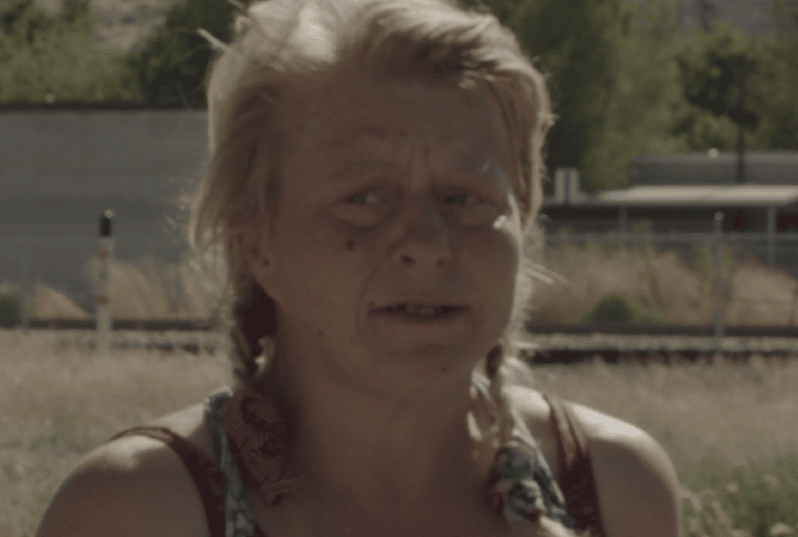
Stacey Johnson, the leader and unofficial SLC homeless mayor.

When I asked Stacey what she would say to Salt Lake City Mayor Erin Mendenhall regarding her situation she said,  “You lied to me so many times! You know there is no way we can get any housing, you know because you keep stopping it”

When I asked how Mayor Mendenhall lied, she said that she was told by Mayor Mendenhall when she visited Fort Pioneer, that the camp would not be abated. One week later, Stacey said the city and health department showed up with front-end loaders to bulldoze the people out.

Mayor Mendenhall’s office responded by saying that they never provided Johnson any assurance that Fort Pioneer would not be abated. They also said that the camp kept expanding to the point it became far larger than its original size, and the city must obey the state ordinance which does not allow for public camping.

Johnson works directly with volunteer agencies such as VOA and others to assist the homeless people living in the camps in getting the basic provisions that they require.
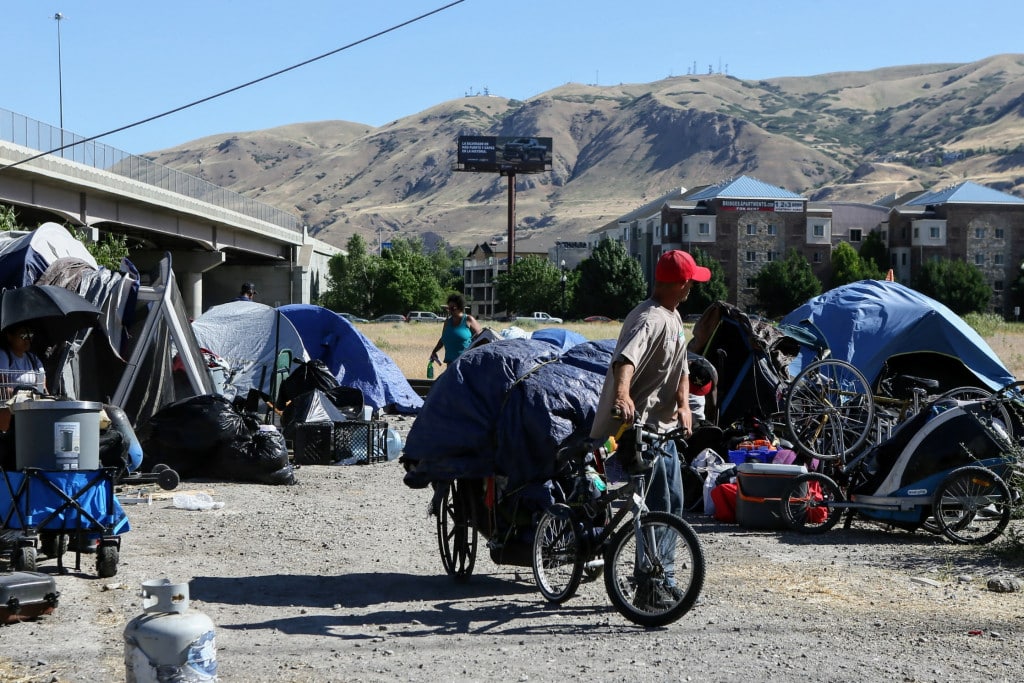
Homeless camp abatement on July 7, 2022. Photo by Robin Pendegrast.

Garbage was piling up at the camp located at 700 West and 230 South, butted up against Union Pacific property and city property. Despite arrangements being made to arrange for a dumpster and a porta-potty into the location, it was too late and the Salt Lake County Health Department along with the Salt Lake City Police Department had already determined to abate the sight.

Robin Pendergrast, who is a New York Times and Getty Image photographer, captured an image that appeared in the New York Times with that abatement. The sign read, “We are Human.” Pendergrass said that “That is emblematic of the treatment that these people are facing.” They are not being treated like humans. And it’s absolutely shameful to witness this treatment among such an affluent population. Pendergrass describes what he has witnessed on the Utah Stories Show. He said recently he witnessed an elderly gentleman named Joe pass away from heat exposure. Indeed the third-world conditions in one of the fastest-growing, most successful cities in the U.S. was difficult to fathom.

Homeless camp abatement on July 7, 2022. Photo by Robin Pendegrast.

This was my first time witnessing an “abatement” in progress. There were around a dozen Salt Lake City police officers present, along three front-end loaders, four dump trucks, and another dozen County Health Official workers. The officers were wearing numbers instead of name tags on their shirt pockets. Officer O25, moved us off of the property when he declared, “We need everyone who isn’t cleaning up to get out of the way. I know you are trying to be a hero, so you can get your Facebook likes, but you will need to move.”

The officer’s snarky remarks, along with this aggressive attitude to move us out of the way preventing us from getting any more revealing shots, demonstrate either his orders or the general sentiment towards media attention of these abatements: nobody wants to be recorded kicking people out of a place who literally have nowhere else to go.

Officer O25 and the health department official who refused to be recorded or photographed, said that all of the services of the city have been reaching out to these people to try to help them. “They have been offered services again and again. But how do you give something to someone who doesn’t want it?” He claimed there was space in the Salt Lake City Homeless Shelters and that there were caseworkers on hand to help addicts or help people find work.

These claims run contrary to our interviews with homeless individuals. “I would lay down on the ground and swear with my life, nobody has come here offering to be my case worker, or offering to help me get into a shelter.” said a woman who goes by Sharon.

Mayor Mendenhall’s homeless PR Director, Andrew Johnson said that they have been in talks with state officials about possibly organizing a city-sanctioned camp, but he says that securing funding for the site is problematic because currently there isn’t any additional money to pay for it. Johnson also said that allowing the homeless to set rules and guidelines for their own camp, has not been a proven workable model. They would need to hire professional staff, and they would need to both secure the land and secure funding to do this, and as of now, the state does not want to contribute funding for this.

WATCH THE VIDEO

RELATED CONTENT

Utah Homelessness Getting Out of Control: What are the solutions?

If Salt Lake City’s Homeless Had a Say in The over $20 Million Spent on Them

Homeless in Salt Lake City: The Worsening Conditions of the Chronically Homeless and Those Suffering from Mental Disorders

Homeless Advocate Claims SLC Mayor Has a Conflict of Interest in Handling Homeless Situation

Why Is the 600% Increase in Homeless Spending Resulting in More Homelessness in Utah?


SUPPORT LOCAL JOURNALISM AND SUBSCRIBE TO PRINT MAGAZINE


Subscribe to Utah Stories weekly newsletter and get our stories directly to your inbox

* indicates required


Join our newsletter.
Stay informed.


  • Artist Kate Kilpatrick Brings Utah’s History to Life Through Murals

    “I think we’re all interconnected; as individuals as well as societies,” Kilpatrick notes. Her work showcases those connections exuberantly, and whatever scale she’s working on, you can bet that in terms of energy and spirit, she’s painting large.


  • Why Most People Stay Stuck in Business and What It Takes to Move Forward

    Every so often, you meet an immigrant who came here with almost nothing and managed to build something exceptional.

    Prakash Shah is the kind of man who has spent enough time around risk that he no longer treats it like an interruption.

    Today, he works in business brokerage and advisory, helping owners sell companies, helping buyers decide whether they should step in, and, when the fit is right, helping connect those buyers with private equity. He works in a world of valuations, leverage, due diligence, and hard questions that most people would rather postpone. He also operates in Utah real estate and has built a career around seeing value before it is obvious to everyone else. That is who he is now. What makes him interesting is how early that instinct started to form, and how little his life resembles the way most Americans are raised to think about comfort, career, and security.

    He grew up in Nepal in a boarding school system that would feel severe to many Americans. He was an only child, yet he saw his parents only twice a year for twelve straight years, until high school graduation. He lived inside routine. He shared space with boys from different social classes and different family circumstances. The school was structured enough that money did not buy you any special standing once you were inside. Everyone followed the same rules. Everyone was subject to the same discipline. In his case, it was an army school. Everything was measured. Everything was scheduled. In that kind of environment, you do not build your life around preference. You build it around adaptation.

    That contrast matters.

    A lot of American children are raised to search for what fits them. What are you passionate about? What do you enjoy? What feels right? Those are not bad questions, but they can create a habit of waiting for life to align itself before action begins. Prakash learned something else much earlier. He learned that life often does not align itself first. You enter the room as it is, you deal with the people in it, and you figure out how to function without making your comfort the center of every decision. He said that one of the biggest lessons from those years was tolerance, the ability to live with people from all walks of life and genuinely learn to get along with them. That is not a soft value. In business, it turns into resilience. In negotiation, it turns into patience. In career terms, it turns into range.

    When he came to the United States over 25 years ago, he did not arrive with the kind of runway that allows for a prolonged identity search. He came with two suitcases and enough money for one semester. He went to Hunter College in New York City, then to NYIT near Central Park, studying media and then media and technology management. He also studied psychology. Those details matter because they show something about his mind. He was interested in people before he built a career around deals. Even then, what attracted him was not technical prestige. It was understanding motives, behavior, and how people reveal themselves.

    But New York is merciless toward vague ambition. It demands payment in rent, transit, food, and time.

    Prakash worked constantly. He took multiple jobs. He paid tuition, paid rent, and skipped most of what Americans imagine as college life. There were no romantic years of drifting from café to concert to self-discovery. He talked about not having the luxury of dates, travel, or finding himself. He was working. Even laundry was not a small detail. In New York, he pointed out, you do not just throw clothes in a machine at home. You haul them to the laundromat, count quarters, and measure what is necessary. He also described distraction in a way that most native-born Americans probably do not think about. For immigrants, distraction is not always pleasure. Sometimes distraction is the constant pressure of competing needs. Tuition or rent. Food or savings. A better coat or another month of making do. He was not romanticizing the struggle. He was describing the arithmetic of it.

    That arithmetic did not make him cautious. If anything, it did the opposite.

    While in college, he had the option of safer analytical work. Instead, he took a sales job with Time Warner Cable that sent him into the South Bronx from 6 p.m. to 10 p.m. to knock on doors. He is not a physically imposing man. He knew exactly what kind of neighborhoods he was walking into. He described apartment buildings where people kept pit bulls, where tension was normal, where one mistake in tone or timing could end a conversation immediately. For most people, that kind of job would have been something to survive and forget. For him, it became a school in human behavior. “It’s not about talking… it’s about listening,” he said.

    One story from that period says almost everything about how he operates. He knocked on a door one night around 8:45 and found himself facing a huge man with a gun on the table, pit bulls nearby, and a half-eaten pizza in front of him. It had all the ingredients of a very bad scene.

    Continue reading and support independent Utah journalism with a purchase of Utah Stories (Digital + Print) or 3 month free trial (Digital).


  • Ancient Pyramid Discovered in Sugar House Park, Salt Lake City

    A Salt Lake City resident says he may have uncovered what he believes to be a buried structure beneath a well-known hill in Sugar House Park, raising questions that have drawn both curiosity and skepticism.


  • Utah Fits All Scholarship Applications Open Through April 30 for K–12 Students

    Utah families have more learning paths than ever and, increasingly, more ways to make those paths affordable. This spring, the Utah Fits All Scholarship opened  for new family applications on April 1, and the application window stays open for one month. The program is a public K–12 scholarship that provides $4,000 to $8,000 per student,…