Healthy Utah

Suspicious skies: Is Our Planet Being Inundated with Unknown Substances without Our Consent? 

Chemtrails have been widely shouldered into the category of conspiracy theory — the notion that the government has long been involved in clandestine programs aimed at weather modification for the purposes of solar geoengineering, cloud seeding, psychological manipulation, population control, chemical and biological warfare tactics, is absolutely crazy, right?  

|


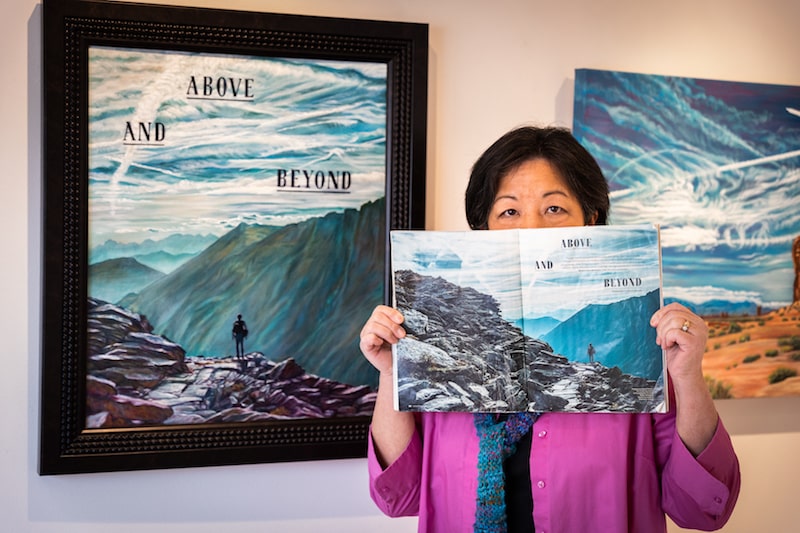
Susan Riedley became fascinated with contrails and incorporated them into her art work.

Weather modification and cloud seeding: is it really that hard to believe?

If you think those long white lines left in the wake of passing airplanes scoring the sky from ear-to-ear are noticeably thicker, longer, and remain for a longer duration than they did twenty or thirty years ago, you’re not alone. A growing number of people are looking skyward and wondering:

What’s going on up there?

That’s exactly what happened to artist Susan Riedley.

Instead of looking down at her phone, Riedley is often looking up to catch a glimpse of a bird, a cloud, a falling star. Her fascination with the above and beyond has remained with her since childhood.

Several years ago, while living in California, she began noticing more and more of the line-shaped clouds known as contrails, which are produced by aircraft exhaust, criss-crossing and covering more of the sky, more frequently. But something seemed off.

“I would take the time to watch the ejection, the process of the dispersion, the rippling waves of matter and the gravity pulling that matter down to earth along with the subsequent haziness,” she said. “Basic observation caused me to conclude that these were fundamentally and physically different from the contrails I knew and recognized.”

It was then she realized she wanted to start talking about it because of the many implications and lasting consequences.

“We need the air to be clean. We breathe it, our children inhale it, our pets, wildlife, everything is affected [by the quality of the air],” she said.

Chemtrails have been widely shouldered into the category of conspiracy theory — the notion that the government has long been involved in clandestine programs aimed at weather modification for the purposes of solar geoengineering, cloud seeding, psychological manipulation, population control, chemical and biological warfare tactics, is absolutely crazy, right?
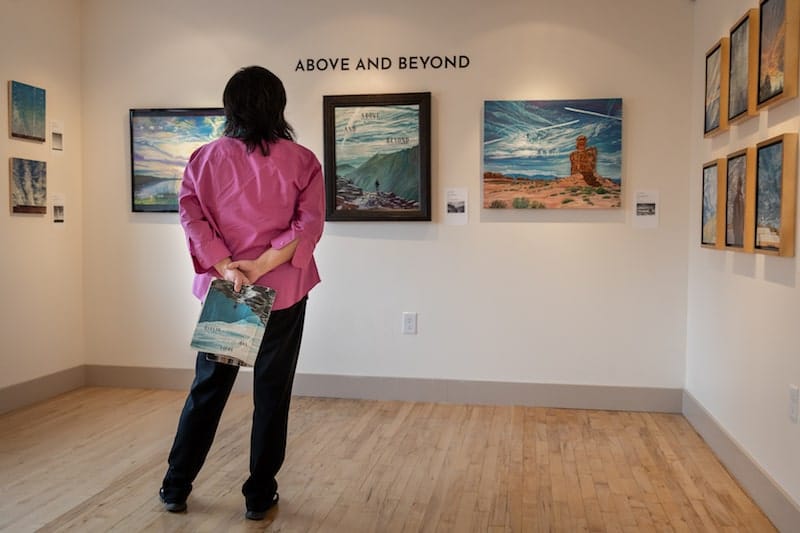
But how do you have a meaningful conversation? How do you ask honest questions about a subject so polarizing that it has already been preemptively discarded as conspiratorial rubbish?

Riedley said,“If someone wants to throw the label ‘conspiracy theorist’ my way, I won’t waste my time wrestling with a closed mind.”

Instead, she is trying to have that conversation via her art.

“This is my attempt to say something I feel needs to be said,” she said of her art show, Above and Beyond, which she considers a Public Service Announcement, currently announcing at Bountiful Davis Art Center in Bountiful, Utah, through February 20.

She paints images of the sky criss-crossed with cloud trails from photographs, even paused scenes from television shows and movies.

“Each [painting] is paired with the source images on the title labels,” she said. “I want people to see that my art is made with my eyes, not my imagination.” Literally, she paints what she sees, albeit with a dab of pretty color here and there.

She doesn’t claim to be an authority, an expert. She’s just an observer. All she wants is people to look up, think, then decide for themselves, because it is far easier to reject an idea that falls outside the status quo, a certain way of thinking, as conspiracy theory, than it is to confront uncomfortable possibilities.

Subscribe to Utah Stories weekly newsletter and get our stories directly to your inbox

* indicates required


,

Join our newsletter.
Stay informed.


  • Chronic Disease in America: Treating Too Late, Prescribing Too Much

    Every January, Americans reflect on the year behind them and draft a familiar list of resolutions. Eat better. Lose weight. Exercise more. Reduce stress. These intentions recur not because people lack discipline, but because the underlying health conditions driving them persist.

    Despite unprecedented medical spending and pharmaceutical access, the United States remains chronically unhealthy. According to the Centers for Disease Control and Prevention, more than 76 percent of US adults live with at least one chronic condition, and over 51 percent live with two or more. The most prevalent conditions are well documented. Heart disease remains the leading cause of death, accounting for 680,981 deaths in 2023, while obesity affects more than 40 percent of US adults. Diabetes impacts 38.4 million Americans, and nearly half of adults have hypertension, a major contributor to stroke, kidney failure, and heart disease.

    Treatment typically begins once disease is clinically apparent, and often relies on pharmaceuticals. Over time, this approach can lead to polypharmacy, the use of five or more medications. Patients with chronic illness frequently average two to four comorbidities, each managed independently, increasing the likelihood that side effects from one medication require another.

    To access this post, you must purchase Utah Stories (Digital + Print) or 3 month free trial (Digital).


  • Why We’re Less Healthy Than Our Parents and What Happened

    Something has gone wrong with our health. Each generation appears sicker than the one before, despite spending more on medicine than any society in history. At the same time, trust in once-authoritative sources of health guidance has eroded as pharmaceutical advertising increasingly blurs the line between reporting and recommendation. This piece examines how lifestyle, food, and institutional incentives reshaped our understanding of health—and why reclaiming it may require more courage than another prescription.

    To access this post, you must purchase Utah Stories (Digital + Print) or 3 month free trial (Digital).


  • A Salt Lake City Gym Uses Fitness and Community to Support Addiction Recovery

    “What I think is really special about that place is that doing hard things is a way that we can become proud of ourselves,” said nursing student Vince Minutello, who has started exercising at the gym in Salt Lake City as a requirement for one of his courses.


  • How I Lost 120 Pounds and Changed My Relationship With Food

    Throughout most of my life, I used food to cope with chaos, depression, and pain I did not yet understand. By my early twenties, I weighed over 320 pounds and felt trapped in a body that limited every part of my life. This is the story of how learning about food, mental health, and habit-building helped me lose 120 pounds and rebuild stability.