Utah Stories

Homeless Millennials—Weighing In On Big Changes to City Programs

Since the Center is now full I asked Tarintino if he feels lucky to be there. “Not lucky. Blessed. I feel blessed for all of the donors. I feel blessed to be in a place I feel comfortable and safe.”

|


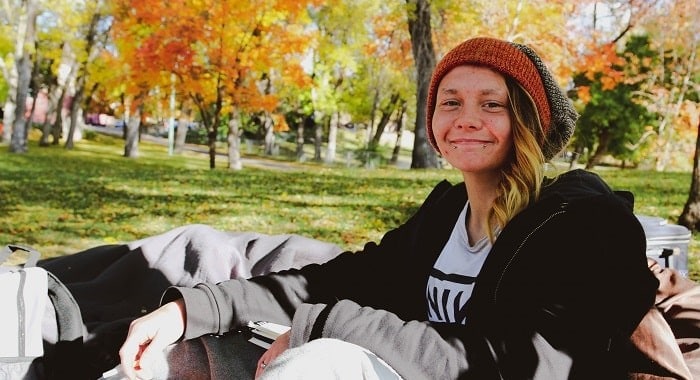
“Jessica” Photos by Richard Markosian.


A resource center is not a homeless shelter, and that helps explain their $63 million price tag. Was this a good investment? We will get to that later in the story, but first I would like to know: What do young homeless people think about these new centers?

Fairmont Park

“Jessica” is a homeless millennial. She says she is “homeless by choice.”

“It’s the choices I made that resulted in me being without a home. My Dad couldn’t deal with me, so he kicked me out.” Jessica is a heroin addict, which she has under enough control to maintain a good conversation. She is articulate, lucid and thoughtful. It really doesn’t seem she should be here in Fairmont Park on a chilly fall afternoon.

If she were working at any of the Sugar House area businesses or walking around, it would be hard to peg her and her boyfriend as being either homeless or addicts, but they are just that. What does she think about the Road Home closure?

“I would never go there. I don’t like Pioneer Park, the cops are way too rude. They have made it essentially illegal to simply hang out there at all. Their discriminatory actions have driven everyone away. It seems like a good idea that they closed the Road Home, I personally would never stay there.”

Jessica’s boyfriend stirs a few times in our conversation. He is passed out. “It’s getting damn cold right now. We are heading to California soon to get a fresh start.” As we are talking a chubby squirrel approaches within a few feet of us. “Is that guy a friend of yours?”

“Yea, that’s Chubs. I feed her. You can see she gets plenty to eat. The other squirrels are stealing from her, and she’s too chubby to chase them now.”

Jessica’s laugh and smile describing Chub’s dumbfounded expression when the squirrels are stealing from her is priceless. Since her boyfriend was asleep, I set out to catch up with them another day.

Three Days  Later

I returned three days later to find that Jessica’s boyfriend had been arrested for a warrant for breaking parole. “I guess I don’t know what I’m going to do now. We were going to head to California. Now he is going to be in prison for a while; it could be a long while. I really have no idea where I’m going to go.”

Jessica is drawing an elaborate letter “J” for her friend. It’s colored and shaded. She obviously has some artistic talent. “Why don’t you go and use the resources?”

“Yea, that’s what they keep telling me. ‘Use the resources’, ‘enroll in our program’; ‘give us all your personal information’. Why is everyone so eager for me to sign up? What’s the deal here?”

I suggest that likely they want to help her because she is so young. I find out Jessica is 23. I also learned that her mother was a drug user when she was pregnant with her and that she lost custody of her when her parents divorced when she was very young. Her father is an alcoholic and her brother is serving time as an alleged sex offender. I commissioned her to draw Chubs the squirrel for me. I also found out that she has more “family” in Fairmont Park, and they don’t readily accept outsiders into their group. Another young man is sleeping beside her.

Memory Grove

I visited Memory Grove. Above the Park there is an area notorious for “urban campers” and I have heard that there were several groups staying here. I walk around and find many camps, with sleeping blankets and garbage but no people. Down at the base of the camp, I find a young couple from Cheyenne, Wyoming, “White Wolf and Andrea”. They arrived in Salt Lake City three months ago. White Wolf was active duty Army and served in Iraq. He said that his dad kicked him out of his house. But he said that when he and his girlfriend attempted to find beds in the new resource centers they were told, “It’s all booked and there are no more beds.”

He says he knows how to stay inside of “an old sewer tunnel if needed”. He actually doesn’t mind that. “I would like to find out how to get my ID, but I’ve been sent on a wild goose chase.” Their little hideout isn’t easily visible, but they said with the cold setting in their routine is now sleeping all day and walking around all night to stay warm. I tell them I’ll try to find out some information about how they can get a bed.

Gail Miller Resource Center

The Gail Miller Resource Center is an immaculate building. Walking inside, the staff is happy the residents are friendly. I asked Daren Tarentino about how he would compare the new center to the old Road Home. “There really is no comparison. This place has comfortable beds, hot showers.” He said that the Road Home’s beds were notoriously hard and it was impossible to get a hot shower because the water was always left on.

“Cowboy”

An African-American man going by the name of “Cowboy” echoed Daren’s sentiment. He says that he is getting all of the resources he needs to be comfortable. I asked both men about the help they are receiving to find jobs. Daren says that every day they present them job listings. “There are openings at Lowes, Little America, Grand America…They show you these listings, but that is about it.” He added that the only major downside is that in order to maintain a bed reservation he needs to check in both in the morning and again between 5-7 PM. “It really takes a lot of the time I could otherwise be spending doing other things, like looking for a job.”

Since the Center is now full I asked Tarintino if he feels lucky to be there. “Not lucky. Blessed. I feel blessed for all of the donors. I feel blessed to be in a place I feel comfortable and safe.”

, , , ,


Join our newsletter.
Stay informed.


  • Artist Kate Kilpatrick Brings Utah’s History to Life Through Murals

    “I think we’re all interconnected; as individuals as well as societies,” Kilpatrick notes. Her work showcases those connections exuberantly, and whatever scale she’s working on, you can bet that in terms of energy and spirit, she’s painting large.


  • Dyslexia and ADHD in Kids: Why Some Students Struggle to Read in School

    That’s what led to my conversation with Donell Pons, a Utah-based dyslexia expert who has spent more than two decades working with students who struggle to read. What struck me right away is how often we get the problem wrong from the start.


  • A Ski Village or a Tipping Point? Nordic Valley Expansion Divides Ogden Valley

    The project, known as Nordic Village, is expected to roll out over the next decade and represents one of the largest tourism developments in the valley’s history.


  • Why Most People Stay Stuck in Business and What It Takes to Move Forward

    Every so often, you meet an immigrant who came here with almost nothing and managed to build something exceptional.

    Prakash Shah is the kind of man who has spent enough time around risk that he no longer treats it like an interruption.

    Today, he works in business brokerage and advisory, helping owners sell companies, helping buyers decide whether they should step in, and, when the fit is right, helping connect those buyers with private equity. He works in a world of valuations, leverage, due diligence, and hard questions that most people would rather postpone. He also operates in Utah real estate and has built a career around seeing value before it is obvious to everyone else. That is who he is now. What makes him interesting is how early that instinct started to form, and how little his life resembles the way most Americans are raised to think about comfort, career, and security.

    He grew up in Nepal in a boarding school system that would feel severe to many Americans. He was an only child, yet he saw his parents only twice a year for twelve straight years, until high school graduation. He lived inside routine. He shared space with boys from different social classes and different family circumstances. The school was structured enough that money did not buy you any special standing once you were inside. Everyone followed the same rules. Everyone was subject to the same discipline. In his case, it was an army school. Everything was measured. Everything was scheduled. In that kind of environment, you do not build your life around preference. You build it around adaptation.

    That contrast matters.

    A lot of American children are raised to search for what fits them. What are you passionate about? What do you enjoy? What feels right? Those are not bad questions, but they can create a habit of waiting for life to align itself before action begins. Prakash learned something else much earlier. He learned that life often does not align itself first. You enter the room as it is, you deal with the people in it, and you figure out how to function without making your comfort the center of every decision. He said that one of the biggest lessons from those years was tolerance, the ability to live with people from all walks of life and genuinely learn to get along with them. That is not a soft value. In business, it turns into resilience. In negotiation, it turns into patience. In career terms, it turns into range.

    When he came to the United States over 25 years ago, he did not arrive with the kind of runway that allows for a prolonged identity search. He came with two suitcases and enough money for one semester. He went to Hunter College in New York City, then to NYIT near Central Park, studying media and then media and technology management. He also studied psychology. Those details matter because they show something about his mind. He was interested in people before he built a career around deals. Even then, what attracted him was not technical prestige. It was understanding motives, behavior, and how people reveal themselves.

    But New York is merciless toward vague ambition. It demands payment in rent, transit, food, and time.

    Prakash worked constantly. He took multiple jobs. He paid tuition, paid rent, and skipped most of what Americans imagine as college life. There were no romantic years of drifting from café to concert to self-discovery. He talked about not having the luxury of dates, travel, or finding himself. He was working. Even laundry was not a small detail. In New York, he pointed out, you do not just throw clothes in a machine at home. You haul them to the laundromat, count quarters, and measure what is necessary. He also described distraction in a way that most native-born Americans probably do not think about. For immigrants, distraction is not always pleasure. Sometimes distraction is the constant pressure of competing needs. Tuition or rent. Food or savings. A better coat or another month of making do. He was not romanticizing the struggle. He was describing the arithmetic of it.

    That arithmetic did not make him cautious. If anything, it did the opposite.

    While in college, he had the option of safer analytical work. Instead, he took a sales job with Time Warner Cable that sent him into the South Bronx from 6 p.m. to 10 p.m. to knock on doors. He is not a physically imposing man. He knew exactly what kind of neighborhoods he was walking into. He described apartment buildings where people kept pit bulls, where tension was normal, where one mistake in tone or timing could end a conversation immediately. For most people, that kind of job would have been something to survive and forget. For him, it became a school in human behavior. “It’s not about talking… it’s about listening,” he said.

    One story from that period says almost everything about how he operates. He knocked on a door one night around 8:45 and found himself facing a huge man with a gun on the table, pit bulls nearby, and a half-eaten pizza in front of him. It had all the ingredients of a very bad scene.

    Continue reading and support independent Utah journalism with a purchase of Utah Stories (Digital + Print) or 3 month free trial (Digital).