Utah Stories

Low wages for Salt Lake City police—a public safety issue?

Low wages for Salt Lake City police officers are far below other departments, and it absolutely creates a public safety issue for Salt Lake City residents.  It’s been seemingly impossible to turn on the television the last few years and not see some drama unfolding around a cop, a gun, and a person of color.…

|

the highest paid cap for Salt Lake City Police officers is lower than Park City, Murray, Heber, Sandy, Cottonwood Heights, Kaysville, and West Valley City, despite the fact that Salt Lake City is much tougher to police.

the highest paid cap for Salt Lake City Police officers is lower than Park City, Murray, Heber, Sandy, Cottonwood Heights, Kaysville, and West Valley City, despite the fact that Salt Lake City is much tougher to police.

Wages for Salt Lake City police—Equal pay for equal work

Low wages for Salt Lake City police officers are far below other departments, and it absolutely creates a public safety issue for Salt Lake City residents. 

It’s been seemingly impossible to turn on the television the last few years and not see some drama unfolding around a cop, a gun, and a person of color. Police officers are in the public’s crosshairs. Every move they make is scrutinized, dissected, and put under a microscope.

Being a police officer isn’t easy in the first place.  

But Salt Lake City officers face another challenge that compounds an already difficult job: low wages.

Less pay for more work

The Salt Lake Tribune recently reported that the highest paid cap for Salt Lake City Police officers is lower than Park City, Murray, Heber, Sandy, Cottonwood Heights, Kaysville, and West Valley City, despite the fact that Salt Lake City is much tougher to police.

One reason for this, Steven Winters, president of the Salt Lake City Police Association, said, “Salt Lake City, being the capital first and foremost, we have a great deal of people that come in during the day, so our population during the night stays stagnant at around 300,000, but during the day it swelters to over a million people.”

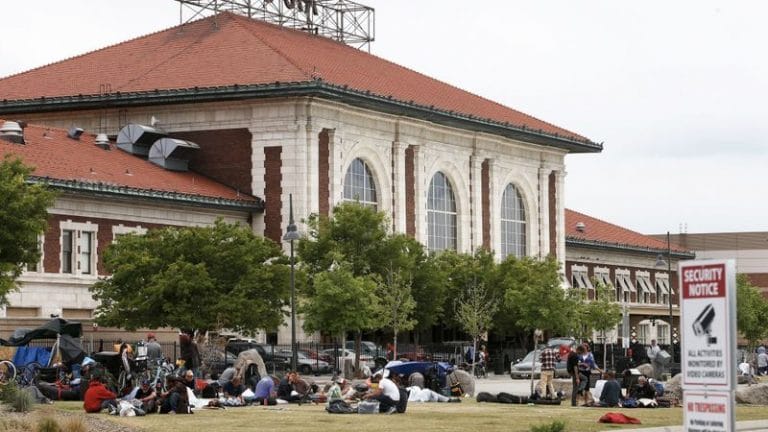
And that’s not even considering that the homeless population in Salt Lake City, especially around pioneer park and Rio Grande.  is much greater than anywhere else in the state. “Their needs drain on our services a great deal.“

Drain seems to be the right word, too. The stresses of the job, the dangers faced, coupled with the low yearly income, has the Salt Lake City Police Department calling foul. One office recently described it as “a sinking ship.”

“What you see is what you get,” Winters said, referring to the fact they don’t even receive social security.

Pay raise vs pay adjustment

He compared it to an average, working civilian. “If you have a set retirement or contribution, the way we have, if you do 25 years you get 50 percent of your salary. And then, obviously, you get social security when you hit 65. The two of those combined should be enough. Our officers don’t get that benefit.” What he’s saying is, is if an Officer retires making $65,000 a year, you’re leaving with $32,500.

“And that’s it,” Winters said. “You’re basically asking them to put their life on the line for a very non-productive ending to their career.”

Winters believes it’s not even about getting a pay raise, per se. It’s about a necessary pay adjustment. There was a time when the Salt Lake City economy wasn’t so great no departments were getting raises. Consequently, because of this, Winters said, “they [Salt Lake City] have neglected our pay to such a degree that now we are calling for a pay adjustment.”

The two, a pay raise and a pay adjustment, are mutually exclusive. Salt Lake City, he claims, hasn’t kept up with the pace; has fallen behind, and that this is the root of the frustration being vocalized by officers. One officer said it feels like being on a sinking ship.

Behind the times

As a result of Salt Lake not keeping up in the competitive market, the low wages for Salt Lake City police officers has resulted in a less-than stellar turnover rate. They are losing veteran officers. “We are many many dollars behind,” Winters said, “and because of that, our officers are starting to look at other options.”

Winters cites a report from last year that put the SLCPD at a 12 percent turnover rate. “Our current HR Director thinks that that number is OK. From my perspective, I think that’s very dangerous because you’re losing your institutional knowledge.”

They are losing their veteran officers who have, for lack of a better term, have been around the block a few times. The continuing loss of vital experience that could be passed down to officers with less experience, it can be a dangerous situation.

In high-intensity situations, Winters explained, is someone who can react immediately, someone who is as sure as the shoes they stand it.

That sort of ability, in any industry, is only realized after years of ‘practice.’

“The reality is when we call for an officer, and he or she, may only have a few years under their belt … their familiarity with each and every situation is less than a more senior officer that knows how to resolve things, negotiate better with people involved, and get a more positive result quicker, simply because of experience,” Winters said.

It’s hard to ignore the fact that those who police our streets, the men and women who work under the umbrella of justice, are unhappy.

All Winters wants, he said, “ … is to see improvement pertaining to our benefits and the well-being of our officers.”

Listen to our conversation with Steven Winters, president of the Salt Lake City Police Association, below:

, , ,


Join our newsletter.
Stay informed.


  • Highway 6 and the Midland Trail: Utah’s Transcontinental Highway History

    From Price Canyon to Delta’s desert stretch, Utah played a central role in building the Midland Trail, one of America’s earliest transcontinental highways and the foundation of today’s Highway 6.


  • Whiskey, Bullets & a Buried Town: Archaeologists Reveal Alta’s Wild Past

    Before Alta was known for powder days and lift lines, it was a silver mining town clinging to the side of a narrow canyon. In the late 1800s, men lived at 8,000 feet, went underground each day, and endured winters that regularly buried buildings in snow. This past summer, that mining town resurfaced — literally — during construction at the Alta Ski Area.

    To understand what Alta really looked like, you don’t begin with legend. You begin with its trash — and this time, that happened almost by accident.

    Alta Ski Area was installing underground water reservoirs to support snowmaking. Because the project sits on Uinta-Wasatch-Cache National Forest land, an archaeologist was required to monitor the excavation. No one expected the trench to produce much.

    But, It did.

    Artifacts began surfacing almost immediately. Enough that the Forest Service contacted the Utah State Historic Preservation Office for help. Lexi Little, who coordinates the Utah Cultural Site Stewardship Program, helped mobilize nearly 30 volunteers to assist with what quickly became a focused two-week excavation.

    Winter deadlines were approaching. The pipes for the reservoirs had to go in the ground. There wasn’t time for a slow, extended dig.

    “It was two weeks of digging in the dirt and helping figure out exactly what we were looking at,” Little said.

    Most of the people screening soil weren’t professional archaeologists. They were trained stewards from around Utah — part of a statewide volunteer network that now approaches 500 people. They poured dirt through shaker screens, scanning for fragments that could piece together a town long buried.

    “Archaeology is human trash,” Little explained. “Archaeologists are very into trash.”

    Alta had left plenty behind.

    https://youtu.be/hzIHzx3OGoo?si=dKcl2CEz-t6FZzYw

    Victorian-style ceramics appeared first — the kind typically used in hotels. Medicine bottles followed. Ink bottles. Hand-blown glass. A porcelain doll’s foot surfaced from the soil, a small detail that shifted the mental image of the town. Families were here. Children were here. This wasn’t only a camp of miners.

    The bottles helped establish time. Manufacturing details — whether glass was hand-blown or mold-made, whether a maker’s mark appeared on the base — allowed archaeologists to date many of the artifacts to the 1870s through the 1890s, when Alta was booming as a silver mining town.

    “That gives you that range of dates for when Alta was really booming,” Little said.

    One reusable soda bottle clearly stamped “Salt Lake City” connected the canyon to the valley economy below.

    Then something unusual rolled out of a dirt pile.

    A corked bottle. Intact. Liquid still inside.

    Continue reading and support independent Utah journalism with a purchase of Utah Stories (Digital + Print) or 3 month free trial (Digital).


  • The Only Full Bottle of Alcohol Ever Found in Utah Was Unearthed in Alta

    When a backhoe rolled a corked bottle out of the dirt at Alta this summer, no one immediately grasped what they were holding. It wasn’t empty. It wasn’t shattered. It was full. “The bottle that was discovered up at Alta is the only bottle of alcohol ever discovered in an archaeological excavation in the state…


  • How Horses Help Kids Heal: Inside Utah’s Equine Therapy World

    Kelty Johnson trains horses for a living, but her deeper work happens in the quiet space between animal and human. On the Utah Stories podcast, she explains how equine therapy helps children regulate emotions, build confidence, and reconnect through presence rather than pressure.