Moab

Moab’s Peace Tree —Green Smoothies and Green Eggs and Ham

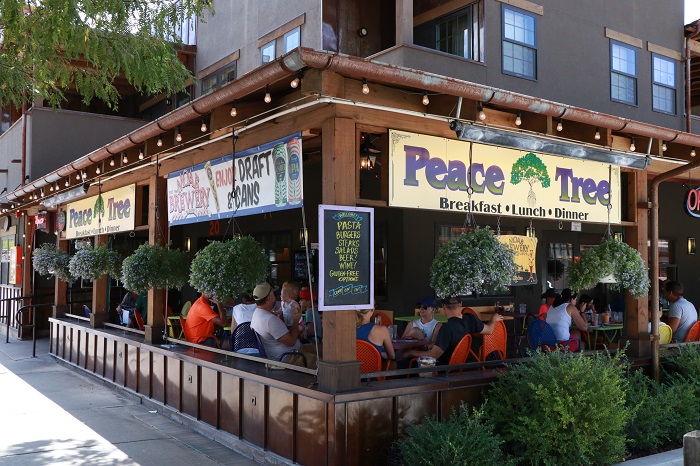
Located in the heart of downtown Moab, Peace Tree Café attracts tourists and locals alike with a diverse, healthful menu including locally-grown produce.

|


The original Peace Tree Cafe in downtown Moab. Photos by Jeff Richards.

Now in its 20th year, Moab’s Peace Tree Café prides itself on using fresh, light, and healthful ingredients in its menu.

“We don’t have any fried foods, and everything is fresh, not frozen,” says owner Karen Whipple, who started the restaurant in downtown Moab in June 1998. For much of 2010, the restaurant was closed while renovations were made to expand the business into the building next door. Since its expansion, the Peace Tree, with its outdoor patio area, now seats up to 120 customers.

Peace Tree’s other location is in Whipple’s hometown of Monticello, about 50 miles south of Moab. Approximately 30 employees work at the Moab store (half of which are full-time), while another 20 work at the Monticello location, which has slightly fewer food and beverage options.

Whipple says many of her employees have worked there for several years without the high degree of turnover experienced by many other area businesses. “We’re like a family,” she says.

Manzana Springs Vegetable Farm in nearby Spanish Valley has supplied garlic, chard, cucumbers, tomatoes, squash, beets, carrots, and spinach to the Peace Tree regularly for the past six years. The farm’s freshly picked vegetables are used in omelets, salads, juices, smoothies, and burger toppings. Whipple said the restaurant also plans to start buying beets, kale, and other vegetables from another local supplier, Castle Valley Farms, in the near future.

“We’ve bought from other local farms in the past, but some of them are no longer in business,” Whipple said, adding, “If anyone comes to us and is willing to bring us produce consistently, we are willing to work with them.”

The Peace Tree also sells locally brewed beer on tap from Moab Brewery, in addition to local wines from Castle Creek Winery.
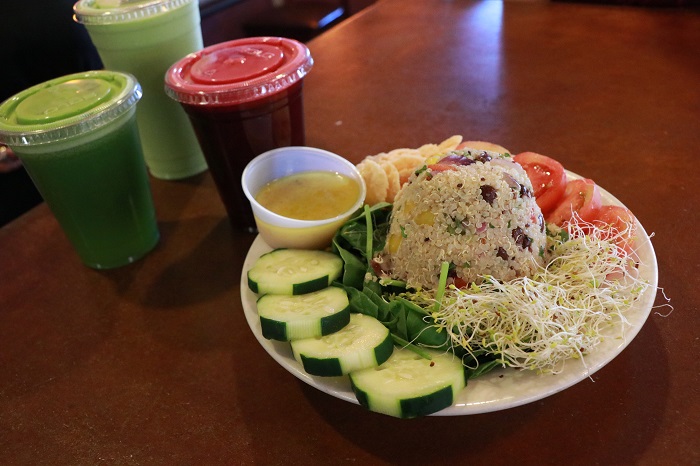
The Jolly Green Smoothie along with two of Peace Tree’s vegetable drinks and their quinoa salad.

Although the Peace Tree started out as a juice and smoothie outlet, it now offers a wide range of menu options. Breakfast choices include omelets, bagels, whole-grain pancakes, and smothered burritos. Lunch and dinner options include salads, wraps, burgers, and pasta dishes. Entrees include beef steak, salmon, pork and chicken dishes, all of which are served with baci rolls, side salad, brussels sprouts and choice of mashed potatoes, and rice pilaf or baked potato.

The meat used in the hamburgers is grass-fed beef, without antibiotics. Numerous vegan, vegetarian, and gluten-free options are found throughout the café’s diverse menu.

The quinoa salad features green peppers, red onions, tomatoes, and black beans embedded in a mound of quinoa and served over spinach leaves, surrounded by cucumber and tomato slices, sprouts, and Parmesan crisps. Dressing options include ranch, blue cheese, or one of three vinaigrettes.

A variety of healthy smoothies are available, the most popular being Jolly Green, a blend of almond milk, spinach, avocado, mango, pineapple, chai seeds, and protein powder. Other drinks include mixed-vegetable juices, coffee, cappuccino, and non-fat yogurt shakes.

Peace Tree Café is located at 20 South Main, Moab, and 516 North Main, Monticello.
Both locations open 7am to 10pm 7 days a week.

Join our newsletter.
Stay informed.


  • Moab’s Identity Crisis: Off-Road Adventure, Tourism, and the Fight Over Utah’s Desert Trails

    our dogs has been our escape for the past twelve years. (If you don’t like dogs, take your kids, your bikes, your jeep, your UTV or ATV and have a blast. Just don’t bring your cats.

    Sandwiched between Canyonlands and Arches National Parks, Moab has attracted international attention for its rare accessible beauty. We met a Parisian lady at the Hoodoo Hotel sitting in a hot tub under the stars. “I just love it here,” She told us. She jets from Paris to Moab to relax. 

    When I spend time here, my asthma is at bay. We go on long walks, take in scenic vistas; the massive starlit night; no freeway noise, and less anxiety.

    Last season, I had the pleasure of experiencing River rafting the Green and the Colorado Rivers with two of Moab’s most trusted river rafting companies: Navtec and Sheri Griffith. We took our kids down the Green River. Disneyland’s long lines for Splash Mountain have nothing on The Gates of Lodore’s whitewater rapids.

    Like everyone who comes to Moab, I am a nature and quiet lover. Permeating our cities are noise, pollution, road rage and anxious vibes. Moab is a great escape. After covering Moab for more than 15 years, I’ve become aware how city-dwellers’ proclivities and priorities – with all of the best intentions – can destroy small, quaint places economically for working class families. 

    In our last issue we profiled people who have made their lives in Helper, Utah. We pointed out how Helper and Carbon County only function due to the coal mining industry and hard-working class residents. Without capitalism, with its sometimes dirty, polluting and soul-sucking work, there would be no working class and family economic viability.

    Perhaps it goes without saying that towns can’t function as tourist destinations without the risk taking of small entrepreneurs and family-operated businesses. So why am I saying it? Because there are fewer places than ever in Utah where families can afford to live. Moab is quickly becoming one of those unaffordable places. Homes here average $500K and there are an excess of properties in Moab costing more than $1 million.

    Continue reading and support independent Utah journalism with a purchase of Utah Stories (Digital + Print) or 3 month free trial (Digital).


  • Moab’s Off-Road Legend Dan Mick: Inside Hell’s Revenge and the Fight for Public Land Access

    The story of Moab’s off-road world isn’t just about machines. It’s about the people who have shaped this place — people like Dan Mick, who has spent a lifetime climbing impossible angles and helping others experience the wonder of the slickrock and the trails.


  • Inside Moab’s Political Divide: Land, Tourism, and the Future of Grand County, Utah

    In the late 1950s, Edward Abbey took a job as a park ranger at Arches National Monument, just outside Moab. What he found there, and what he watched happen to it, would shape the rest of his life. Roads were being cut into the canyon country. Cars were replacing foot traffic. The National Park Service, in the name of accessibility, was engineering a kind of industrialization of the wilderness he’d come to love. Abbey wrote about it in Desert Solitaire, published in 1968, and the anger in that book wasn’t abstract. It came from watching something specific be changed by people who either didn’t understand what they had or didn’t care.

    Grand County has long been the most reliably left-leaning county in the state, a fact that puts it in sharp contrast to nearly everything around it. To understand how that happened, and where things stand now, I spoke with longtime residents and politicians who’ve watched it from the inside, people who’ve served in local government and lived through the shifts firsthand.

    Robert Greenberg.

    Bob Greenberg came from New York in 1976, took a job at the community mental health center, and never left. He went on to chair the Grand County Democratic Party and serve on the county council. When he arrived, he said, “the Democratic Party was said to be able to meet in a phone booth” — and even then, its members were a contradictory bunch. Yellow Dog Democrats from the oil patch were fiscally conservative but surprisingly open socially, allowing different demographics to feel safe moving to the county. 

    “The town fathers were desperate to have new people come to town,” Greenberg recalls. “They just didn’t want the people who actually showed up. They wanted some other people.”

    What followed was a demographic shift nobody planned. The people who filled the gap left by the bust were river guides, federal agency workers, artists, and eventually waves of outdoor recreationists discovering that southeastern Utah was among the most spectacular landscapes on earth. Tourism ended up being the only economic development avenue that actually worked. Manufacturing never had the labor force or market access, sewing factories came and went. The people the tourist economy attracted tended to be younger, more outdoor-oriented, and more liberal.

    Kevin Walker.

    Kevin Walker, a former Grand County commissioner who moved here in 1990 for the landscape, puts the county’s diversity in context. “Moab [is] a pretty diverse place since, I think, at least the 1950s with the uranium mining boom,” he says. “So it’s not a typical Southern Utah town.” 

    Part of what makes Grand County distinct is self-reinforcing. Federal agencies like the Park Service, the Forest Service, the BLM, have large presences here and pull in a different demographic than surrounding counties. People looking to live in Southern Utah with certain values gravitate toward the place where those values already have a foothold. Over time, that critical mass has made Grand County what it is politically, while neighboring counties went in very different directions.

    The defining conflict in Grand County has always been over land.

    In the 1970s and 80s, it was extraction versus preservation in the starkest terms. County commissioners floated toxic waste incinerators. A plan emerged to site a high-level nuclear waste repository at the entrance to Canyonlands National Park. 

    “It really, really galvanized environmentalists everywhere, but particularly in Grand County,” Greenberg says. Activists put up signs at the park entrance, watched them get chainsawed down, and came back with steel reinforcement. That stubborn, physical, unglamorous persistence became part of the local political character.

    Continue reading and support independent Utah journalism with a purchase of Utah Stories (Digital + Print) or 3 month free trial (Digital).