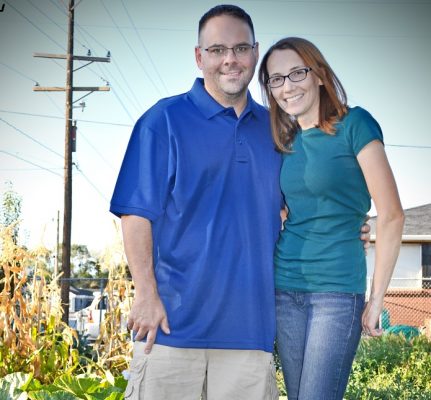
Kristy McNealy laughs when asked if she thinks her lifestyle is revolutionary. “It doesn’t feel revolutionary,” she responds. “I just have this huge great lot and it feels wasteful to only use it to water grass.”
Two years ago, Kristy and her husband, Rod, bought a 1950s-era Millcreek home on a half-acre lot. Included in the sale were the property’s water shares. Their vision is to grow most of their family’s produce on their property, as well as build self-sufficiency skillsets so they can live as independently as possible.
“We thought we’d be more radical at one point,” Kristy says of the couple’s having considered remote homesteading in Wyoming. But what relocating to an urban area allows the McNealy’s is home-schooling for their four children and easy access to the technologies they use to augment their lifestyle.
Integrating tools of technology with construction and fabrication tools, the McNealy’s exercise a blended DIY approach to life. The couple uses a variety of internet resources, from Facebook groups to ag websites to seek information or problem-solve. “I can’t tell you how many things we’ve learned how to do on YouTube,” Rod shares. But for knowing what produce grows well or when to plant, Kristy says their neighbors have been their best resource.
For the McNealy’s, the “eco” in “eco-friendly” might best be defined as “economically” as well as “ecologically” friendly. “It’s really expensive to give four kids adequate fruits and vegetables,” Kristy relates. After two growing seasons, she hasn’t yet calculated her garden’s total yield, but says she hasn’t bought grocery store vegetables for the past two months. “That’s for a family of six,” she adds.
An orchard used to occupy their neighborhood, and the McNealy’s inherited mature pear trees from the original grove. “The pear trees were over 40 feet tall when we moved in,” Kristy says, and were in need of some serious attention. After consulting with arborists and realizing the impact professional services would have on their budget, Rod spent hours researching different pruning techniques, rented the necessary tools, and prudently truncated the prodigious trees. The dramatic rejuvenation resulted in greatly reduced trunks with prolific new growth.
As the McNealy’s expand their agricultural endeavors, Kristy says that current yield will guide next year’s garden plan, as well as inform what new skill the couple will learn. The family is still eating cold-stored spaghetti squash from last summer, and this year, Kristy shares, “was all about cucumbers. Right now I have about a two-year supply of pickles in the pantry.” And Rob’s just finished making a cider press so they can put this season’s apples to good use. “We’re very adventurous when it comes to trying new things,” he adds.
In addition to providing sustenance, growing their own food has been an exercise in appreciation. The kids understand the effort required to grow food, and both Rod and Kristy are impressed by the “top-level education” they’ve acquired. “I spent a lot of time this summer paying attention to the life cycle of grasshoppers,” Kristy laughs.
“The house and yard are a labor of love and sometimes frustration,” Kristy says, but the couple’s dedication to their family and their goal will keep them learning and growing into the future.