Utah Stories

A Need to Knead: Moore Bread

Looking for delicious bread you can receive on a monthly basis? Read all about Moore Bread here.

|

moore bread utah

moore bread utah
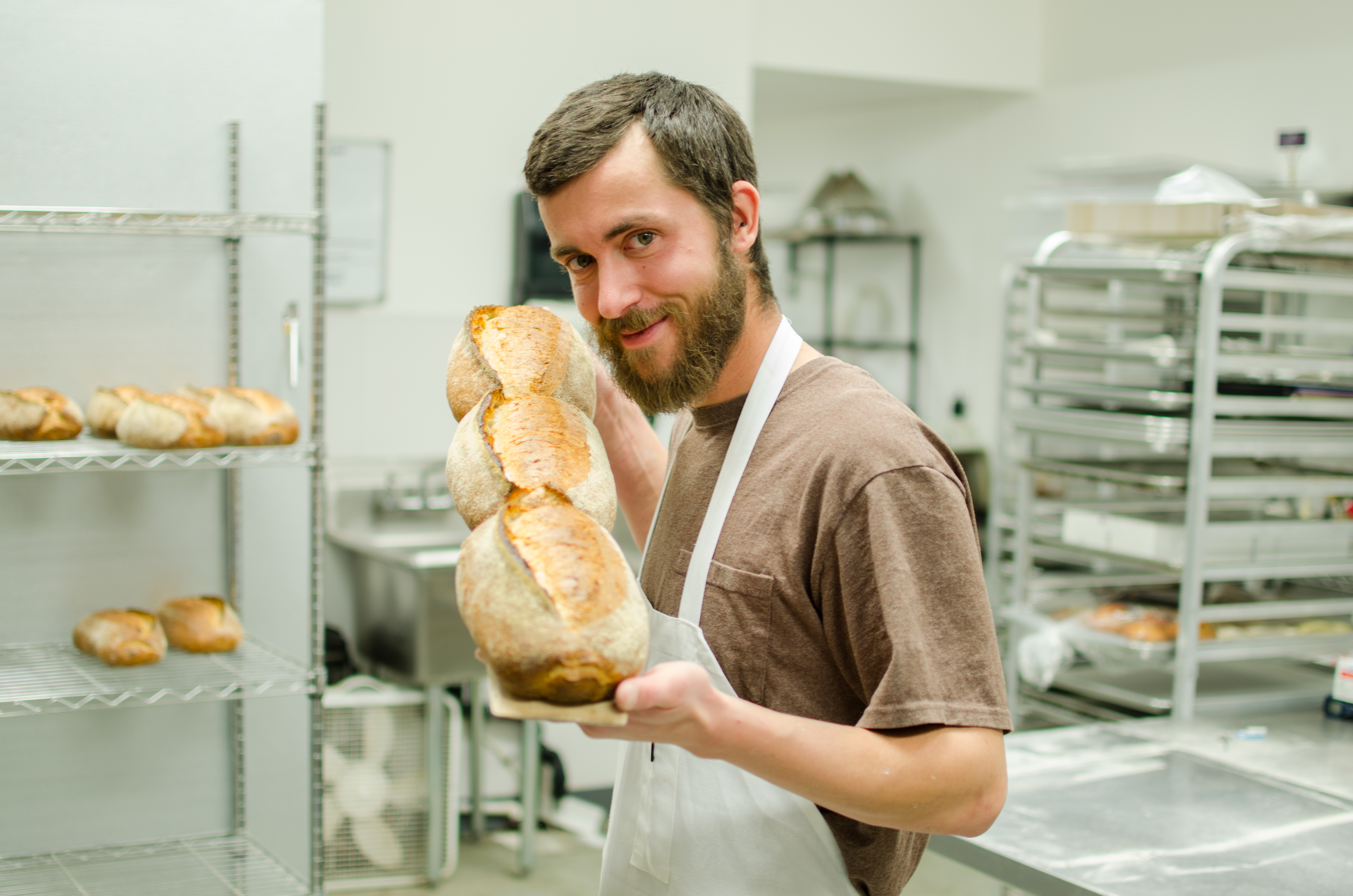
Ryan Moore holding loaves of fresh baked bread

A revolution is on the rise in Utah. Loaf by loaf, Ryan Moore’s distinct breads have the power to reshape the way we think about our oldest source of sustenance.

Moore Bread is Utah’s first Community Supported Baker (CSB) program through which participants buy monthly shares and receive exceptional, consciously crafted loaves made from locally grown and milled organic flour.

Ryan has created bread programs at notable SLC restaurants, including Eva’s and From Scratch. More recently, he enrolled in theBread Baker’s Guild of America, and, last October, participated in the guild’s Team USA competition, the nation’s most prestigious artisan bread baking event.

When Ryan returned from the competition, he decided to direct his singular passion into a sole endeavor. Adamant about quality, Moore Bread ingredients are organic and locally-sourced. “I buy as much as I can from the Farmers Market,” he says. “Freshness is the key to better flavor.” Fresh-milled flour, he says, yields “out of this world flavor.” Moore Breads are all natural, non-GMO, vegan and vegetarian.
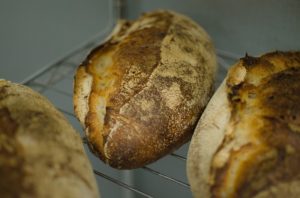
Ryan Moore's Potato bread resizedAnd though ingredients are paramount to a superior product, Ryan claims that “it’s not the recipe that makes the bread, it’s the baker.” What sets his bread apart, he indicates, is his understanding of the relationship between ingredients and the baking process. Baking a loaf in two hours, he says, is “insane.” “That’s not enough time to break down the proteins and enzymes into a form that our bodies can easily digest.” Each Moore Bread loaf is the end result of a 40-hour process that includes 36 hours of fermentation which allows the wild yeast in the levain, a traditional flour and water bread starter, to convert complex sugars to gases.

Science aside, Moore Bread is robust in both form and flavor. Deeply-colored, thick crusts encapsulate an airy cushion of oven-baked dough, rich in complex flavor. In each through-the-night baking session, Ryan creates Ciabatta, Pain au Levain, Rustic Roasted Potato and a daily special bread that customers may pick up at designated locations. Moore Bread is also now carried in Tony Caputo’s markets.

Looking at Ryan’s lean frame, you wouldn’t guess he eats a whole loaf of bread every day. Bread, and its host of carbohydrates, we’re told, should be shelved if we want to steer clear of unwanted pounds, but singling out the staff of life as an insidious accomplice to obesity is a popular accusation that Moore would like to rectify. “People are afraid of wheat,” he notes, “and there’s nothing wrong with gluten as long as the protein is broken down into structures our bodies can digest. My whole mission is to create bread that people can consume.”

“No other bakers in Utah are doing what I do,” he maintains, “and I make a mean loaf of bread.” Sign up for a share, and join the revolution.

www.squareup.com/market/moore-bread

https://www.facebook.com/MooreBreadSLC


Join our newsletter.
Stay informed.


  • Highway 6 and the Midland Trail: Utah’s Transcontinental Highway History

    From Price Canyon to Delta’s desert stretch, Utah played a central role in building the Midland Trail, one of America’s earliest transcontinental highways and the foundation of today’s Highway 6.


  • Whiskey, Bullets & a Buried Town: Archaeologists Reveal Alta’s Wild Past

    Before Alta was known for powder days and lift lines, it was a silver mining town clinging to the side of a narrow canyon. In the late 1800s, men lived at 8,000 feet, went underground each day, and endured winters that regularly buried buildings in snow. This past summer, that mining town resurfaced — literally — during construction at the Alta Ski Area.

    To understand what Alta really looked like, you don’t begin with legend. You begin with its trash — and this time, that happened almost by accident.

    Alta Ski Area was installing underground water reservoirs to support snowmaking. Because the project sits on Uinta-Wasatch-Cache National Forest land, an archaeologist was required to monitor the excavation. No one expected the trench to produce much.

    But, It did.

    Artifacts began surfacing almost immediately. Enough that the Forest Service contacted the Utah State Historic Preservation Office for help. Lexi Little, who coordinates the Utah Cultural Site Stewardship Program, helped mobilize nearly 30 volunteers to assist with what quickly became a focused two-week excavation.

    Winter deadlines were approaching. The pipes for the reservoirs had to go in the ground. There wasn’t time for a slow, extended dig.

    “It was two weeks of digging in the dirt and helping figure out exactly what we were looking at,” Little said.

    Most of the people screening soil weren’t professional archaeologists. They were trained stewards from around Utah — part of a statewide volunteer network that now approaches 500 people. They poured dirt through shaker screens, scanning for fragments that could piece together a town long buried.

    “Archaeology is human trash,” Little explained. “Archaeologists are very into trash.”

    Alta had left plenty behind.

    https://youtu.be/hzIHzx3OGoo?si=dKcl2CEz-t6FZzYw

    Victorian-style ceramics appeared first — the kind typically used in hotels. Medicine bottles followed. Ink bottles. Hand-blown glass. A porcelain doll’s foot surfaced from the soil, a small detail that shifted the mental image of the town. Families were here. Children were here. This wasn’t only a camp of miners.

    The bottles helped establish time. Manufacturing details — whether glass was hand-blown or mold-made, whether a maker’s mark appeared on the base — allowed archaeologists to date many of the artifacts to the 1870s through the 1890s, when Alta was booming as a silver mining town.

    “That gives you that range of dates for when Alta was really booming,” Little said.

    One reusable soda bottle clearly stamped “Salt Lake City” connected the canyon to the valley economy below.

    Then something unusual rolled out of a dirt pile.

    A corked bottle. Intact. Liquid still inside.

    Continue reading and support independent Utah journalism with a purchase of Utah Stories (Digital + Print) or 3 month free trial (Digital).


  • The Only Full Bottle of Alcohol Ever Found in Utah Was Unearthed in Alta

    When a backhoe rolled a corked bottle out of the dirt at Alta this summer, no one immediately grasped what they were holding. It wasn’t empty. It wasn’t shattered. It was full. “The bottle that was discovered up at Alta is the only bottle of alcohol ever discovered in an archaeological excavation in the state…


  • How Horses Help Kids Heal: Inside Utah’s Equine Therapy World

    Kelty Johnson trains horses for a living, but her deeper work happens in the quiet space between animal and human. On the Utah Stories podcast, she explains how equine therapy helps children regulate emotions, build confidence, and reconnect through presence rather than pressure.