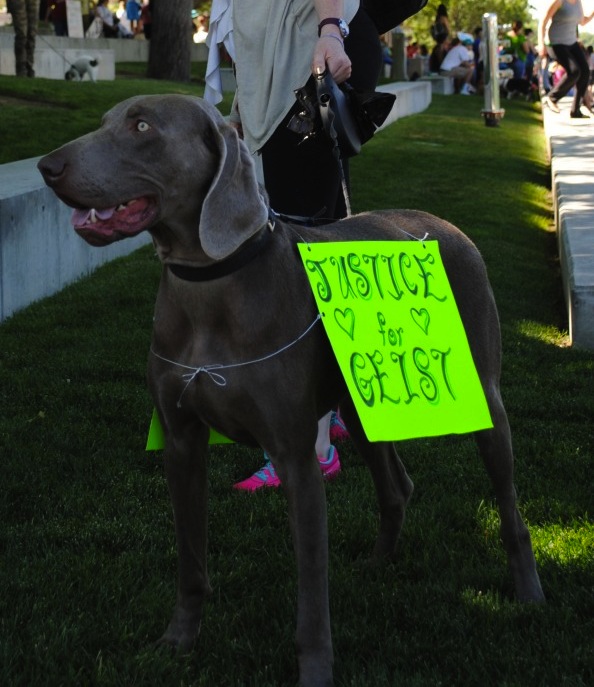
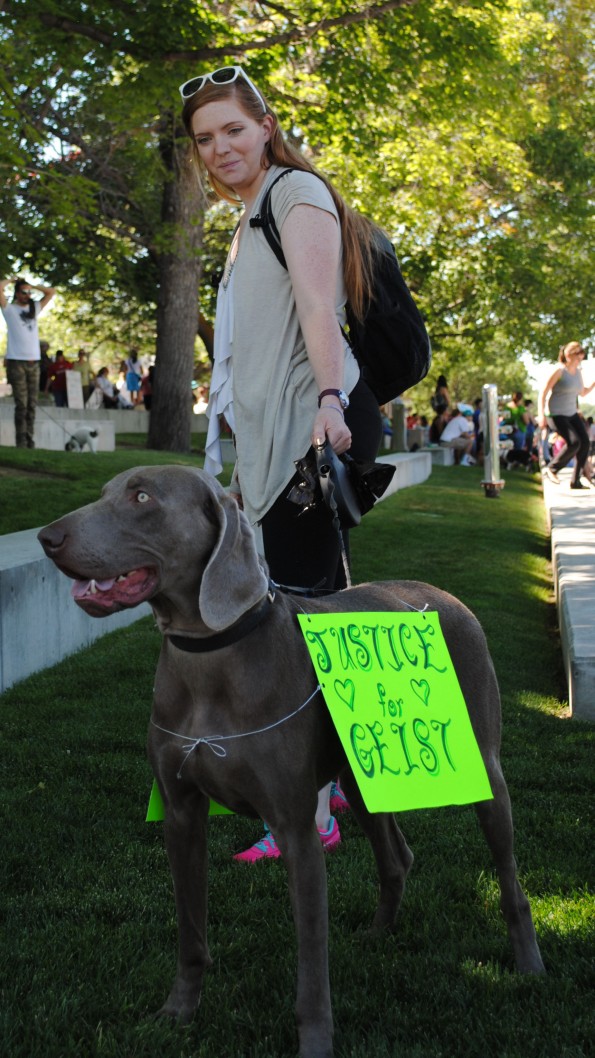
 An estimated 2,000 people attended the rally at the Public Safety building in downtown Salt Lake City holding signs reading “Justice For Geist!” “Put a leash on killer cops” “My dogs are my children.” “Pets R Family.” Chants ranged from “Hold Him Accountable” to “Fire Officer Olsen!” The latter refers to Officer Brett Olsen, who shot and killed Sean Kendall’s Weimaraner, Geist in the dog’s backyard on June 18th, when the officer was looking for a missing child.
The philosophical argument of the protest held on June 28th 2014 is that because “dogs are family members or at the very least an extension of the family, “ as Sean Kendall put it, they deserve to be treated as such and we should have laws in place that protect their rights, and procedures in place which prevent the dogs from being harmed by law enforcement. “Dogs are much more than property…They killed my best friend,” Kendall said at a press conference at the event.
On June 27th Salt Lake City Police Chief Chris Burbank held a taped press conference where he revealed Officer Olsen’s identity, and added ”Olsen was one of three police officers who shot and killed 18-year-old Sulejman Talovic at Trolley Square on Feb. 12th, 2007.
Burbank added, “This is a seasoned officer who has tremendous experience and, in fact, has been under fire and performed very well.”
Another question is why Burbank would use this fact to persuade the public to give Olsen a pass? If any completely law abiding citizen decides to kill a neighbor’s dog, that person, independent of all good deeds done previously, would face felony charges. Burbank’s points during the press conference indicate that termination seems an unlikely scenario.
“The officer indicated in his police report that he felt there were no other options,” Burbank added,“We will explore what other options were available to you. What could have you done?” Burbank kept the conference focused on the protocol that the department uses in finding missing children, which is not the subject of this debate.
He stressed that, “Most missingchildren who are killed, are killed within the first half hour after they are abducted.” However, Burbank does not mention that Geist was killed 20 minutes before the missing child was found in her own house. Burbank said that in this instance,“You have a very seasoned officer who is not prone to panic,and the distances were extremely close.”
Chief Burbank’s response when a reporter asks for his reaction to the public outcry that the officer should lose his job over this? “Every year there are officers who are asked to no longer work here. Most involve misconduct, because they have lost the trust of the police department and the community in which they serve. In this particular circumstance a review will take place. If the officer acted appropriately under the policies and guidelines that are in place—then he should absolutely not lose his job. Why should he?”
What do the “policies and guidelines”state regarding an incident when an officer feels threatened by a dog? We could not get an answer to this question in time for press.
Later, Burbank was asked why Officer Olsen wasn’t placed on administrative leave as an officer would be who discharged his firearm to kill a human, pending an investigation. “Shouldn’t they treat this as the same when an officer shoots and kills a dog?”
Burbank’s response: “I think you need to ask yourself that question. An officer utilized a firearm for an animal who he believed was attacking him. I think there is a different standard and should always be, for an officer who takes the life of a human being.”
Burbank added, “I’m not minimizing,but a review should takeplace. But that is in fact a felonyunder state law when you take ahuman being’s life.”
It is also now a felony to take the life of a dog, and felony charges are filed regularly for animal abuse when a citizen commits these crimes. Certainly there are two standards,but what the protesters are arguing for is a much higher level of accountability when officers interact with pets who are believe by their owners to be, “family members or best friends.”
Chief Burbank asked membersof the media attending his press conference to not speculate on the facts and details of what happened.
This is convenient for the SLCPD, so things will die down before the results of the investigation and decisions are made. Thirty to fifty days from now, public awareness of this story will weaken and the national spotlight this story has received will have moved on. This seems to be at least very convenient and helpful for the SLCPD PR to not allow the media to analyze this series events until all of the facts are in, but we can assume that if Geist had made any physical contact with Officer Olsen, this would have been said in the press conference.
It’s difficult to believe that Officer Olsen did not have any other options available to him when he interacted with Geist. Anytime searches are conducted, officers have their partners at close hand, Officer Olsen’s partner might not have been directly behind him, but he might have been close enough to come help. He could have come to assist Olsen if he felt Geist was threatening him. Officer Olsen had his taser on hand, he had a baton,he had pepper spray. As Kendall stated, “Why couldn’t he just back out of the yard.”
We can speculate that Geist was growling and perhaps running toward Officer Olsen. Could have Officer Olsen gotten scratched or mauled by Geist? Perhaps. Could have Officer Olsen lost his life to Geist? Readers can make their own determination.
Had Olsen made contact with his partner, had he discharged peppe rspray, or even discharged his Taser could have prevented a threatening situation. As protesters stated, mailcarriers and UPS delivery people handle situations with agitated dogs all the time in non-violent ways.
At least four Weimaraners were in attendance at the Salt Lake City rally receiving affection from strangers, along with dozens of other dogs. Dogs with heads hanging out of windows of honking cars passed by. Even a Salt Lake City Fire Department truck rolled by, honking its booming horn to the cheer of hundreds of protesters.
Facebook indicates that some rally-goers flew in from other states to attend. This is a serious issue for dog owners who view their pets as family members. Burbank nor does the law believe that the killing of a dog by a police officer is similar tokilling a child. For those of us who don’t yet have children, it is thesame thing. My dogs are my best friends and if someone, anyone, did them harm, in almost any scenario, like Kendall felt, it would be much more than the loss of property–it would be the loss of family member.
Sean Kendall does not want to see Officer Olsen reprimanded. He doesn’t want to see him resign. Kendall also spoke strongly against those who were threatening the life of Officer Olsen. Kendall wants to see Officer Olsen fired and lose his pension benefits. If indeed Burbank goes by the standard set for misconduct, despite any past achievements or honors, Officer Olsen should be fired.
View our photos taken at the June 28th, 2014 rally at the Salt Lake City Public Safety Building
What are your thoughts on the issue? Let us know in the comments below.