Moab

Meet Moab’s 92-Year-Old Trail Runner

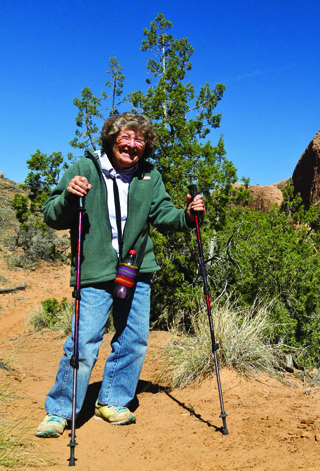
Moab’s veteran trail runner, Jean McDowell, has been hiking the Mill Creek Trail for 30 years.

|


Jean McDowell doing what she likes best

The Mill Creek Trail on the south side of Moab is a popular hike for tourists and locals alike. Longtime Moab local, 92-year-old Jean McDowell, has regularly hiked this trail for the past 30 years.

Just above the trail, McDowell lives in a house with a façade of river rocks the size of cinder blocks. There are no river rocks this size anywhere near Moab. When Jean built her house in 1987, she hauled every one of the
rocks with her own hands— 15 at a time—to her house. That patience is the first thing you’d discern if you encountered Jean hiking Mill Creek Trail. Just after her 80th birthday Jean slipped on the Mill Creek trail. Since then she’s used hiking poles and her pace has slowed a lot.

As a University of Colorado freshman in 1941, Jean began hiking with the university’s club. “It was a choice between photography or the hiking club. Well I could walk, so I decided I could hike with the hiking club.” Hiking was just the beginning of her life-long attraction to outdoor recreation. Soon after she graduated and got married in 1945, she and her husband bought a huge, heavy, black navy surplus raft and hauled it all over the Western US and Alaska, wherever her husband worked building roads as a civil engineer. They ran the Colorado River through Glen Canyon and the Green in northwest Utah long before any permits were required or dams were built.

When Jean and her husband split up in the 1980s, Jean got the raft. That raft connected Jean with other adventurous men and women half her age, active folk who were capable of keeping up with her river and hiking trail pursuits. Jean retired the navy surplus raft when she moved to Moab in 1986, but kept on hiking.

Even after her accident more than a decade ago, Jean can’t keep off the trails. “My daughter says I shouldn’t go so far, but I think she’s about given up.” Not a lot of 92-year-olds can still hike but Jean takes it all in stride. “I’m not the adventurous type. I’m really sort of a chicken. I know some adventuresome people. They climb all those 14er’s,” she says, “I keep walking because that’s what I know to do. I like the red rocks.”

,


Join our newsletter.
Stay informed.


  • Inside Moab’s Political Divide: Land, Tourism, and the Future of Grand County, Utah

    In the late 1950s, Edward Abbey took a job as a park ranger at Arches National Monument, just outside Moab. What he found there, and what he watched happen to it, would shape the rest of his life. Roads were being cut into the canyon country. Cars were replacing foot traffic. The National Park Service, in the name of accessibility, was engineering a kind of industrialization of the wilderness he’d come to love. Abbey wrote about it in Desert Solitaire, published in 1968, and the anger in that book wasn’t abstract. It came from watching something specific be changed by people who either didn’t understand what they had or didn’t care.

    Grand County has long been the most reliably left-leaning county in the state, a fact that puts it in sharp contrast to nearly everything around it. To understand how that happened, and where things stand now, I spoke with longtime residents and politicians who’ve watched it from the inside, people who’ve served in local government and lived through the shifts firsthand.

    Robert Greenberg.

    Bob Greenberg came from New York in 1976, took a job at the community mental health center, and never left. He went on to chair the Grand County Democratic Party and serve on the county council. When he arrived, he said, “the Democratic Party was said to be able to meet in a phone booth” — and even then, its members were a contradictory bunch. Yellow Dog Democrats from the oil patch were fiscally conservative but surprisingly open socially, allowing different demographics to feel safe moving to the county. 

    “The town fathers were desperate to have new people come to town,” Greenberg recalls. “They just didn’t want the people who actually showed up. They wanted some other people.”

    What followed was a demographic shift nobody planned. The people who filled the gap left by the bust were river guides, federal agency workers, artists, and eventually waves of outdoor recreationists discovering that southeastern Utah was among the most spectacular landscapes on earth. Tourism ended up being the only economic development avenue that actually worked. Manufacturing never had the labor force or market access, sewing factories came and went. The people the tourist economy attracted tended to be younger, more outdoor-oriented, and more liberal.

    Kevin Walker.

    Kevin Walker, a former Grand County commissioner who moved here in 1990 for the landscape, puts the county’s diversity in context. “Moab [is] a pretty diverse place since, I think, at least the 1950s with the uranium mining boom,” he says. “So it’s not a typical Southern Utah town.” 

    Part of what makes Grand County distinct is self-reinforcing. Federal agencies like the Park Service, the Forest Service, the BLM, have large presences here and pull in a different demographic than surrounding counties. People looking to live in Southern Utah with certain values gravitate toward the place where those values already have a foothold. Over time, that critical mass has made Grand County what it is politically, while neighboring counties went in very different directions.

    The defining conflict in Grand County has always been over land.

    In the 1970s and 80s, it was extraction versus preservation in the starkest terms. County commissioners floated toxic waste incinerators. A plan emerged to site a high-level nuclear waste repository at the entrance to Canyonlands National Park. 

    “It really, really galvanized environmentalists everywhere, but particularly in Grand County,” Greenberg says. Activists put up signs at the park entrance, watched them get chainsawed down, and came back with steel reinforcement. That stubborn, physical, unglamorous persistence became part of the local political character.

    Continue reading and support independent Utah journalism with a purchase of Utah Stories (Digital + Print) or 3 month free trial (Digital).


  • Moab Trail Closures: The Fight Over Public Land Access and Off-Roading

    Trail closures threaten livelihoods and slowly limit access to ordinary families, says Dave Hellman, owner of Xtreme 4×4 Tours in Moab. Wilderness advocates argue that stronger protections are necessary to preserve fragile landscapes. As lawsuits reshape trail access across southern Utah, Moab increasingly sits at the center of a growing conflict over who public lands are really for.