

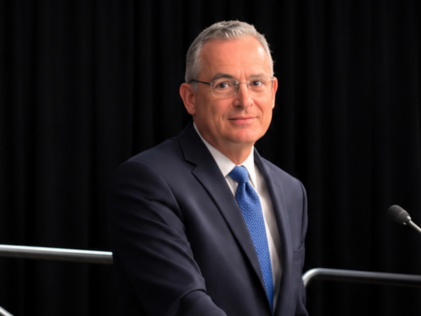
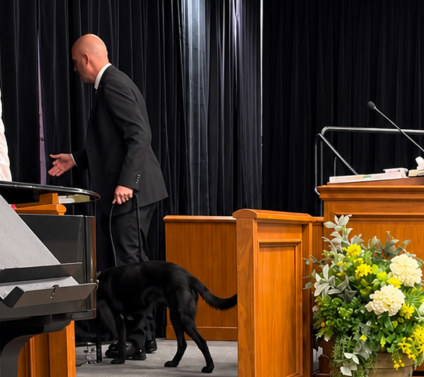
The room was packed. Security personnel were present, and a bomb-sniffing dog passed through the area as part of the preparations. A choir contributed to the occasion, and students gathered eagerly for the opportunity to hear an Apostle speak.
A devotional is a religious gathering intended to strengthen faith through prayer, music, and spiritual instruction. But this gathering became something more conversational. The devotional began at 11:15 a.m., but anticipation had been building long before Elder Patrick Kearon of the Quorum of the Twelve Apostles of The Church of Jesus Christ of Latter-day Saints arrived.
In Salt Lake City students attending a devotional at Ensign College on Tuesday, October 27, might have expected to fill their notebooks with the words of an Apostle. Instead, they watched him open his own notebook and write down theirs.
I had held my place for an hour and a half before being moved to another seat by staff. The change turned out to be a pleasant one. I found myself sitting beside a humorous student who seemed just as excited as I was to be in the presence of an Apostle.
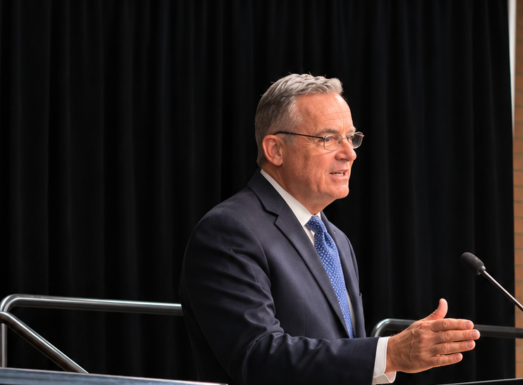
The college president even remarked that he needed additional time to gather himself after seeing how many students had come. From my seat in the second row, to the right behind the piano, I watched Elder Kearon do something unexpected. He wrote notes.
As students answered his questions, he looked directly at each speaker, pen in hand, recording their thoughts in a physical notebook. When students offered particularly insightful responses, he jokingly suggested their grades deserved to go up.
Elder Kearon invited students to imagine a man riding a bus. The passenger remained peaceful while people around him argued, promoted political opinions, criticized vegetarianism, encouraged marathon running, and advertised products. Despite the commotion, he seemed content to look out the window.
Then he opened his phone.
Suddenly, the same kinds of arguments, opinions, and distractions that had failed to disturb him on the bus appeared to consume his attention. Elder Kearon asked students why.
One suggested that the passenger was now giving the distractions his full attention. Another explained that opening a phone invited messages into his personal space. Others discussed algorithms, personalized content, and the way online problems can follow people everywhere through their devices. Elder Kearon listened, wrote down their observations, and encouraged further discussion. Rather than immediately supplying the answers, he appeared genuinely interested in discovering what students understood about their digital experiences.
Perhaps the most memorable part of the devotional wasn’t the illustration itself, but what happened as students responded. Here was a religious leader who addresses an international audience, taking handwritten notes from college students.
It was a reversal of expectations. Students had gathered to learn from him, yet he seemed equally interested in learning from them. At one point, Elder Kearon explained that he wanted to hold back from issuing a specific invitation. Instead, he encouraged students to reflect on their technology habits and develop their own plans for change.
He expressed interest in hearing about their discoveries, challenges, and successes afterward. Watching him write, I wondered whether the insights collected in that notebook might someday influence a message delivered to the worldwide Church during general conference.
As a marketing student and social media professional, I listened with a question of my own. How can someone whose livelihood depends on social media follow religious counsel encouraging people to disengage from it? My work involves publishing content, reviewing analytics, responding to audiences, and helping a media organization reach readers through digital platforms. Social media isn’t simply entertainment for me. It’s part of my professional responsibility.
Elder Kearon referenced President Russell M. Nelson’s invitation to participate in a seven-day social media fast. He also discussed the importance of personal revelation and the spiritual risks of allowing digital distractions to dominate our attention.
But he emphasized another teaching from Elder David A. Bednar: technology itself is neither inherently good nor evil. The challenge is how we use it. That distinction matters for anyone whose work requires an online presence. Perhaps following this counsel doesn’t mean abandoning social media. Perhaps it means approaching it with greater intention.
A social media manager can open an application to accomplish a specific task rather than automatically scrolling. Scheduling tools can reduce constant monitoring, while boundaries between professional responsibilities and personal consumption can preserve time for relationships and reflection.
There is also a responsibility extending beyond the individual. Social media professionals don’t merely consume content. They help create and distribute what others see. Are we producing information that genuinely benefits our audiences, or contributing to the endless stream of distractions competing for their attention?
For a publication like Utah Stories, which uses digital platforms to connect readers with local journalism, that question is particularly relevant.
Throughout the devotional, Elder Kearon compared students to Nephi, a young prophet in the Book of Mormon who moved forward in faith without knowing everything his future would hold. He encouraged students to exercise their agency, seek personal revelation, and make deliberate choices.
He didn’t prescribe a universal solution to the challenges of social media. Instead, he asked students to discover what worked for them, then report back to him on what worked. Sitting just behind the piano, I considered raising my hand to ask how his guidance applied to people working in digital marketing. However, the question came to me too late as he called on someone else.
But the question stayed with me long after the devotional ended.
Perhaps the most meaningful lesson wasn’t simply about how much time we spend on our phones, but how intentionally we choose to spend our attention. After all, Elder Kearon had demonstrated that principle throughout the gathering. While discussing a world increasingly consumed by digital distractions, he put his own attention on the students sitting in front of him.