Utah Stories

Deer Valley Expands With $600M Upgrade and Utah’s Longest Run

Deer Valley Resort is undergoing a $600 million expansion, doubling its size with 3,700 acres of new terrain, seven lifts, and four new peaks. The project introduces Utah’s longest ski run, the 4.7-mile Green Monster, and marks the resort’s largest transformation since opening in 1981.

|


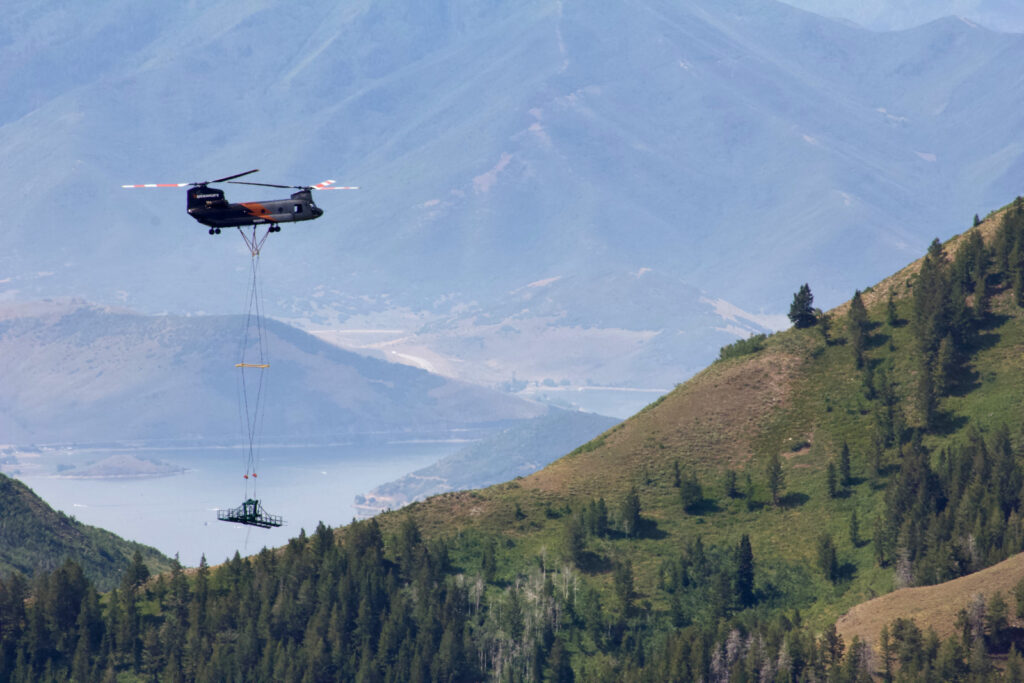
Standing on the top of Bald Mountain, the thumping whir of a Chinook helicopter draws attention as it  rises into view over Peak Mountain towards Big Dutch, where Deer Valley’s new gondola mid-station is nearing completion. Materials and supplies are tethered beneath the chopper, in flight to the tower site on the summit. 

This is the largest expansion Deer Valley Resort has undertaken since opening in 1981, expanding more than doubled in size. The Resort has invested approximately $600 million in the new expansion.  The expansion includes seven new lifts, 3,700 acres of additional skiable terrain. Opening access to four entirely new peaks, deep glades, wide-open bowls, and untouched alpine views. This new terrain promises to satisfy both advanced skiers and curious first-timers. 

A new 4.7 mile long run called the Green Monster that opened earlier this year. This trail overtakes Park City’s iconic Home Run as the longest ski run in Utah. This run is beginner friendly, accessible to families and beginners alike.

“This terrain will offer more safe in-bounds options and we hope it will reduce the temptation to venture into the risky backcountry.” Deer Valley’s Avalanche Mitigation Supervisor, Mark Chytka, says In the OverHerd at Deer Valley Podcast (March 2025).
Mark goes into more detail about the safety procedures that he and his patrol have taken into account with this large expansion. He discusses the danger of the Southwest winds calling them their “problem child.” These winds build cornices, deceptive and dangerous overhanging shelves of wind-packed snow that pose serious avalanche risks. “Anytime we see the Southwest winds coming in with snow,” Chytka says,  “we know it’s going to start building cornus in our avalanche paths.” 

Despite the risks, Mark is excited. “It’s going to be unlike anything you’ve seen at Deer Valley before.’ He goes on to say “The geography out there is incredible.”

Deer Valley Resort opened on December 26, 1981 , founded by Edgar Stern. At the time of opening, the resort featured five chairlifts, 35 ski runs, and two day lodges. Over the next 4 decades, those numbers have increased significantly. Today, Deer Valley offers 21 lifts, 103 ski runs, and three day lodges.

In 2002, served as a key venue for the Salt Lake City Winter Olympic Games, hosting the freestyle moguls, aerials, and alpine slalom events. Already renowned for its luxury and innovative guest service, like being the first to offer tissues in their lift line, the Olympic spotlight elevated the resort’s international profile and added serious sporting credibility, drawing both elite skiers and high-end travelers.

In August 2017, Deer Valley was acquired by Alterra Mountain Company bringing substantial investments, and long-term expansion plans. The resort was integrated into Alterra’s Ikon Pass system in 2018, offering global ski destination access.

Deer Valley has been ranked the number one ski resort in North America eight times by SKI Magazine readers, including a five-year streak from 2008 to 2012. They also consistently placed in the top three resorts worldwide from 1998 – 2018.

Atop summit of Bald Mountain, watching the Chinook drop out of sight with its now empty cables, it’s clear that Deer Valley is not just expanding, it’s evolving. From its modest beginnings in 1981 to hosting Olympic events and now launching one of the most ambitious ski expansions in U.S. history, the resort continues to push boundaries while staying true to its roots: luxury, safety, and world-class skiing.


,

Join our newsletter.
Stay informed.


  • Artist Kate Kilpatrick Brings Utah’s History to Life Through Murals

    “I think we’re all interconnected; as individuals as well as societies,” Kilpatrick notes. Her work showcases those connections exuberantly, and whatever scale she’s working on, you can bet that in terms of energy and spirit, she’s painting large.


  • Why Most People Stay Stuck in Business and What It Takes to Move Forward

    Every so often, you meet an immigrant who came here with almost nothing and managed to build something exceptional.

    Prakash Shah is the kind of man who has spent enough time around risk that he no longer treats it like an interruption.

    Today, he works in business brokerage and advisory, helping owners sell companies, helping buyers decide whether they should step in, and, when the fit is right, helping connect those buyers with private equity. He works in a world of valuations, leverage, due diligence, and hard questions that most people would rather postpone. He also operates in Utah real estate and has built a career around seeing value before it is obvious to everyone else. That is who he is now. What makes him interesting is how early that instinct started to form, and how little his life resembles the way most Americans are raised to think about comfort, career, and security.

    He grew up in Nepal in a boarding school system that would feel severe to many Americans. He was an only child, yet he saw his parents only twice a year for twelve straight years, until high school graduation. He lived inside routine. He shared space with boys from different social classes and different family circumstances. The school was structured enough that money did not buy you any special standing once you were inside. Everyone followed the same rules. Everyone was subject to the same discipline. In his case, it was an army school. Everything was measured. Everything was scheduled. In that kind of environment, you do not build your life around preference. You build it around adaptation.

    That contrast matters.

    A lot of American children are raised to search for what fits them. What are you passionate about? What do you enjoy? What feels right? Those are not bad questions, but they can create a habit of waiting for life to align itself before action begins. Prakash learned something else much earlier. He learned that life often does not align itself first. You enter the room as it is, you deal with the people in it, and you figure out how to function without making your comfort the center of every decision. He said that one of the biggest lessons from those years was tolerance, the ability to live with people from all walks of life and genuinely learn to get along with them. That is not a soft value. In business, it turns into resilience. In negotiation, it turns into patience. In career terms, it turns into range.

    When he came to the United States over 25 years ago, he did not arrive with the kind of runway that allows for a prolonged identity search. He came with two suitcases and enough money for one semester. He went to Hunter College in New York City, then to NYIT near Central Park, studying media and then media and technology management. He also studied psychology. Those details matter because they show something about his mind. He was interested in people before he built a career around deals. Even then, what attracted him was not technical prestige. It was understanding motives, behavior, and how people reveal themselves.

    But New York is merciless toward vague ambition. It demands payment in rent, transit, food, and time.

    Prakash worked constantly. He took multiple jobs. He paid tuition, paid rent, and skipped most of what Americans imagine as college life. There were no romantic years of drifting from café to concert to self-discovery. He talked about not having the luxury of dates, travel, or finding himself. He was working. Even laundry was not a small detail. In New York, he pointed out, you do not just throw clothes in a machine at home. You haul them to the laundromat, count quarters, and measure what is necessary. He also described distraction in a way that most native-born Americans probably do not think about. For immigrants, distraction is not always pleasure. Sometimes distraction is the constant pressure of competing needs. Tuition or rent. Food or savings. A better coat or another month of making do. He was not romanticizing the struggle. He was describing the arithmetic of it.

    That arithmetic did not make him cautious. If anything, it did the opposite.

    While in college, he had the option of safer analytical work. Instead, he took a sales job with Time Warner Cable that sent him into the South Bronx from 6 p.m. to 10 p.m. to knock on doors. He is not a physically imposing man. He knew exactly what kind of neighborhoods he was walking into. He described apartment buildings where people kept pit bulls, where tension was normal, where one mistake in tone or timing could end a conversation immediately. For most people, that kind of job would have been something to survive and forget. For him, it became a school in human behavior. “It’s not about talking… it’s about listening,” he said.

    One story from that period says almost everything about how he operates. He knocked on a door one night around 8:45 and found himself facing a huge man with a gun on the table, pit bulls nearby, and a half-eaten pizza in front of him. It had all the ingredients of a very bad scene.

    Continue reading and support independent Utah journalism with a purchase of Utah Stories (Digital + Print) or 3 month free trial (Digital).


  • Ancient Pyramid Discovered in Sugar House Park, Salt Lake City

    A Salt Lake City resident says he may have uncovered what he believes to be a buried structure beneath a well-known hill in Sugar House Park, raising questions that have drawn both curiosity and skepticism.


  • Utah Fits All Scholarship Applications Open Through April 30 for K–12 Students

    Utah families have more learning paths than ever and, increasingly, more ways to make those paths affordable. This spring, the Utah Fits All Scholarship opened  for new family applications on April 1, and the application window stays open for one month. The program is a public K–12 scholarship that provides $4,000 to $8,000 per student,…