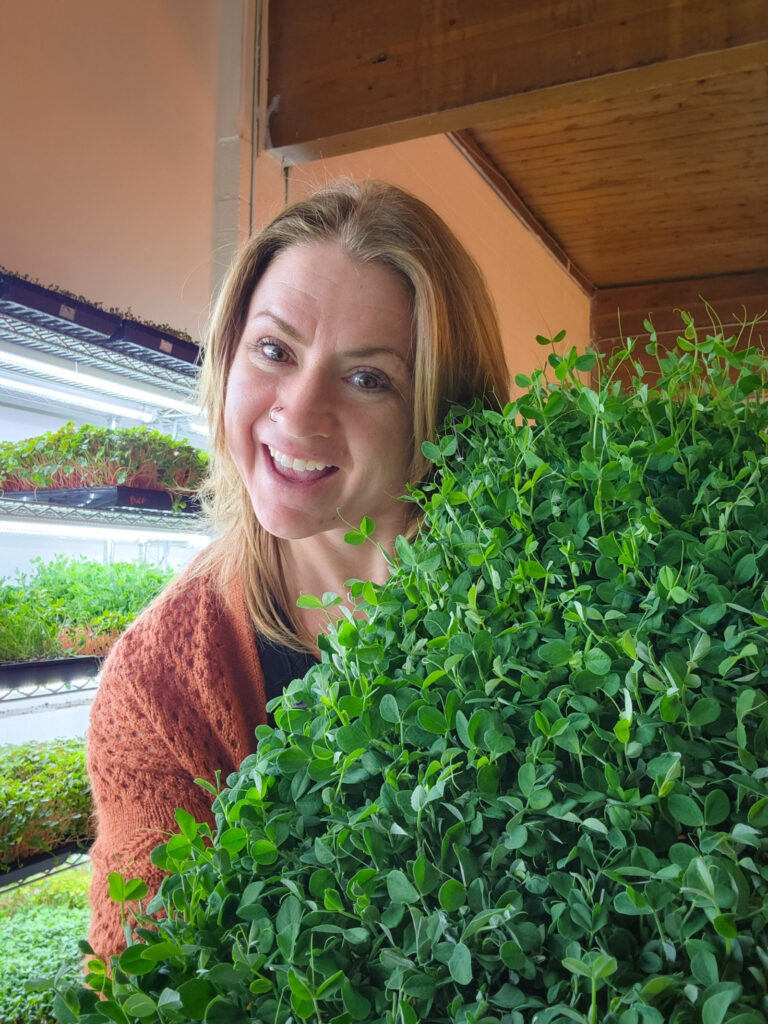
Providing fresh, nutritious food choices for Ogdenites.
Anne Dunaway’s small grocery store and hydroponic growing facility in a downtown Ogden neighborhood appears like an oasis in the desert — a food desert, that is.
Dunaway, a single mom and entrepreneur, began growing microgreens in her garage in 2018. That gave birth to Urban Prairie Agriculture, her business focused on nurturing fresh local food sources that can boost health and strengthen communities.
But her latest leap — the indoor grow facility and storefront in a low-income urban neighborhood — involved buying and retrofitting an old building and getting the necessary permits from Ogden City to begin production.
That sometimes confusing process took several months longer than expected, which led to the loss of lucrative contracts that could have supplied $8,600 in revenue each week, Dunaway said.
In October 2023, Dunaway focused on purchasing the 65-year-old structure at 301 28th Street, and completed that transaction in March 2024. But she later learned of costly improvements that Ogden City required in order to issue her business license.
While Dunaway had hoped to host the market’s grand opening in mid-May, that date got pushed back to July. And it wasn’t until late September 2024 that she finally obtained her operating license. By then, the major contracts had disappeared.
Those hurdles seemed like a “gauntlet of impossible and often conflicting city processes,” Dunaway said. But now she’s scrambling to line up new contracts and meet production timelines posted on her warehouse wall.
PLANTING SEEDS, MOVING FORWARD
Dunaway described her wall calendar as “pretty regimented,” with weekly seed planting and transplanting rotations that would provide the most efficiency in building out each portion of the indoor farm that will also feature a wall of strawberries and arugula.
By mid-January 2025, Dunaway’s indoor hydroponic farm took root and began to blossom.
“We’ve got several units going. We’ve got Indoor tomatoes flowering, and we’re on our way,” Dunaway said. “As we’re able to feed, start and propagate more plants, we’ll just keep going.”
Along with microgreens, tomatoes and various herbs — including cilantro — Dunaway also expected lettuces to mature by early February.
“That will be a good start,” she said, projecting that her warehouse has at least 10 times more capacity to cultivate edible plants.

SHORTENING THE FOOD CHAIN
Urban Prairie’s compact indoor market features locally grown and manufactured food products that diverge from the processed stock found on many grocery store shelves.
Providing fresh, nutritious food choices within walking distance matters in this neighborhood where convenience or dollar stores currently provide the only grocery options.
According to the U.S. Department of Agriculture, a food desert exists in areas where more than 30 percent of residents live in poverty and at least 1/2 mile away from a supermarket, supercenter, or large grocery store.

SHARED VISION
Carla Trentelman, a retired sociology professor at Weber State University, said she first got to know Dunaway at Ogden Farmers Market where they bonded while discussing sustainable food systems.
“Annie’s focus from the start has been two-fold: how can we get local small farmers to be able to have places where they can sell their goods, and also, how can we create better food situations for people who have not had access to good fresh food,” Trentelman said. “I love it, I think it’s a win-win.”
Ogden City Councilwoman Angela Choberka said she first met Dunaway nearly a decade ago while working with United Way. And in her current job managing equity initiatives with Intermountain Healthcare, Choberka has seen how lack of healthy food choices impact people.
“I’m really excited that she’s attempting to have that store right down in the Jefferson Park area,” Choberka said.
While representing Ogden’s House District 10, former Rep. Rosemary Lesser met Karl Ebeling on Utah’s Capitol Hill.
Ebeling serves as director of Eden Streets, a nonprofit focused on utilizing community-based farming to address social challenges worldwide. Through Ebeling, Lesser connected with Dunaway.
“Both Annie and I are now on Eden Streets’ board together,” Lesser said. “I believe in the importance of doing everything we can to eliminate food deserts and introduce healthy eating to people who may not be exposed to those choices.”
Stephanie Howerton, co-owner of the Local Artisan Collective in downtown Ogden, said her friendship with Dunaway reaches back at least six years.
“It’s been pretty cool to see her go from just microgreens to a whole store,” Howerton said. “It’s fun to watch that progress.”
In addition to microgreens, the market often features eggs, mushrooms, sourdough, granola, hot sauces, salsas and more. But microgreens rank as Howerton’s favorite buy.
“They’re fun to do in a variety of ways … with apples on your sandwich,” Howerton said. “I love adding them to everything — like in the morning on my eggs.”
Feature Image: Anne Dunaway, founder and owner of Urban Prairie Agriculture. Photos courtesy of Anne Dunaway.