Go Local

Aerial Adventures in Moab: Fly, Float & Freefall

Moab’s most daring adventures don’t happen on the ground. Whether you’re leaping from planes, floating in a hot air balloon at sunrise, or soaring over red rock canyons in a plane, seeing Utah’s wildest landscape from the sky offers a whole new perspective — and a serious adrenaline rush for those brave enough to take…

|


Moab Air Adventures: The Sky’s Not the Limit

Some come to Moab for the arches. Others come for the trails. But the real thrill-seekers? They look up. If hiking, biking, and Jeeping aren’t enough, Moab’s sky-high adventures will take your breath away — literally. 

From skydiving at 15,000 feet, to BASE jumping off sheer cliffs, Moab is where the truly fearless take flight. And for those who prefer to cruise the skies at a slower pace, hot air balloons and scenic flights deliver an awe-inspiring look at Utah’s red rock wonderland.

Skydiving Over Moab: The Ultimate Leap

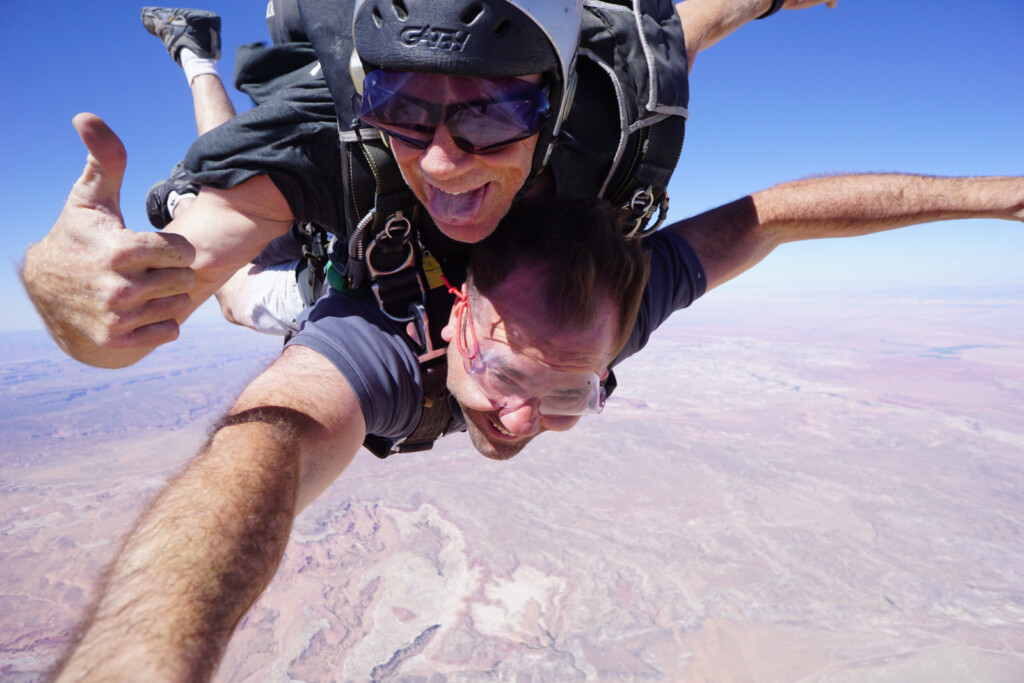
Want to see Moab from a new perspective? How about doing it while freefalling at 120 mph? Skydiving over Moab isn’t just about the adrenaline — it’s about soaring over one of the most spectacular landscapes on Earth.

Skydive Moab offers tandem jumps from up to 15,000 feet, where first-timers are strapped to seasoned instructors for the ride of their lives. One moment you’re in a plane, the next you’re plummeting toward canyons, rivers, and sandstone towers. The rush is unmatched. And after about a minute of freefall, the parachute opens, and suddenly, the world slows down — giving you time to take in Moab’s vast beauty before touching back down.

Experienced skydivers can jump solo, carving through the desert air at their own pace. Either way, there’s nothing quite like freefalling over Utah’s legendary red rock landscape.

Hot Air Balloon Rides: A Quieter Kind of Thrill

Not every adventure requires a heart-pounding drop. For those who prefer to see Moab’s majesty in slow motion, a hot air balloon ride at sunrise is pure magic.

Drifting thousands of feet above the desert as the first light spills across the sandstone, the view is surreal. The La Sal Mountains rise in the distance, the Colorado River snakes through the canyons, and for a little while, the world below feels completely silent. The only sounds? The occasional burst of the burner and the wind carrying you over the landscape.

Canyonlands Ballooning operates year-round, offering passengers the chance to experience Moab’s beauty in its softest light. Unlike skydiving, where the thrill lasts seconds, a balloon ride gives you time to soak it all in — every curve of the canyons, every shifting shadow on the rock.

Photo by Richard Markosian.

Airplane and Helicopter Tours: The Grand Tour

For those who want to cover as much ground as possible — without strapping on a parachute — airplane and helicopter tours offer the ultimate bird’s eye view.

Redtail Air provides fixed-wing flights over Canyonlands National Park, Dead Horse Point, and The Maze, one of the most remote and dramatic landscapes in the Southwest. From above, the Colorado and Green Rivers carve through the canyons, revealing millions of years of geological history in a single glance.

Helicopter tours bring you even closer, flying low over sheer cliffs and rock formations that are impossible to reach any other way. Seeing Moab from the air isn’t just about the views — it’s about perspective. From the ground, the canyons feel massive. From the sky, they stretch on forever.

BASE Jumping: The Boldest Leap

For some, skydiving isn’t extreme enough. That’s where BASE jumping comes in. Instead of jumping out of a plane, BASE jumpers hurl themselves off sheer sandstone cliffs, with only a parachute to break their fall.

Moab is a world-renowned BASE jumping destination, attracting the boldest jumpers to spots like Mineral Bottom and Tombstone Butte. These towering rock formations provide the perfect launch pads for those ready to take the ultimate leap. But make no mistake — this sport is for experts only. There’s little room for error, and the stakes are sky-high.

For those who want to experience the thrill without years of training, Tandem BASE offers a way to jump with a professional instructor. Even for spectators, watching a BASE jumper step off a sheer rock face and glide to the ground is nothing short of mesmerizing.

The Sky’s the Limit

Moab is a place that redefines adventure, and its aerial experiences are no exception. Whether you’re free falling, floating, or flying, one thing is guaranteed — once you see Moab from above, you’ll never look at it the same way again.

Feature Image courtesy of Skydive Moab.

, ,

Join our newsletter.
Stay informed.


  • Inside Moab’s Political Divide: Land, Tourism, and the Future of Grand County, Utah

    In the late 1950s, Edward Abbey took a job as a park ranger at Arches National Monument, just outside Moab. What he found there, and what he watched happen to it, would shape the rest of his life. Roads were being cut into the canyon country. Cars were replacing foot traffic. The National Park Service, in the name of accessibility, was engineering a kind of industrialization of the wilderness he’d come to love. Abbey wrote about it in Desert Solitaire, published in 1968, and the anger in that book wasn’t abstract. It came from watching something specific be changed by people who either didn’t understand what they had or didn’t care.

    Grand County has long been the most reliably left-leaning county in the state, a fact that puts it in sharp contrast to nearly everything around it. To understand how that happened, and where things stand now, I spoke with longtime residents and politicians who’ve watched it from the inside, people who’ve served in local government and lived through the shifts firsthand.

    Robert Greenberg.

    Bob Greenberg came from New York in 1976, took a job at the community mental health center, and never left. He went on to chair the Grand County Democratic Party and serve on the county council. When he arrived, he said, “the Democratic Party was said to be able to meet in a phone booth” — and even then, its members were a contradictory bunch. Yellow Dog Democrats from the oil patch were fiscally conservative but surprisingly open socially, allowing different demographics to feel safe moving to the county. 

    “The town fathers were desperate to have new people come to town,” Greenberg recalls. “They just didn’t want the people who actually showed up. They wanted some other people.”

    What followed was a demographic shift nobody planned. The people who filled the gap left by the bust were river guides, federal agency workers, artists, and eventually waves of outdoor recreationists discovering that southeastern Utah was among the most spectacular landscapes on earth. Tourism ended up being the only economic development avenue that actually worked. Manufacturing never had the labor force or market access, sewing factories came and went. The people the tourist economy attracted tended to be younger, more outdoor-oriented, and more liberal.

    Kevin Walker.

    Kevin Walker, a former Grand County commissioner who moved here in 1990 for the landscape, puts the county’s diversity in context. “Moab [is] a pretty diverse place since, I think, at least the 1950s with the uranium mining boom,” he says. “So it’s not a typical Southern Utah town.” 

    Part of what makes Grand County distinct is self-reinforcing. Federal agencies like the Park Service, the Forest Service, the BLM, have large presences here and pull in a different demographic than surrounding counties. People looking to live in Southern Utah with certain values gravitate toward the place where those values already have a foothold. Over time, that critical mass has made Grand County what it is politically, while neighboring counties went in very different directions.

    The defining conflict in Grand County has always been over land.

    In the 1970s and 80s, it was extraction versus preservation in the starkest terms. County commissioners floated toxic waste incinerators. A plan emerged to site a high-level nuclear waste repository at the entrance to Canyonlands National Park. 

    “It really, really galvanized environmentalists everywhere, but particularly in Grand County,” Greenberg says. Activists put up signs at the park entrance, watched them get chainsawed down, and came back with steel reinforcement. That stubborn, physical, unglamorous persistence became part of the local political character.

    Continue reading and support independent Utah journalism with a purchase of Utah Stories (Digital + Print) or 3 month free trial (Digital).


  • The Perfect Girls’ Day in Park City: Brunch, Shopping, Spas & Nightlife

    After a week of work, grocery shopping, meal prep, driving the kids around, housework and last minute emergencies, a day of bonding and fun with our BFF’s is just what the doctor ordered. Fortunately, one of the best getaways is just a short drive away to Park City.


  • Can Utah Farms Survive the Corporate Food System?

    Local farms and restaurants battle similar economic pressures as they struggle to survive in a tight economy where slim profit margins and increased labor costs and conditions are often beyond their control.


  • Moab Trail Closures: The Fight Over Public Land Access and Off-Roading

    Trail closures threaten livelihoods and slowly limit access to ordinary families, says Dave Hellman, owner of Xtreme 4×4 Tours in Moab. Wilderness advocates argue that stronger protections are necessary to preserve fragile landscapes. As lawsuits reshape trail access across southern Utah, Moab increasingly sits at the center of a growing conflict over who public lands are really for.