Community Relations

Why Utahns Like to Collect Things?

Utahns collect things. Lots of things. Sports cards. Timepieces. Figurines. Olympic pins. If you can name it, someone has a collection of it. But what prompts a person to become a collector? Is it a collecting “gene”? An obsessive personality? A brain disorder? It could be all these things and more.

|


There are many answers to this question of why people collect, but mostly, it’s lots of fun.

Salt Lake has active collectors in two popular areas ― numismatics and philately ― fancy names for coin and stamp collecting. 
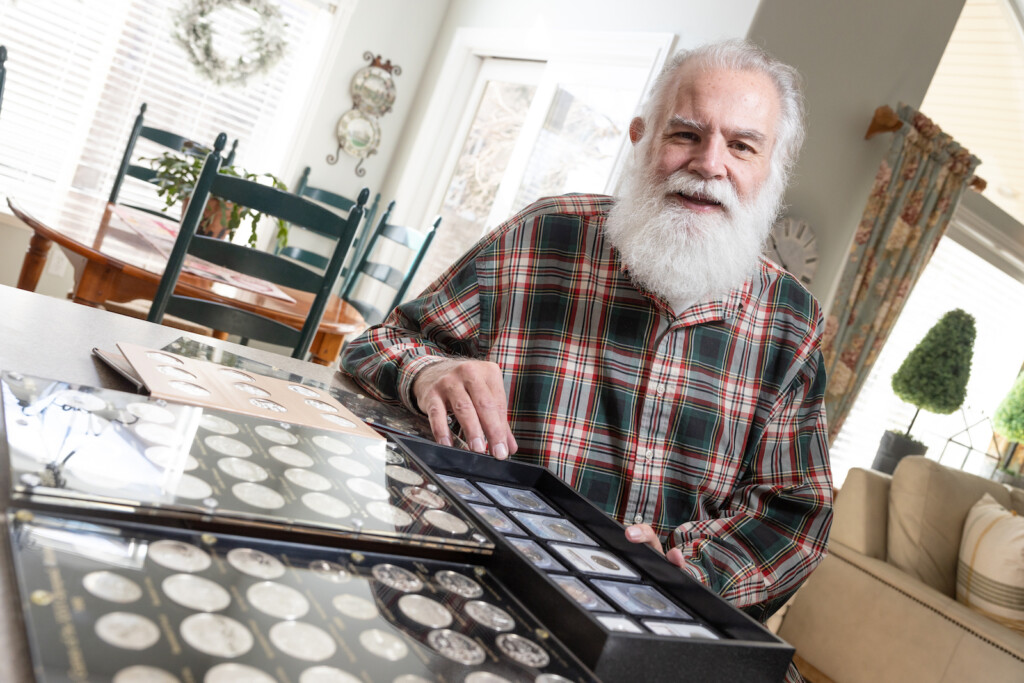
Bruce Wayne Briggs and a sample of his coin collection. Photo by John Taylor.

“I’m a huge nerd with a passion for history,” says Bruce Wayne Griggs. Bruce has been collecting since childhood and is an active member of the National Utah Token Society (N.U.T.S.) and Utah Numismatic Club

Both coins and tokens provide Bruce with an emotional connection to past events. In pioneer times, hard currency was difficult to obtain. Stores and trading posts issued their own tokens to facilitate commerce. 

Bruce has taken this interest to an artistic level by designing nine medals focusing on aspects of Utah history. The most recent was struck to remember the Topaz internment camp for Japanese-Americans during WW2.

For Bruce, shiny discs of metal are only part of the story, but there is a social aspect as well. “Being part of a club allows you to find others to share your nerdhood,” he says. His advice to young people seeking to start coin collecting? Get a 50 cent roll of pennies and a coin book in which to place the unique dates. There is a certain dopamine rush when a missing coin appears.

Stamp collecting also has its allure. Anyone complaining about the high cost of postage can take heart that an American airmail stamp from 1918 ― the Inverted Jenny ― recently sold at auction for two million dollars. Utah collectors may salivate at such an addition to their holdings ― a dopamine rush indeed, but are happy to expand in other directions.

Stamps provide myriad ways to satisfy the collecting urge. There are topical collectors focusing on art, sports, dinosaurs, music, etc., country collectors, collectors by era, and first-day-of-issue collectors to name several. 
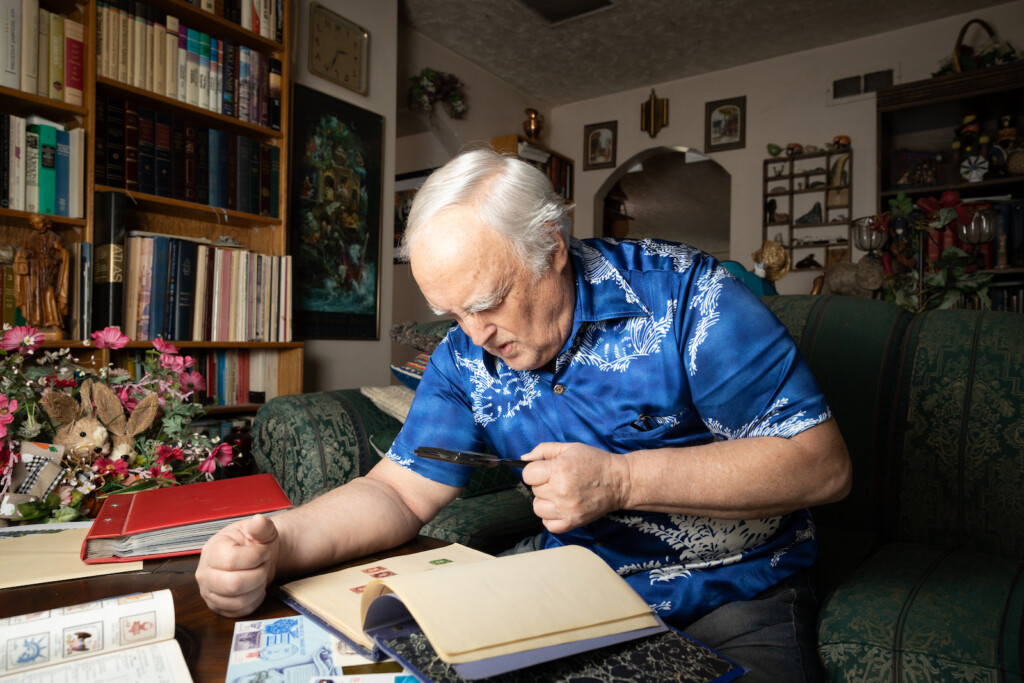
Steve Baldridge, president of the Utah Philatelic Society, examines one of the stamps in his collection. Photo by John Taylor.

“Stamp collecting can go any way you want it to,” says avid collector Dave Blackhurst. Take Steve Baldridge, for example, who is president of the Utah Philatelic Society. He has collected since age nine and currently has 50 albums and is still expanding his collection.

“It is as addictive as heroin but more expensive,” he laughs. Rick Leimbach echoes this sentiment. “It’s not about what you have, but what you don’t have.” Rick chose a second path of the hobby ― beginning young and then letting it go dormant only to regain interest later in life.

As it is with numismatics, the friendship involved with philately is also rewarding. “You can learn art, history and culture. The stamp club is enormously helpful in discovering the scope of the hobby,” Steve says.

Take a look at the upper right corner of the next letter you receive. The stamp there may not be worth $2 million, but it could be the start of something equally as rewarding.

Feature Image: Stamps from Steve Baldridge’s collection showing stamps that have a Utah connection. Photo by John Taylor.


,


Join our newsletter.
Stay informed.


  • Has Utah’s Soft-on-Crime Justice Reform Made Communities Safer?

    Has this “soft-on-crime” approach resulted in safer streets?

    SALT LAKE CITY — A decade has passed since former Utah Governor Gary Herbert signed a massive justice reform bill into law in hopes that the state could reduce its prison population and manage low-level offenders through rehabilitation programs instead of incarceration. Has this reinvestment resulted in lower crime and recidivism rates?

    According to the Utah Department of Corrections, that landmark Justice Reinvestment Initiative aimed to “continue holding offenders accountable and securing our communities, but in a way that considers individual risks and treatment needs.”

    Are communities really safer when mental health and substance use needs are addressed through programs administered outside prison walls? The idea was to treat criminals differently based on their mental health needs and backgrounds. But at least one retired Adult Probation and Parole Officer, believes this “soft-on-crime” approach hasn’t resulted in safer streets.

    LOOKING BACK

    State Senator Todd Weiler, in that legislative role since 2012, helped drive the passage of the Justice Reinvestment Initiative (JRI), a massive bill that enjoyed broad-based approval among state officials and the Legislature as a whole.

    In November 2014, Weiler attended the national summit on the issue in San Diego, an event hosted by Pew Charitable Trusts. 

    “I was very involved in it. We had a lot of high hopes,” Weiler, a Woods Cross Republican, said in a recent interview. “That was about the time we were finalizing plans for the new prison. And we actually said that because of JRI we don’t need as many beds because we’ll be incarcerating fewer people. So that new prison was designed with this idea.”

    A key part of JRI dealt with adjusting sentencing for crimes related to addiction, dividing offenders into two basic groups: dangerous criminals who are a threat to society (that group goes to prison), and low-level offenders who get help kicking addictions through state-sponsored programs or private-sector rehabilitation.

    “The ultimate goal was if we have an otherwise good person who got caught up in an addiction, and as a result committed crimes, they need to be punished for their crimes,” Weiler said. “It’s not that we’re going to overlook what they did, but we wanted to focus primarily on helping them overcome their addiction and [that means] getting them back to their job and their family.” 

    Before JRI, low-level drug offenders with felonies would spend years in prison, which wreaked havoc with their lives and future prospects. Addressing the root cause of their theft and property crimes through supervision and treatment made sense. 

    “We’re all imperfect people,” Weiler said. “So we want people working their jobs, paying their bills and raising their kids rather than sitting in jail and watching TV or playing cards.”

    To access this post, you must purchase Utah Stories (Digital + Print) or 3 month free trial (Digital).


  • Salt Lake City Newcomers Club: Finding Friendship and Belonging Since 1948

    Moving away from your hometown can come with many blessings. But for some, it also comes with just as many bouts of loneliness. That ache of not knowing where to meet people, or grieving the friends you left behind, comes in waves. Workplaces and churches can sometimes provide ready-made communities, but what happens when they don’t? Where do you go to find true belonging?


  • A Ski Village or a Tipping Point? Nordic Valley Expansion Divides Ogden Valley

    The project, known as Nordic Village, is expected to roll out over the next decade and represents one of the largest tourism developments in the valley’s history.