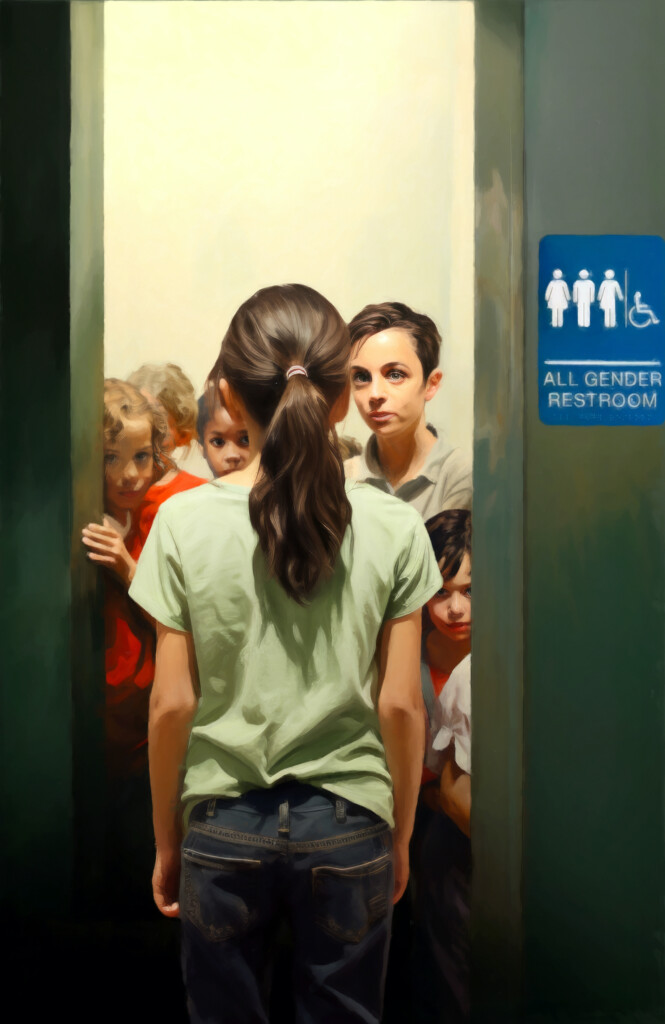
We’re all glued to the news screen, watching the battle between people who want to use the public bathroom that is for their identified gender and the people who want birth-gender to be the deciding factor for which bathroom anyone uses. This battle is not exclusive to the United States. It is world-wide, with each country handling it in their own way.
Title IX
In the United States, the US Department of Education refers to Title IX when the topic of transgender bathroom use is brought up. Title IX is the law that protects students and employees in public education from discrimination based on gender:
“ … No person shall, on the basis of sex, be excluded from participation in, be denied the benefits of, or be subjected to discrimination under any academic, extracurricular, research, occupational training, or other education program or activity operated by a recipient which receives Federal financial assistance.”
Since its first inception, it has undergone some adjustments, and in the near future may get even more.
As all laws are, Title IX is open to interpretation. When it comes to someone who identifies as a gender other than what they were assigned at birth, or someone would say “biologically born”, does it count as discrimination when it comes to who gets to use which bathroom at public schools and locker rooms?
Adult Man Using Women’s Locker Rooms
Dea Theadore, councilmember for Salt Lake County Council was contacted by a woman named Candace Duncan, who reported being watched by a man in a public locker room on two separate occasions as she left a shower in a public facility. In July, Theadore released a press statement that said the following:
“I requested my staff to immediately draft a policy addressing the issue of adult men using women’s locker rooms. I understand there might be some Constitutional questions regarding this issue. I anticipate and encourage much legal review from our County Council attorney, the DA’s office, and possibly from the State level.”
Salt Lake County Parks and Recreation also released a statement saying:
“We are aware of the concerns raised by one of our patrons. And responded to them in December of 2022. We will continue to work collaboratively with the public, and stakeholders to maintain the safety, legal protections, and integrity of all who use our recreational facilities.”
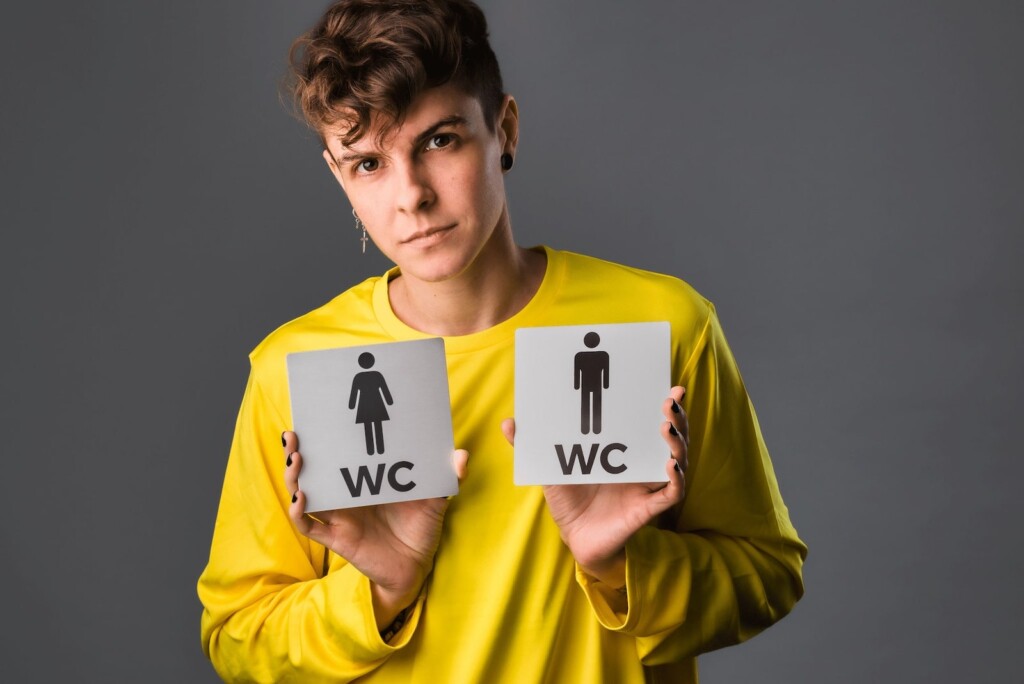
If there aren’t official policies on gendered bathroom/locker room use at the county level, what about cities? What about public schools?
Public Schools Bathrooms
A Jordan School District board meeting was packed full of parents and state school board leaders in September, voicing their ideas of who should be allowed in what bathroom in elementary and secondary schools.
Natalie Klein, a member of the state board of education, spoke to the board and residents saying, “Any legitimate education should be based on truth. Even if in the current environment of censorship and political correctness some find that truth to be uncomfortable. One truth is, boys are boys and girls are girls. And no amount of name, pronoun, hairstyle or wardrobe changing can change that biological fact.”
She continued, citing US Department of Education law Title IX, that genders are protected from harassment and assault in schools. “ … [W]e have at least one school in Jordan School District, likely more, that are telling girls to use the faculty bathrooms if they are not comfortable sharing the girls bathroom with boys who claim to be girls. This school has made this decision informally, citing Title IX.”
She continued saying that allowing biological boys into a girls’ bathroom is “psychologically abusive” and “immoral.”
Afraid to Speak Out
Christina Boggess, Utah State Board of Education representative in District 8, said that several people had reached out to her because they were afraid of what would happen if they spoke out.
“Some of these parents, because of genuine fear of government employees hired to represent this board, chose not to attend … they cited what they believed to be authentic incidents of retaliation to objective and justified concerns and refusal to engage by JSD (Jordan School District) personnel.“
One transgender child, Alison Sirivanchai and her father, Jesse, spoke immediately following the school board leaders. Alison was born a boy, but now identifies as a girl. Alison said, “I came here not to fight but to make peace. When I imagine myself as a grown human, I see a woman in a white dress, dancing through a meadow of flowers. And when I see that, I know that’s who I am.”
Jesse said that Alison must deal with comments almost daily about the bathroom she uses.
“She goes into the boys restroom but she’s not accepted there. She goes into the girls restroom and she’s not accepted there.”
Beyond Bathrooms
Randy Hoffman said that the problem is more than just who is allowed in what bathroom.
“According to this survey in 2022, 73% [of teens] have viewed pornography. 52% of boys and 36% of girls had intentionally watched it. And of those individuals, the majority viewed it regularly. And very importantly, of all teens, 52% had seen violent or aggressive pornography … that includes depictions of rape, choking or somebody in pain. It’s been found that early exposure to any pornography for males predicted more sexual harassment perpetration. Male teens exposed to violent pornography were 3 times more likely to commit sexual dating violence.
“If barriers are removed for decency and safety, it’s not a matter of when, but a matter of how often sexual assault is going to happen.”
Other comments included: “I’m not claiming that those who identify as the opposite sex are more likely to be perpetrators of such crimes. I’m just claiming that by favoring a subjective pass, Fox Hollow is opening themselves up to those who pose as girls to harm girls.”
A woman with a transgender child, who no longer attends public school, wanted to appease both sides of the issue.
“I hear both sides. I’ve always been conservative, Christian even. I get the fear. I get the concern that parents want to protect their daughters. I don’t want this open-door policy … we can meet in the middle. These humans, who were assigned male at birth, they’re not pretending to get a trophy. We do have some people out there who are troubled who are predators. But that’s not who we’re talking about here. We’re talking about people who have gender incongruence. You go and talk to ob-gyns; there are not just two genders. There’s chromosomes, things going on with the brains. There can be some common ground. We don’t have to attack. We don’t have to label them predators.”
A charter school in Sandy, Beehive Science and Technology Academy, does not have an official policy, but an established practice. Vice Principal, Kim Hamilton said, “We do not have an official “policy” regarding LGBTQ+ and locker rooms or bathrooms. However, when we built our new facility, we added Gender Neutral bathrooms and a Gender Neutral Locker room. Students tend to prefer the gender-neutral option regardless of gender identity and we haven’t had any problems.”
Sophia Hawes-Tingey served on the Midvale Community Council for many years before moving to West Valley City where she now is running for council office. She serves as the chair of the Transgender Inclusion Project, is Vice Chair of the Utah Stonewall Dems, and is on the board of the ACLU of Utah. Her thoughts bring around another thought to chew on.
“This is a very nuanced issue. While I am not discounting her experience, she is making the assumption that anyone who appears to be male (or male enough) is a threat to our children. It also assumes that women in general are perfectly safe with children. I have cisgender female friends who have been clocked as male. The proposed policy would harm them as well,” Hawes-Tingey said.
There are laws on the books against assault with severe penalties, and that assault does not strictly come from biological males. It can come from biological females as well.
“Private stalls should be available for everyone,” she elaborated. “As a parent, you should be concerned about your child’s privacy, no matter their gender or gender identity, and help them to protect their privacy. Just because someone makes you feel uncomfortable, them making you or anyone else uncomfortable is not against the law. It wasn’t that long ago that we had laws against people of color in the same facility, even using the same pool, because they made other people uncomfortable, so the public facilities were segregated in the name of safety.”
Theadore is still in the process of drafting county legislation.
“I am still in the process of drafting a policy with the assistance of our council attorney as well as the district attorney’s office. I am also seeking a meeting with our parks and recreation department to discuss. To have a piece of legislation come before the council, two council members must sponsor the bill. I already have a co-sponsor when the legislation is ready. I will also need 5 votes to pass the legislation,” Theadore said.
There are not a lot of policies and laws that explicitly state which public bathrooms and locker rooms are meant for gendered/transgendered individuals. Watch for federal updates to Title IX, and further legislation from schools, counties, and state to see what becomes law, and what is simply policy from one building to the next.
Feature image by Dung Hoang.