Debate

305 Feet Tall Residential Project To Be Built In Sugar House

A developer, located in Illinois, has petitioned for a Sugar House zoning change to allow a building that would tower over the existing infrastructure there.

|


This once quaint neighborhood could soon compete with Salt Lake City’s downtown for sun-blocking skyscrapers packed with high-density housing.

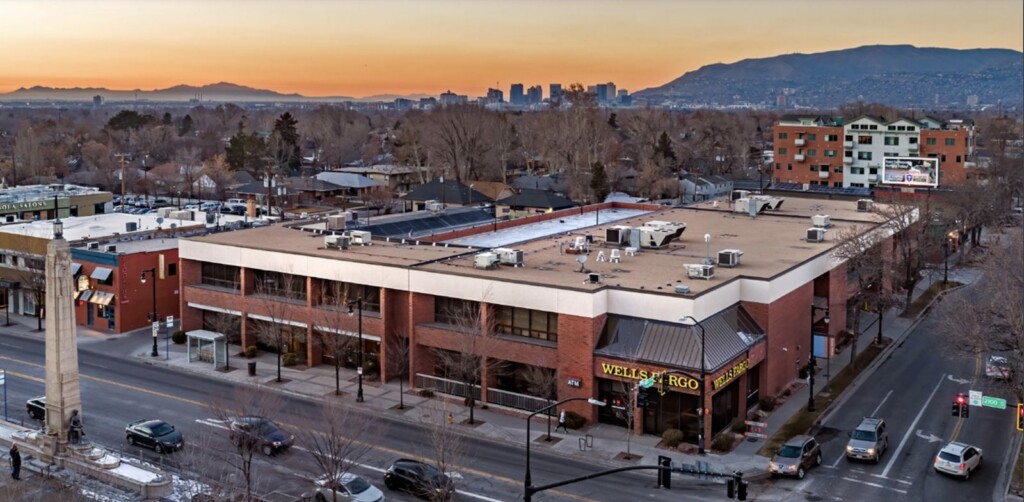
In January 2023, Build Salt Lake reported that Harbor Bay Ventures had plans to redevelop the old Wells Fargo site at 1095 East 2100 South into a massive residential project that could reach 305 feet in height if a zoning change to the community’s 2005 master plan gets approval.

The 1.2-acre parcel represents the heart of old Sugar House, an eclectic haven at risk of vanishing altogether as properties change hands and developers usher in dramatic changes.

Current business district zoning along 21st South caps building heights at 105 feet, also specifying active uses at ground floor level.

Illinois-based Harbor Bay Ventures teamed with the private equity Bascom Group out of Irvine, California for this project that aims to bring the first mass timber residential building to the Salt Lake City area. 

Building Salt Lake described mass timber as posts, beams, and panels made of factory-pressed wood. The material reportedly performs well in seismic events and can be more cost effective than concrete and steel. 
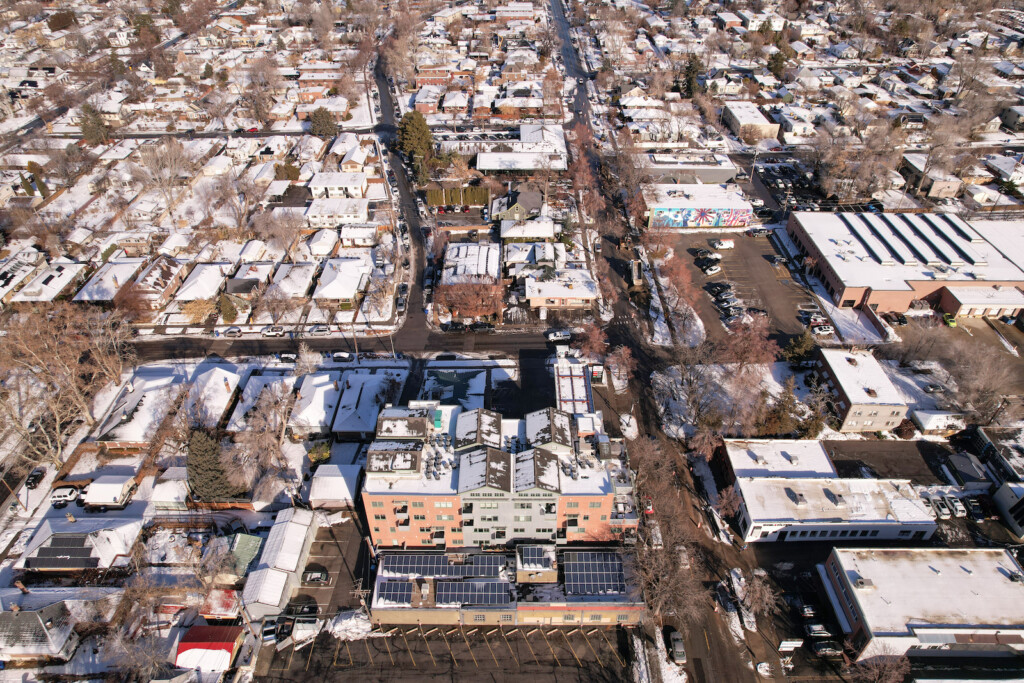
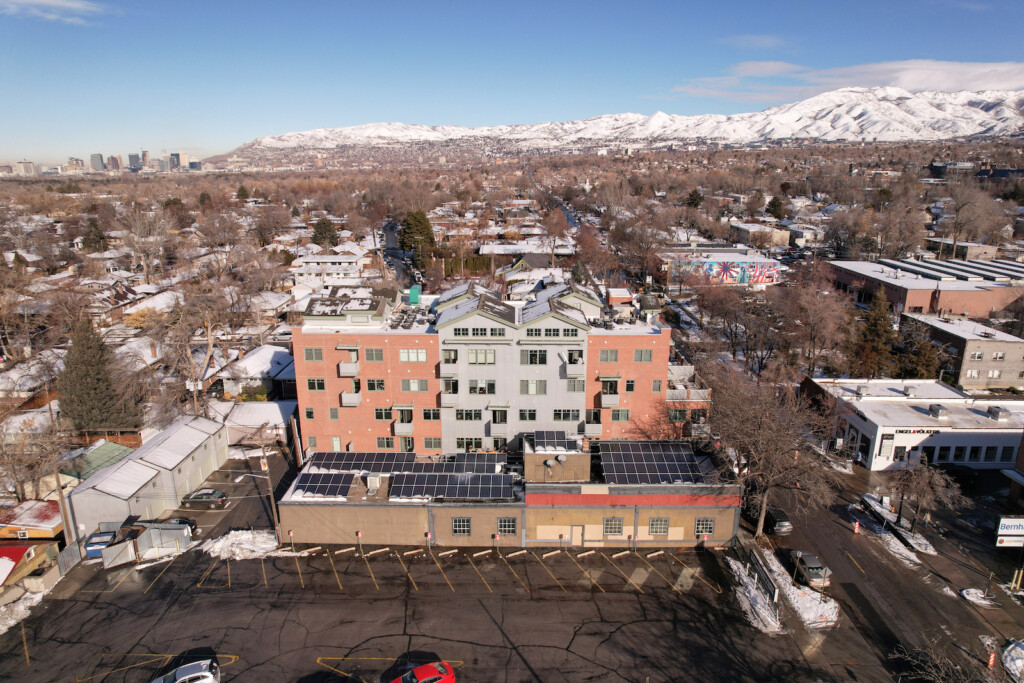
Drone photo taken at 305 feet, the heighth of the proposed building at the Wells Fargo site. Drone photos by Kelly Hannah.
Drone photo taken at 105 feet, the current limit for building height in Sugar House.

Too Much Shade?

Kelly Hannah purchased his Sugar House property at 1988 South 1100 East in 2011 after carefully scrutinizing the community’s master plan. 

But now he fears that if the pending sustainability zone gets approved, his business — less than 200 feet north of the proposed project — will “literally be in the shadow of this building.”

As a licensed drone operator, Hannah took two photos in mid-January of the site to compare the 105-foot height to 305 feet. 

Hannah, owner of Eightline Real Estate, also shared his concerns  in writing to city officials. 

“While there are a host of reasons this proposed amendment should be denied, my core concern is that the developer is effectively asking for a spot approval zoning exemption,” Hannah said. That, he warned, “would create a disastrous precedent for the future growth and development of Salt Lake City, in whole.”

Deja Vu?

Some small business owners in Sugar House vividly remember the razing of old and historic buildings on the south side of 21st Street to make way for a new mixed-use development.

Financial challenges caused that plan to stall for four years after long-existing structures had been demolished, and the vacant lot acquired the nickname of “Sugar Hole.”

Resources finally came together by 2011 to commence construction of The Vue, a massive seven-story apartment building with ground floor shops, restaurants and a parking garage underneath.

But photographer Laurie Bray fears the proposed Wells Fargo development will impact her business at 1066 East 21st South even more directly than the one across the street.

“The project is way too tall for the area,” Bray said. “Some posts on social media are in favor of it, saying it will bring more customers to local businesses. But people that live in all the apartments are really not frequenting local businesses anyway.”

Bray said she’s seen 15 restaurants come and go on her own block since 2014, even as apartments sprouted in the space where Granite Furniture formerly stood.

“Just because you build it doesn’t mean they will come,” Bray said.

Oversized ambitions?

In support of the project, the law firm of Snell & Wilmer wrote a 24-page petition to Salt Lake City’s Planning Commission last November listing the project’s potential benefits.

“Salt Lake City is experiencing a housing crisis that demands a bold response,” the letter said. “The proposed zoning map amendment will permit the development of a unique mass timber mixed-use project that is focused on sustainability. Mass timber has become recognized as a central building material in a global effort to reduce Greenhouse Gas Emissions within the built environment.”

The letter also touted its proximity to existing neighborhood services, arguing that increased population density would encourage “utilization of public transit, cycling, walking and carpooling within this portion of the city.” 

What’s next

The public comment period for the proposed zoning change — which would apply only to this particular 1.2-acre parcel — opened December 26, 2023, and are still on going. The developer presented an overview of the project to the Sugar House Community Council on Jan. 31. You can find the form to submit comments here.

Next in the process: the Salt Lake City Planning Commission will hold a public hearing for additional comments, and will then make a recommendation to the Salt Lake City Council, which is responsible for making the final decision to accept or reject the requested sustainability zone for this 1.2-acre parcel.


, ,


Join our newsletter.
Stay informed.


  • Ogden Utah: Boomtown, Bargain, or Utah’s Next Unaffordable City?

    With its reinvigorated downtown and close proximity to mountains and river pathways, this northern Utah city is enjoying a renaissance. Ogden’s stock of affordable housing — compared to other metros along the Wasatch Front — currently draws people in for a closer look. 


  • The End of an Era? FanX and the Salt Palace Closure

    For more than a decade, FanX has called the Salt Palace home. With the convention center set to close for a massive renovation, founder Dan Farr is preparing for a new chapter while planning one final celebration in its longtime venue.


  • The Stratos Project and Corporate Power: Who Controls Utah’s Future?

    If we were all just consumers, Governor Cox, Mike Lee, Speaker Schultz, and Kevin O’Leary would have it easy. If we were just more concerned about money, jobs, and tech, and less concerned about raising our kids in communities (not in front of screens), culture, the environment, and water, those smart dudes would get exactly what they want — Stratos: a city of the future, buzzing with processors and transistors, making all of our AI dreams come true! 

    The world we could live in would be a dazzling, Mr. Wonderful kind of place. We would beat those pesky Chinese in the AI war; our AI robots could do all of our farming and ostensibly harvest the water we need for the Great Salt Lake out of thin air. But apparently, we just don’t get it. We haven’t yet reached the point predicted by Aldous Huxley’s vision in Brave New World, where we are completely distracted, dopamine-driven consumers who only need sex, drugs, and stuff to remain happy.

    Maybe Stratos will be an amazing marvel, and somehow, as Governor Cox claims, “. . . add more water to the Great Salt Lake.” But we aren’t sold. While this Stratos project has received considerable attention, it’s worth taking a step back to attempt to understand how corporate power appears to have usurped civic power.

    Civics is the practice of shaping our society through our collective voices and community involvement. Ask the residents in Tremonton, Utah how well that is working out for them. Can we still shape our world through our elected leaders? Does it matter who we vote for at the ballot box if organizations like UDOT, UTA, and MIDA can supersede our local government authority and citizen backlash? 

    The corporatization of our communities and the interests that impact our political leaders’ decision making processes are seen as far more of a concern than the average Utah resident’s concerns. Special interests and corporate power are shaping Utah’s future more than ever. 

    It’s worth asking: ‘How can we regain control over shaping Utah’s future in light of the growing power and billions that the technocrats now wield in shaping our world today?’ Amazon’s market cap exceeds the GDP of Canada. The “Magnificent Seven” tech stocks now have a greater market cap than the entire GDP of Europe ($23.6 trillion. EU countries have $19.3 trillion GDP). Will tech companies become their own nation-states and dominate their own chunks of various states? Will we become their subjects?

    There are two sides to this coin: We love Utah not just because we have the most outdoor wilderness playgrounds, but also because of Utah’s prosperity and job market. This is because Utah has become a tech hub. Our tech leadership has minted several billionaires and billion-dollar businesses. Utah offers a market and an educated workforce that more businesses and giant corporations want to be a part of. This is a benefit for even non-tech Utahns.

    The problem with this success is that as we dole out more money to attract more tech businesses, data centers, fulfillment centers, and big corporate retailers, it becomes more difficult to carve out our “sense of community.” As corporate sovereignty replaces local business sovereignty, we see that our voices and our votes matter less.

    Ask who our politicians work for, and nearly every Utahn believes they work far more for their corporate donors than they work for the average Utah citizen. So how do we best regain control over our communities?

    Continue reading and support independent Utah journalism with a purchase of Utah Stories (Digital + Print) or 3 month free trial (Digital).


  • The Utah Farm That Refuses to Give Up as Development Closes In

    Running a farm is hard enough, but rapid city growth makes it even tougher. More than a decade ago, the late Verl Cook faced a series of staggering hurdles that threatened to wipe out his family’s livelihood.

    First, the city decided to treat the Cook’s greenhouse — the most profitable part of the farm — like a big-box retail store. They demanded the family build a paved parking lot, a project that would cost $200,000.