Utah Stories

Hammer Spring Distillery: Crafting Grain-to-Glass Spirits with Care and Passion

Introducing Hammer Spring Distillery JP Bernier is the founder and owner of Hammer Spring Distillery. He recently discussed with Richard Makosian, publisher of Utah Stories and host of the Utah Stories Podcast, his journey of starting the distillery in 2016, and the challenges of founding a startup in such a competitive market.  JP explains that…

|


Introducing Hammer Spring Distillery

JP Bernier is the founder and owner of Hammer Spring Distillery. He recently discussed with Richard Makosian, publisher of Utah Stories and host of the Utah Stories Podcast, his journey of starting the distillery in 2016, and the challenges of founding a startup in such a competitive market. 

JP explains that he decided to enter the industry early to avoid being overwhelmed by Utah’s growing number of distilleries. On the podcast, JP talks about focusing on cash-forward growth rather than relying on heavy marketing or leveraging. 

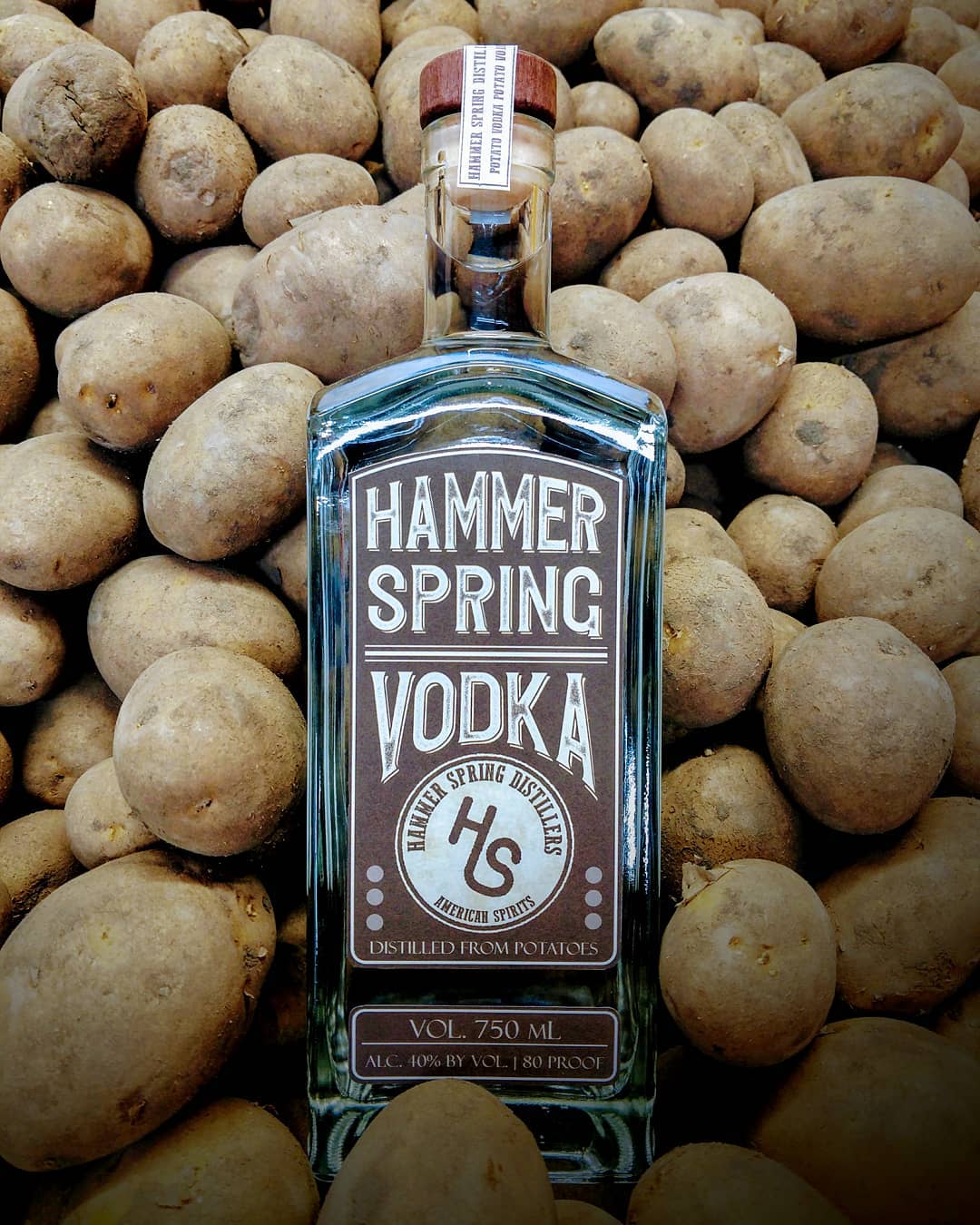
Hammer Spring Distillery produces grain-to-glass spirits, including potato vodka and bourbon, and they handle the entire production process in their shop, from milling the grains to bottling the final product. Another important component is the importance of careful distillation to avoid producing toxins that can cause hangovers. JP explains the process of separating the heads (undesirable components) from the hearts (good alcohol) during distillation.

In the broadcast, JP and Richard touch upon the challenges of getting good placement in liquor stores and the need for more specificity in labeling for craft distilleries, dicussing the differences between FDA regulations for food packaging and Tax and Trade Bureau (TTB) regulations for alcohol labeling, and expressing frustration with emphasizing bottle turnover rather than supporting local distilleries.

JP invites listeners to visit Hammer Spring Distillery for tours and tasting experiences. Sampling the barrel-finished gin, they discuss the flavors imparted by the oak barrel aging process, and JP explains the purpose of using juniper berries and other botanicals in their gin production.

JP touts the benefits of supporting the local economy by buying local liquor, while, at the same time, highlighting the diversity of the Utah distilling scene, where different distillers specialize in various types of spirits.

Liquor Laws In Utah

Shifting the conversation to Utah’s draconian liquor laws, JP expresses his frustration with certain restrictions, such as being unable to stand up with a drink in a club, or having tight proximity rules for manufacturers. He explains that the proximity rule restricts distilleries from being too close to public spaces like churches, schools, or parks. Also of concern is the concept of ‘steady states’, where the government controls the distribution, sale, and manufacture of alcohol, and the fact that most states in the US are controlled states.

“All the local people have that same struggle, and we kind of get the same song and dance from the state that, well, your numbers are low. And the common response is, ‘Well, I’ve only got two or three shelves, so of course my numbers are going to be low. Give me more shelves, and I’ll give you bigger numbers,’” JP said.

JP emphasizes his background as a design architect and a paramedic, and how his knowledge in those fields has influenced his work in the distilling industry. He also mentions his current pursuit of a business degree. 

Discussion of the Distillery’s Products

Rich and JP discuss various products in JP’s distillery, starting with the habanero-flavored vodka, which is based on a unique potato vodka made in Utah. JP personally sources the potatoes from a local farm, peels and crushes them, then ferments and distills them on-site. The habanero peppers are added to the potato vodka, extracting their spicy and earthy flavors without overpowering the drink. A great deal of  passion and effort go into creating this farm-to-glass product.

“And so the potato vodka, this is really a unique thing in Utah. We never found a commercial distillery in Utah, before or after prohibition, that sold a distilled potato vodka here. Now, that doesn’t mean there’s no potato vodka being sold in Utah, but that’s coming from resource repackaging or sourcing, which is fine, whatever, but it’s not actually made here,” JP explains. 

Eventually, the discussion moves to barrel-finished and silver gin, which share the same botanical recipe. The barrel-finished gin is aged in a used rye whiskey barrel for eight months, naturally giving it a light golden color. JP proudly claims that he uses no artificial additives in the process.

Next, they talk about bourbon, a grain-to-glass product made with 70% corn, rye, and wheat. The bourbon has a full and delicious flavor, with notes of butterscotch and toasted marshmallows. It ages for at least a year in small barrels, with the optimal aging time being around 18 months.

Coffee liqueur is based on a vodka infusion, and has a velvety texture with hints of chocolate. JP is excited that the state has finally decided to carry the coffee liqueur after years of effort.

Some of Hammer Springs products are available in liquor stores, such as the silver gin, coffee liqueur, and a sourced vodka called Hidden Vodka. The Hidden Vodka label is used as a fundraiser to raise awareness about human trafficking, with a portion of the proceeds going to the Utah Rape Recovery Center.

The podcast discusses the lack of media coverage on human trafficking and thanks JP for sharing his products and insights with Utah Stories’ listeners.


, ,

Join our newsletter.
Stay informed.


  • Artist Kate Kilpatrick Brings Utah’s History to Life Through Murals

    “I think we’re all interconnected; as individuals as well as societies,” Kilpatrick notes. Her work showcases those connections exuberantly, and whatever scale she’s working on, you can bet that in terms of energy and spirit, she’s painting large.


  • Why Most People Stay Stuck in Business and What It Takes to Move Forward

    Every so often, you meet an immigrant who came here with almost nothing and managed to build something exceptional.

    Prakash Shah is the kind of man who has spent enough time around risk that he no longer treats it like an interruption.

    Today, he works in business brokerage and advisory, helping owners sell companies, helping buyers decide whether they should step in, and, when the fit is right, helping connect those buyers with private equity. He works in a world of valuations, leverage, due diligence, and hard questions that most people would rather postpone. He also operates in Utah real estate and has built a career around seeing value before it is obvious to everyone else. That is who he is now. What makes him interesting is how early that instinct started to form, and how little his life resembles the way most Americans are raised to think about comfort, career, and security.

    He grew up in Nepal in a boarding school system that would feel severe to many Americans. He was an only child, yet he saw his parents only twice a year for twelve straight years, until high school graduation. He lived inside routine. He shared space with boys from different social classes and different family circumstances. The school was structured enough that money did not buy you any special standing once you were inside. Everyone followed the same rules. Everyone was subject to the same discipline. In his case, it was an army school. Everything was measured. Everything was scheduled. In that kind of environment, you do not build your life around preference. You build it around adaptation.

    That contrast matters.

    A lot of American children are raised to search for what fits them. What are you passionate about? What do you enjoy? What feels right? Those are not bad questions, but they can create a habit of waiting for life to align itself before action begins. Prakash learned something else much earlier. He learned that life often does not align itself first. You enter the room as it is, you deal with the people in it, and you figure out how to function without making your comfort the center of every decision. He said that one of the biggest lessons from those years was tolerance, the ability to live with people from all walks of life and genuinely learn to get along with them. That is not a soft value. In business, it turns into resilience. In negotiation, it turns into patience. In career terms, it turns into range.

    When he came to the United States over 25 years ago, he did not arrive with the kind of runway that allows for a prolonged identity search. He came with two suitcases and enough money for one semester. He went to Hunter College in New York City, then to NYIT near Central Park, studying media and then media and technology management. He also studied psychology. Those details matter because they show something about his mind. He was interested in people before he built a career around deals. Even then, what attracted him was not technical prestige. It was understanding motives, behavior, and how people reveal themselves.

    But New York is merciless toward vague ambition. It demands payment in rent, transit, food, and time.

    Prakash worked constantly. He took multiple jobs. He paid tuition, paid rent, and skipped most of what Americans imagine as college life. There were no romantic years of drifting from café to concert to self-discovery. He talked about not having the luxury of dates, travel, or finding himself. He was working. Even laundry was not a small detail. In New York, he pointed out, you do not just throw clothes in a machine at home. You haul them to the laundromat, count quarters, and measure what is necessary. He also described distraction in a way that most native-born Americans probably do not think about. For immigrants, distraction is not always pleasure. Sometimes distraction is the constant pressure of competing needs. Tuition or rent. Food or savings. A better coat or another month of making do. He was not romanticizing the struggle. He was describing the arithmetic of it.

    That arithmetic did not make him cautious. If anything, it did the opposite.

    While in college, he had the option of safer analytical work. Instead, he took a sales job with Time Warner Cable that sent him into the South Bronx from 6 p.m. to 10 p.m. to knock on doors. He is not a physically imposing man. He knew exactly what kind of neighborhoods he was walking into. He described apartment buildings where people kept pit bulls, where tension was normal, where one mistake in tone or timing could end a conversation immediately. For most people, that kind of job would have been something to survive and forget. For him, it became a school in human behavior. “It’s not about talking… it’s about listening,” he said.

    One story from that period says almost everything about how he operates. He knocked on a door one night around 8:45 and found himself facing a huge man with a gun on the table, pit bulls nearby, and a half-eaten pizza in front of him. It had all the ingredients of a very bad scene.

    Continue reading and support independent Utah journalism with a purchase of Utah Stories (Digital + Print) or 3 month free trial (Digital).


  • Ancient Pyramid Discovered in Sugar House Park, Salt Lake City

    A Salt Lake City resident says he may have uncovered what he believes to be a buried structure beneath a well-known hill in Sugar House Park, raising questions that have drawn both curiosity and skepticism.


  • Utah Fits All Scholarship Applications Open Through April 30 for K–12 Students

    Utah families have more learning paths than ever and, increasingly, more ways to make those paths affordable. This spring, the Utah Fits All Scholarship opened  for new family applications on April 1, and the application window stays open for one month. The program is a public K–12 scholarship that provides $4,000 to $8,000 per student,…