Moab

Don’t Wait Until 2029 to Visit Mars. Do It Now by Going to Utah Desert!

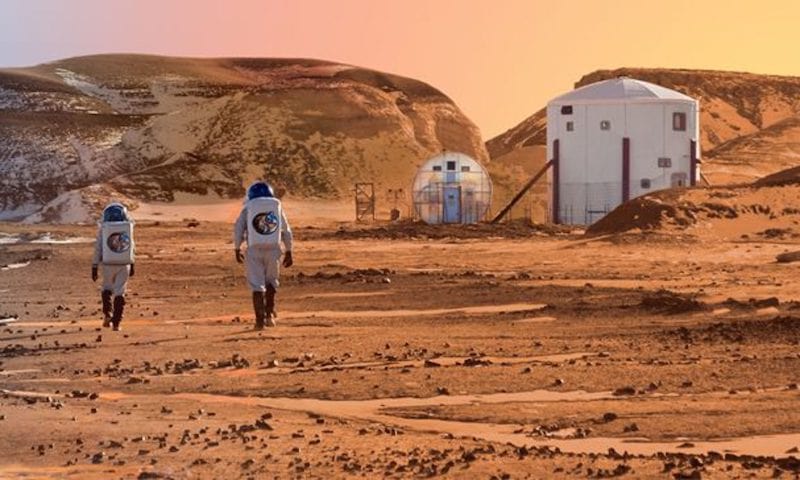
The Mars Desert Research Station (MDRS) is a “space” station located near Hanksville.  The Mars Society operates the laboratory in the remote BLM land expanse, which they describe as an “analog to Mars geology”.

|


Don’t Wait Until 2029 to Visit the Red Planet

We stumbled upon the Martian research station after exiting onto a dirt road near Hanksville, Utah; population 190. Signs are posted everywhere to not fly drones over the facility, so we didn’t.

Assuming we had finally found the new base where DARPA’s team must be keeping the descendants of Roswell’s Martians (kept alive since their untimely crash in Roswell, New Mexico in the early 1950s), we honored their seclusion and privacy and maintained our distance. We saw no sign of the aliens who are likely being housed inside, still unaccustomed to the heavy high-oxygen atmosphere of Earth.

The Mars Desert Research Station (MDRS) is a “space” station located near Hanksville.  The Mars Society operates the laboratory in the remote BLM land expanse, which they describe as an “analog to Mars geology”. MDRS takes researchers on 2-3 week missions. Crews need to carry out their missions in microbiological and geological laboratories. The station features state-of-the-art aquaponic growing systems as well as a 7.5-foot automated dome telescope.  Sleeping quarters reside in the upper deck of the “Hab”, which is a cylindrical building originally constructed in 2001.

The habitat offers an air lock where biological and geological experiments can be conducted in similar conditions to what the first colonists on Mars might encounter, 
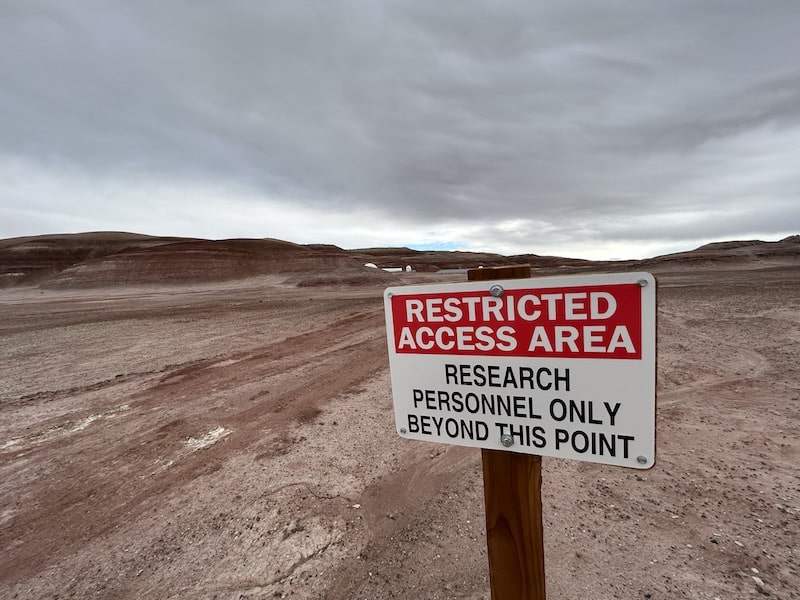
Photo by Richard Markosian.

By 2029, Elon Musk’s SpaceX will land a human on Mars. Musk hopes to accomplish the feat possibly before we destroy planet earth. While the actual planet of Mars is 140 million miles away, and will require over six months of travel time with primarily a CO2 atmosphere, this Mars station was about 14 miles off Cow Dung Road. The methane from cow dung assists in mimicking the Martian high-methane atmosphere.

The facility appeared to be well funded. In addition to the original observatory, there is a robotic observatory that is linked to the Hab via above ground tunnels. The facility includes a solar array which provides enough electricity to maintain all the needs of the inhabitants. Don’t try to speak to the inhabitants or approach the observatory; they don’t want to be bothered.

The operation is a fully volunteer enterprise with over 1,000 people participating in the Martian (alien cover-up) to date. Rumors persist that the Martians living in the Hab want to return home, but they will have to wait until after 2029.

Join our newsletter.
Stay informed.


  • Where to Go in Utah This February

    A change of scenery that doesn’t require a plane ticket or a complicated itinerary. Sometimes the best reset is just a few miles from home.


  • Sheri Griffith and the Moab Rafting Company That Put Women on the River

    –Long before “women-only adventure travel” became a category, Sheri Griffith was loading rafts in Moab, building a business that made space for women in a landscape long dominated by men — doing it quietly, stubbornly, and on her own terms.


  • Moab Rustic Inn: Walkable Lodging Near Mill Creek Trail

    Moab Rustic Inn is a locally owned motel near Mill Creek Trail, offering walkable access to downtown restaurants, shops, and Moab’s trail system.


  • Moab’s Identity Crisis: Off-Road Adventure, Tourism, and the Fight Over Utah’s Desert Trails

    our dogs has been our escape for the past twelve years. (If you don’t like dogs, take your kids, your bikes, your jeep, your UTV or ATV and have a blast. Just don’t bring your cats.

    Sandwiched between Canyonlands and Arches National Parks, Moab has attracted international attention for its rare accessible beauty. We met a Parisian lady at the Hoodoo Hotel sitting in a hot tub under the stars. “I just love it here,” She told us. She jets from Paris to Moab to relax. 

    When I spend time here, my asthma is at bay. We go on long walks, take in scenic vistas; the massive starlit night; no freeway noise, and less anxiety.

    Last season, I had the pleasure of experiencing River rafting the Green and the Colorado Rivers with two of Moab’s most trusted river rafting companies: Navtec and Sheri Griffith. We took our kids down the Green River. Disneyland’s long lines for Splash Mountain have nothing on The Gates of Lodore’s whitewater rapids.

    Like everyone who comes to Moab, I am a nature and quiet lover. Permeating our cities are noise, pollution, road rage and anxious vibes. Moab is a great escape. After covering Moab for more than 15 years, I’ve become aware how city-dwellers’ proclivities and priorities – with all of the best intentions – can destroy small, quaint places economically for working class families. 

    In our last issue we profiled people who have made their lives in Helper, Utah. We pointed out how Helper and Carbon County only function due to the coal mining industry and hard-working class residents. Without capitalism, with its sometimes dirty, polluting and soul-sucking work, there would be no working class and family economic viability.

    Perhaps it goes without saying that towns can’t function as tourist destinations without the risk taking of small entrepreneurs and family-operated businesses. So why am I saying it? Because there are fewer places than ever in Utah where families can afford to live. Moab is quickly becoming one of those unaffordable places. Homes here average $500K and there are an excess of properties in Moab costing more than $1 million.

    To access this post, you must purchase Utah Stories (Digital + Print) or 3 month free trial (Digital).