Community Relations

A New Several Stories High Apartment Building on Historic 25th Street in Ogden, Utah Ruining Its Charm or Not? Residents Complain.

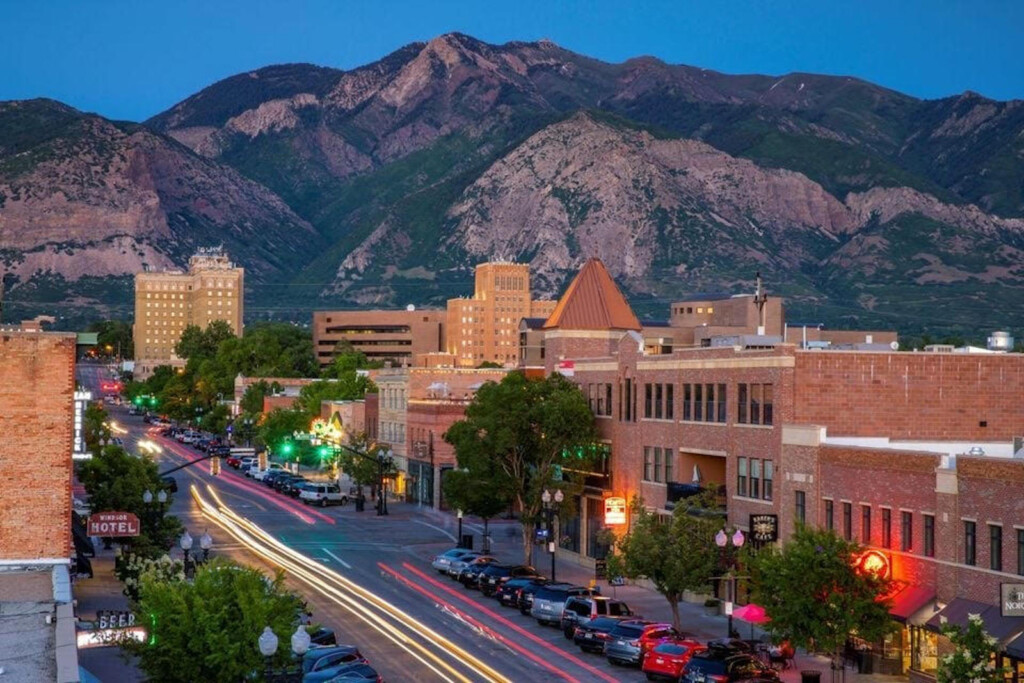
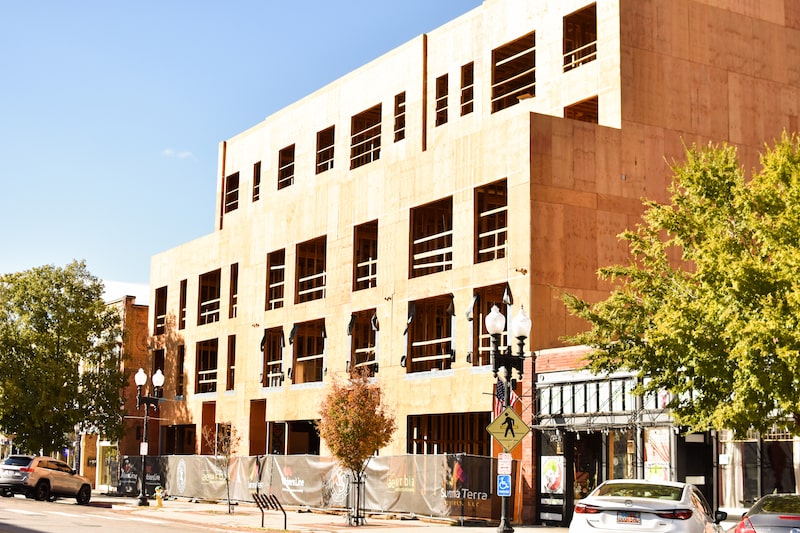
Ogden’s Historic 25th Street is rich with charm, historic significance and unique architecture, but in the works is a several- story apartment complex right in the heart of the street.

|


The new building will overshadow the current buildings and change the look of 25th Street. Photos by Jess Knott.

Ogden’s Historic 25th Street is rich with charm, historic significance and unique architecture, but in the works is a several- story apartment complex right in the heart of the street. While there are some that agree with the build or feel neutral about it, most residents seem to be either opposed to it or outright angry about the towering building nestled between much shorter, historically aesthetic buildings.

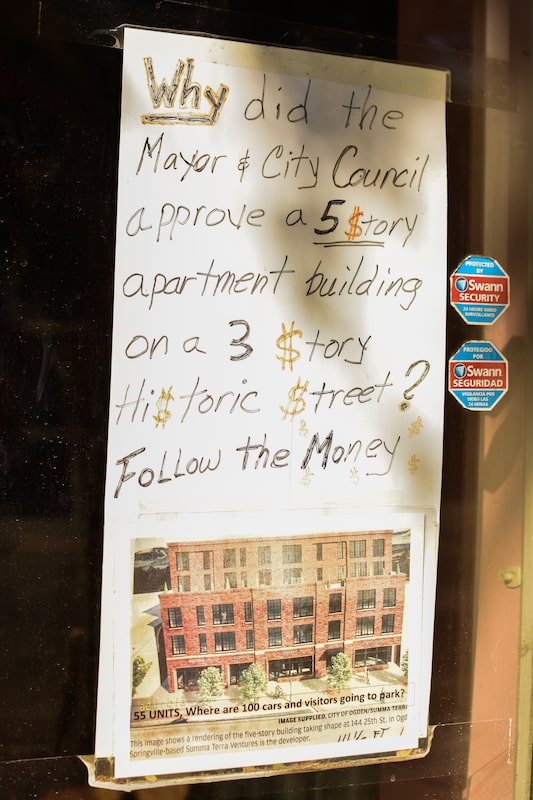
Throughout Ogden, you can find signs taped to windows and walls with a picture of the apartment complex that read “Follow the money.” Money seems to be a common theme in the opinions surrounding the construction of 25th Street’s newest addition ― be it the potential price to live at the apartment complex, the amount of money put into building with no added parking, or the idea that the design should have never been approved according to previously established guidelines for building in the historic district. Many individuals share the belief that the apartments had to have extreme profit potential for it to be approved in the first place. 

Most of the “redevelopment” happening in Ogden is the result of a plan called “MAKE Ogden”, which was established in 2019. Ogden land has seen a drastic increase in apartment and townhome complexes over the last three years as part of this plan. With the cost of living still climbing and minimum wage in Utah still sitting at a low $7.25 an hour, frustration has risen surrounding the complexes, because the cost to live in them is too high for many to afford. 

There have been many complaints about the lack of parking available on 25th Street already, with questions on how the new apartments will accommodate parking for residents. The MAKE Ogden Masterplan states that one of the goals for downtown Ogden is to facilitate an urban environment with higher foot traffic. While this can be beneficial for businesses downtown by bringing passersby to their doorsteps, some business owners also express concern. 
Barbara Chrisman is the owner of the building that houses Endless Indulgence Retro Wear, which is closed permanently on November 30th. Chrisman says, “I own the two-story [building] next door. I knew it was going up when I bought the property, but when I see five stories next to my two-story, I wonder ‘What are they going to do about snow mediation?’ Snow from a five-story will blow off onto my two-story.”

Chrisman also expresses that many attempts were made to schedule an appointment with the planning manager before his retirement, but nothing came of it. MAKE Ogden did not respond to requests for comment on the building. 

Locals are saddened by the views of Ogden’s beautiful landscape being obstructed, such as the one from the rooftop of one of the local bars, Alleged.

Where the sunset would once enhance a photo, the new complex now obstructs the view and locals don’t understand why. 
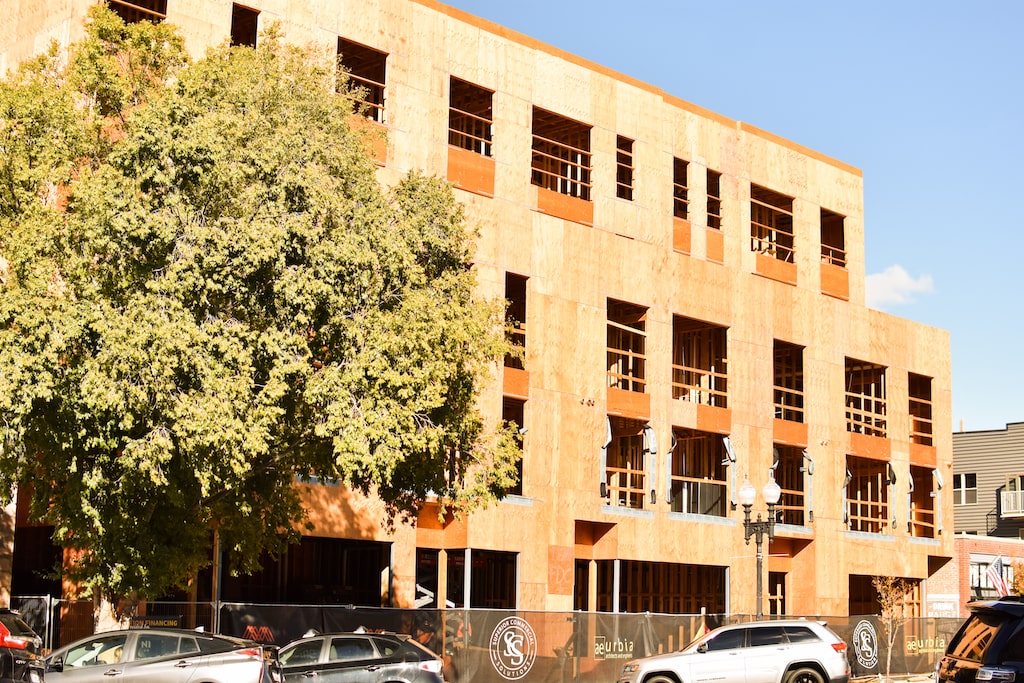
It has been well-announced that there are specifications that must be met to build anything in “historic districts” in Ogden. Buildings must blend with the historic architecture and Historic 25th Street does not include five-story buildings, which means the complex stands much taller than anything else that surrounds it. 

There is ongoing dialogue surrounding Ogden’s redevelopment, specifically the new apartment complex, with varying opinions, but the majority of commentary has been an expression of negative feelings. A common frustration for issues like this one is, “But, what can I do about it?” 

Local resident, Wayne Russell, has an idea. He says, “Makes you mad enough to vote, doesn’t it?”

RELATED CONTENT

Ogden’s Food Scene Bolsters Diversity

Secret Tunnels under Ogden’s 25th Street

Top Five Coffee Shops in Ogden to Warm Up in this Winter

History of Ogden’s 25th Street: Overcoming a Bad Rap

More Development Projects Coming to Ogden

SUPPORT LOCAL JOURNALISM AND SUBSCRIBE TO PRINT MAGAZINE


Subscribe to Utah Stories weekly newsletter and get our stories directly to your inbox

* indicates required


, ,

Join our newsletter.
Stay informed.


  • Ogden Utah: Boomtown, Bargain, or Utah’s Next Unaffordable City?

    With its reinvigorated downtown and close proximity to mountains and river pathways, this northern Utah city is enjoying a renaissance. Ogden’s stock of affordable housing — compared to other metros along the Wasatch Front — currently draws people in for a closer look. 


  • The End of an Era? FanX and the Salt Palace Closure

    For more than a decade, FanX has called the Salt Palace home. With the convention center set to close for a massive renovation, founder Dan Farr is preparing for a new chapter while planning one final celebration in its longtime venue.


  • The Stratos Project and Corporate Power: Who Controls Utah’s Future?

    If we were all just consumers, Governor Cox, Mike Lee, Speaker Schultz, and Kevin O’Leary would have it easy. If we were just more concerned about money, jobs, and tech, and less concerned about raising our kids in communities (not in front of screens), culture, the environment, and water, those smart dudes would get exactly what they want — Stratos: a city of the future, buzzing with processors and transistors, making all of our AI dreams come true! 

    The world we could live in would be a dazzling, Mr. Wonderful kind of place. We would beat those pesky Chinese in the AI war; our AI robots could do all of our farming and ostensibly harvest the water we need for the Great Salt Lake out of thin air. But apparently, we just don’t get it. We haven’t yet reached the point predicted by Aldous Huxley’s vision in Brave New World, where we are completely distracted, dopamine-driven consumers who only need sex, drugs, and stuff to remain happy.

    Maybe Stratos will be an amazing marvel, and somehow, as Governor Cox claims, “. . . add more water to the Great Salt Lake.” But we aren’t sold. While this Stratos project has received considerable attention, it’s worth taking a step back to attempt to understand how corporate power appears to have usurped civic power.

    Civics is the practice of shaping our society through our collective voices and community involvement. Ask the residents in Tremonton, Utah how well that is working out for them. Can we still shape our world through our elected leaders? Does it matter who we vote for at the ballot box if organizations like UDOT, UTA, and MIDA can supersede our local government authority and citizen backlash? 

    The corporatization of our communities and the interests that impact our political leaders’ decision making processes are seen as far more of a concern than the average Utah resident’s concerns. Special interests and corporate power are shaping Utah’s future more than ever. 

    It’s worth asking: ‘How can we regain control over shaping Utah’s future in light of the growing power and billions that the technocrats now wield in shaping our world today?’ Amazon’s market cap exceeds the GDP of Canada. The “Magnificent Seven” tech stocks now have a greater market cap than the entire GDP of Europe ($23.6 trillion. EU countries have $19.3 trillion GDP). Will tech companies become their own nation-states and dominate their own chunks of various states? Will we become their subjects?

    There are two sides to this coin: We love Utah not just because we have the most outdoor wilderness playgrounds, but also because of Utah’s prosperity and job market. This is because Utah has become a tech hub. Our tech leadership has minted several billionaires and billion-dollar businesses. Utah offers a market and an educated workforce that more businesses and giant corporations want to be a part of. This is a benefit for even non-tech Utahns.

    The problem with this success is that as we dole out more money to attract more tech businesses, data centers, fulfillment centers, and big corporate retailers, it becomes more difficult to carve out our “sense of community.” As corporate sovereignty replaces local business sovereignty, we see that our voices and our votes matter less.

    Ask who our politicians work for, and nearly every Utahn believes they work far more for their corporate donors than they work for the average Utah citizen. So how do we best regain control over our communities?

    Continue reading and support independent Utah journalism with a purchase of Utah Stories (Digital + Print) or 3 month free trial (Digital).


  • The Utah Farm That Refuses to Give Up as Development Closes In

    Running a farm is hard enough, but rapid city growth makes it even tougher. More than a decade ago, the late Verl Cook faced a series of staggering hurdles that threatened to wipe out his family’s livelihood.

    First, the city decided to treat the Cook’s greenhouse — the most profitable part of the farm — like a big-box retail store. They demanded the family build a paved parking lot, a project that would cost $200,000.