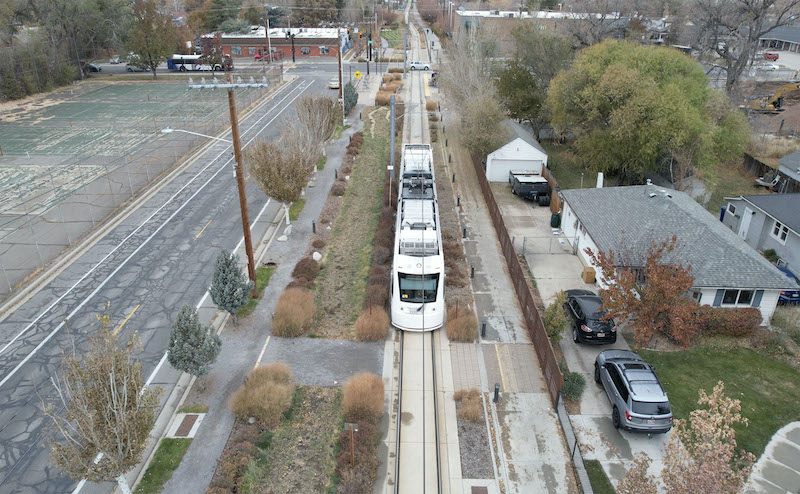
When the concept of the S-Line was introduced in the Sugar House area, many business owners in the community were excited by the prospect of the increased foot traffic an additional Trax line would bring. The plan to build was announced in 2012, and construction was completed in 2013, with the goal of making transportation in and around Sugar House more accessible to those who didn’t have a private form of transportation.
In March 2021, Salt Lake City received $12 million to extend the S-Line to the intersection of Simpson Avenue and Highland Drive.
“It’s that head on the body of the S-Line that we’ve been missing for so long, and we are really thrilled to have this opportunity,” said Salt Lake County Mayor, Erin Mendenhall, in a March 2021 press conference. “Where it’s at now and where we can get it to makes it so much more rideable for … navigating through Sugar House.”
Members of the Sugar house Community Council were encouraged by the extension plan as ridership for the S-Line has increased dramatically due to the population increase in the Sugarhouse area.
“I’m very excited for the project,” said Will Kocher, 2nd Vice Chair of the Sugar House Community Council, in the March 2021 press conference. “I think it’s important that we get it up to Highland Drive. That’s where a lot of the building and the new population growth in Sugar House is happening, and that S-Line is vital to our community to be able to connect to other modes of transportation. It takes us down to the central station, and from there you can really get anywhere into the valley.”
This project is currently underway, but the $12 million budget hasn’t been enough to complete the extension as initially planned.
“We have spent the past year or more evaluating options for where to take it and how far the budget would get us,” said Lynn Jacobs, Salt Lake City Transportation Engineer. “UTA has also been working on getting environmental clearances completed for the area we intend to work in.”
The extension was originally set to be completed in 2024, but Jacobs says that will depend on filling the current funding shortfall.
“As part of this project, our team also determined that we would need to construct some additional double tracking area between 500 East and 700 East on the S-Line alignment to maintain our current operational condition,” said Jacobs. “This additional need is what is driving our shortfall as we can’t just extend the S-Line to Highland Drive without also building this section of double tracking. The City and UTA are collaborating on how to find the additional funds that are needed for this project. While we are hopeful that this funding will be identified by 2024, it is quite possible that the project will be delayed by this issue.”
The current project plan does not allow for the S-Line to extend further north, south, or east than the Simpson Avenue and Highland Drive intersection, but future plans allude to a possible extension that would take the S-Line north, up Highland Drive.
“Salt Lake City’s Transit Master Plan shows the S-Line extending to the north up Highland Drive and 1100 East at some point in the future,” said Jacobs. “But it is currently unfunded and I wouldn’t expect to see it anytime soon.”
The City’s recent Local Link Study recommends eventually taking the S-Line south down Highland Drive into Millcreek and Holladay as well, but Jacobs anticipates that project to be more than 30 years away.
“In the meantime, we are recommending implementation of an enhanced bus line on 1100 East/Highland Drive that is intended to serve that need for the immediate future,” said Jacobs. “That study has not yet been adopted and is working through the process right now.”
The S-Line is the first of its kind, and some small business owners and residents in the area worry that extending it in any capacity could take away from the small-town charm of Sugarhouse.
“It has been challenging to communicate with the public about streetcars because we currently don’t have a ‘true’ example, where the streetcar operates in the street in the same lanes that motor vehicles are using and stops are curbside, more like bus stops,” said Julianne Sabula, Strategic Planning & Programming Manager for the Salt Lake City Transportation Division. “This leads to fears that the only way to build a line is to widen the road, take out trees, and potentially seek right-of-way from existing property owners for stations. Conversely, many people envision an old-fashioned trolley and are disappointed to see modern vehicles that don’t convey historic charm.”
Sabula and Jacobs are both enthusiastic about what the S-Line has done for the community thus far and look forward with optimism toward what the extension can do for the Sugarhouse area.
“Fundamentally, there is a desire to have it extend north, south and east, and there are also people opposed to each of those concepts,” said Jacobs. “Much further work is needed to determine next steps, and it will likely be some time before you see any additional significant movement on this topic. At least that is my opinion. This current project ‘puts the head on the body’ and that is a big deal for all of us.”
RELATED CONTENT
Transformation of Sugar House and Its Impact on Small Local Businesses
Sugar Town: Snelgrove Development Will Change What’s Left of Sugar House

SUPPORT LOCAL JOURNALISM AND SUBSCRIBE TO PRINT MAGAZINE