Community Relations

The Last Ride on Number 6 Bus: 100 Years Long Mass Transit along Sixth Avenue in Salt Lake City Ends

The route’s closure marks the end of mass transit along Sixth Avenue, which has seen public vehicles lumber along in one form or another for more than 100 years.

|


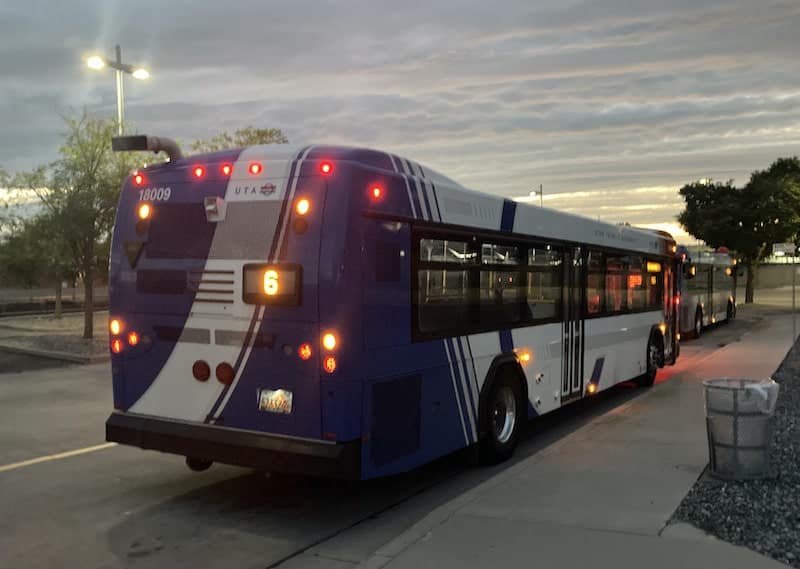
Last ride on #6. Photos by Marco Leavitt.

It’s the end of the line for the Number 6 bus.

More than half a dozen people gathered at UTA’s central station on August 6 to mark the occasion and take one last trip.

“Commemorating a bus route that is about to be discontinued is a very fun idea,” said rider Sam Thomas.

The route’s closure marks the end of mass transit along Sixth Avenue, which has seen public vehicles lumber along in one form or another for more than 100 years.

The route through the Avenues neighborhood had earlier been serviced by the No. 2 bus line, itself a descendent of the old No. 2 street car. Historical records show the street car had been in service since at least 1921.

“I’m gonna miss the 6 bus,” said Evelyn Lamb, who organized the trip.

But Lamb is excited about the new schedule, which boosts service on routes 209 and 1. The buses now run every 15 minutes and continue well into the night.

“I really like the 209 connecting to the bars and restaurants in Sugarhouse and South Salt Lake, and even down to Millcreek,” said Lamb.

Increased service for the Avenues along the north and south corridor was a key part of UTA’s strategy, which saw the elimination of 22 routes on August 7. Another 42 rail and bus lines also saw changes.

Utah Transit Authority has had to adapt to a decline in ridership and available bus drivers related to Covid. It’s hoped the changes will spur participation in the Avenues, which has been identified as having potential for more ridership. The area was noted for its lack of cul-de-sacs, high number of students, people of color, and those without cars.

“This is a neighborhood where people are more receptive to mass transit,” said Eric Callison, Utah Transit Authority’s manager of service planning.

From left to right: Sam Thomas, Harrison Cale, Jon Chaika, Will Watkins, and Evelyn Lamb.

Not everyone. After the new routes were announced, flyers were distributed opposing the new traffic. A group of residents presented their own scaled-back plan at a meeting of the Greater Avenues Community Council in June.

“People don’t want things to be different, even if they’re better,” said Kyle Holland, who co-hosts a podcast at the University of Utah about mass transit called The Red Line.

The bus jostles down from the Avenues and climbs up to University of Utah Hospital, the half-way point of the trip. There’s a cheer and someone wonders if they should all get out. But there’s the question of how to get home. This is, after all, the last run. The mood grows somber.

Lamb remains upbeat. A plate of cookies sits on her lap. It’s her mother’s recipe — oatmeal, chocolate chips, dried cherries and pecans.

But the plate is still full. Sadly, riders eating cookies is not a sanctioned activity of the Utah Transit Authority.

“You’re not technically allowed to eat on the bus,” Lamb said, with a sly grin. “But some people have taken them and I don’t know if they have been consumed on the bus.”

As the bus continues along the end of its route, the little group grows smaller. Another passenger gets off, making a call for trans rights that elicits another cheer.

Eventually the bus comes to Lamb’s stop and she exits as well. There are now only a few people left. Among them is Will Watkins, who keeps a spreadsheet documenting all of his trips.

“I am a little bit of a transit nerd, especially for the UTA,” said Watkins.

The bus ride is his 394th trip since last August. After the trip, an annotation on his spreadsheet will read simply, “Final 6 bus.”

RELATED CONTENT

Utah’s Little Cottonwood Canyon: A Gondola Wins, Granolas Lose

How More Bicycle Infrastructure Could Help Solve Our Affordable Housing Crisis

Utah’s Top 5 Walkable Neighborhoods: Communities Where Kids Can Walk to School

Sugar House Growing Pains

PediCab Legacy in Downtown Salt Lake City

SUPPORT LOCAL JOURNALISM AND SUBSCRIBE TO PRINT MAGAZINE


Subscribe to Utah Stories weekly newsletter and get our stories directly to your inbox

* indicates required


, , , ,

Join our newsletter.
Stay informed.


  • Ogden Valley City Incorporates as Voters Deliver a Surprising Mayoral Outcome

    Ogden Valley City has officially incorporated at a pivotal moment for northern Utah, just as growth pressures tied to the 2034 Winter Olympics begin to accelerate. Voters also delivered an unexpected mayoral outcome, setting the tone for how the new city will approach land use, local control, and the work of building a government from the ground up.

    To access this post, you must purchase Utah Stories (Digital + Print) or 3 month free trial (Digital).


  • Salt Lake County Approves 14% Property Tax Increase, Shifting the Burden to Taxpayers

    After hours of public testimony, Salt Lake County approved a 14% property tax increase, despite mounting concerns over spending growth, compensation, and the impact on seniors and fixed-income residents. This analysis examines where the money is going, what could be cut, and why residents are pushing back


  • From Water Bottles to “Brain Rot”: Classroom Trends Shaping Student Culture in 2026

    What may sound like noise or nonsense to adults often carries meaning inside today’s classrooms. From oversized, sticker-covered water bottles to repeated phrases borrowed from online videos, small habits have become shared language among students. This is what student culture looks like heading into 2026.


  • Has Utah’s Soft-on-Crime Justice Reform Made Communities Safer?

    Has this “soft-on-crime” approach resulted in safer streets?

    SALT LAKE CITY — A decade has passed since former Utah Governor Gary Herbert signed a massive justice reform bill into law in hopes that the state could reduce its prison population and manage low-level offenders through rehabilitation programs instead of incarceration. Has this reinvestment resulted in lower crime and recidivism rates?

    According to the Utah Department of Corrections, that landmark Justice Reinvestment Initiative aimed to “continue holding offenders accountable and securing our communities, but in a way that considers individual risks and treatment needs.”

    Are communities really safer when mental health and substance use needs are addressed through programs administered outside prison walls? The idea was to treat criminals differently based on their mental health needs and backgrounds. But at least one retired Adult Probation and Parole Officer, believes this “soft-on-crime” approach hasn’t resulted in safer streets.

    LOOKING BACK

    State Senator Todd Weiler, in that legislative role since 2012, helped drive the passage of the Justice Reinvestment Initiative (JRI), a massive bill that enjoyed broad-based approval among state officials and the Legislature as a whole.

    In November 2014, Weiler attended the national summit on the issue in San Diego, an event hosted by Pew Charitable Trusts. 

    “I was very involved in it. We had a lot of high hopes,” Weiler, a Woods Cross Republican, said in a recent interview. “That was about the time we were finalizing plans for the new prison. And we actually said that because of JRI we don’t need as many beds because we’ll be incarcerating fewer people. So that new prison was designed with this idea.”

    A key part of JRI dealt with adjusting sentencing for crimes related to addiction, dividing offenders into two basic groups: dangerous criminals who are a threat to society (that group goes to prison), and low-level offenders who get help kicking addictions through state-sponsored programs or private-sector rehabilitation.

    “The ultimate goal was if we have an otherwise good person who got caught up in an addiction, and as a result committed crimes, they need to be punished for their crimes,” Weiler said. “It’s not that we’re going to overlook what they did, but we wanted to focus primarily on helping them overcome their addiction and [that means] getting them back to their job and their family.” 

    Before JRI, low-level drug offenders with felonies would spend years in prison, which wreaked havoc with their lives and future prospects. Addressing the root cause of their theft and property crimes through supervision and treatment made sense. 

    “We’re all imperfect people,” Weiler said. “So we want people working their jobs, paying their bills and raising their kids rather than sitting in jail and watching TV or playing cards.”

    To access this post, you must purchase Utah Stories (Digital + Print) or 3 month free trial (Digital).