Utah Stories

Parley’s Canyon Fire Initial Response And Rapid Growth — Photos and Video

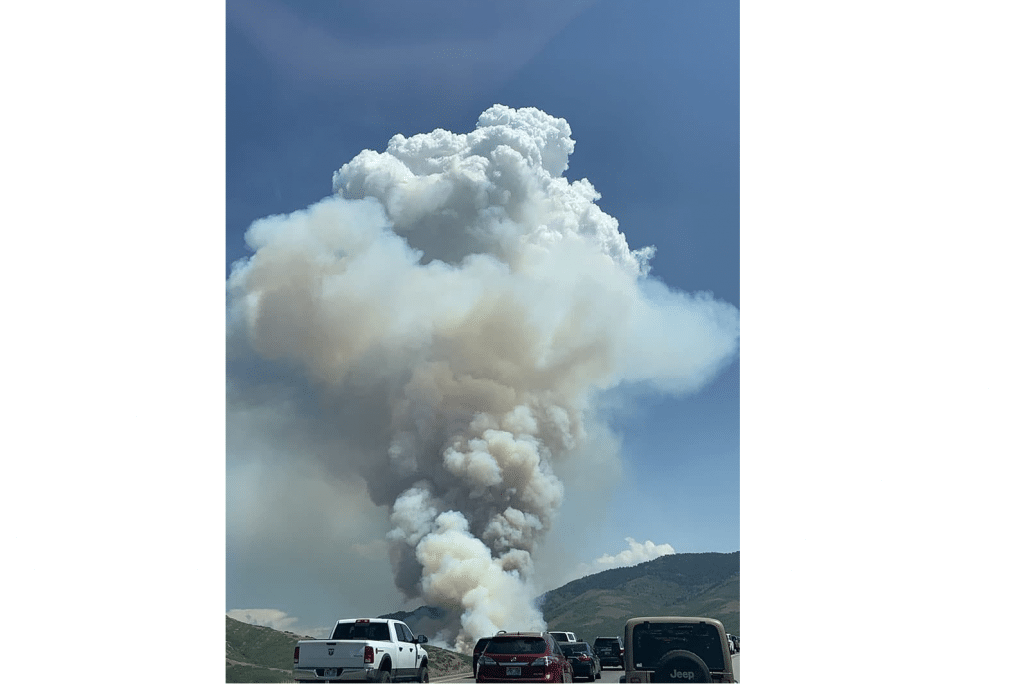
Traveling east on I-18 to Park City, we personally witnessed the incredible speed and growth of the Parley’s Canyon Fire on August 14th.

|


Traveling east on I-18 to Park City, we personally witnessed the incredible speed and growth of the Parley’s Canyon Fire on August 14th, at around 2:20 PM.
The plume of smoke was easily 1,500 feet high, but the air was still clear and there was no smell. These hints told us this fire had just started. We learned that the fire started at around 1 PM, and it was caused by an overheated catalytic converter on a vehicle.

At the time we were traveling, dozens of firefighters from both the Summit County Fire Department as well as BLM wilderness firefighters were on the scene. They had done an excellent job at keeping the fire from the freeway, which would be catastrophic if it spread across I-80.

Returning home (West on I-180) We witnessed that the size of the crews and the number of vehicles on scene had doubled, and the number of vehicles stuck in traffic heading eastbound on I-80 had increased. The size of the fire didn’t appear to have grown substantially.

Currently, as of Sunday at 12:00 pm, the fire is 0% contained and fire crews are attempting to create a fireline, to prevent the spread of the fire to Summit Park. The natural wind pattern is for the wind to blow east during the day, which would cause the fire to jeopardize burning Summit Park. For this reason, there is an evacuation order in place for all Summit Park Residents as well as all residents of Lambs Canyon.

Utah Stories wrote about BLM firefighters three years ago as they were attempting to control a blaze at that time that had burned hundreds of thousands of acres. The Parley’s Canyon fire of 2021 is currently 2,000 acres.


, , ,


Join our newsletter.
Stay informed.


  • Salt Lake City Newcomers Club: Finding Friendship and Belonging Since 1948

    Moving away from your hometown can come with many blessings. But for some, it also comes with just as many bouts of loneliness. That ache of not knowing where to meet people, or grieving the friends you left behind, comes in waves. Workplaces and churches can sometimes provide ready-made communities, but what happens when they don’t? Where do you go to find true belonging?


  • Highway 6 and the Midland Trail: Utah’s Transcontinental Highway History

    From Price Canyon to Delta’s desert stretch, Utah played a central role in building the Midland Trail, one of America’s earliest transcontinental highways and the foundation of today’s Highway 6.


  • A Stand-Up Wheelchair Gives Paralysis Patients Greater Independence

    After a cycling accident left him paralyzed, Bill Winchester had to relearn how to navigate daily life from a wheelchair. A stand-up wheelchair later gave him the ability to rise, move more independently, and regain parts of the active life he once knew.


  • Whiskey, Bullets & a Buried Town: Archaeologists Reveal Alta’s Wild Past

    Before Alta was known for powder days and lift lines, it was a silver mining town clinging to the side of a narrow canyon. In the late 1800s, men lived at 8,000 feet, went underground each day, and endured winters that regularly buried buildings in snow. This past summer, that mining town resurfaced — literally — during construction at the Alta Ski Area.

    To understand what Alta really looked like, you don’t begin with legend. You begin with its trash — and this time, that happened almost by accident.

    Alta Ski Area was installing underground water reservoirs to support snowmaking. Because the project sits on Uinta-Wasatch-Cache National Forest land, an archaeologist was required to monitor the excavation. No one expected the trench to produce much.

    But, It did.

    Artifacts began surfacing almost immediately. Enough that the Forest Service contacted the Utah State Historic Preservation Office for help. Lexi Little, who coordinates the Utah Cultural Site Stewardship Program, helped mobilize nearly 30 volunteers to assist with what quickly became a focused two-week excavation.

    Winter deadlines were approaching. The pipes for the reservoirs had to go in the ground. There wasn’t time for a slow, extended dig.

    “It was two weeks of digging in the dirt and helping figure out exactly what we were looking at,” Little said.

    Most of the people screening soil weren’t professional archaeologists. They were trained stewards from around Utah — part of a statewide volunteer network that now approaches 500 people. They poured dirt through shaker screens, scanning for fragments that could piece together a town long buried.

    “Archaeology is human trash,” Little explained. “Archaeologists are very into trash.”

    Alta had left plenty behind.

    https://youtu.be/hzIHzx3OGoo?si=dKcl2CEz-t6FZzYw

    Victorian-style ceramics appeared first — the kind typically used in hotels. Medicine bottles followed. Ink bottles. Hand-blown glass. A porcelain doll’s foot surfaced from the soil, a small detail that shifted the mental image of the town. Families were here. Children were here. This wasn’t only a camp of miners.

    The bottles helped establish time. Manufacturing details — whether glass was hand-blown or mold-made, whether a maker’s mark appeared on the base — allowed archaeologists to date many of the artifacts to the 1870s through the 1890s, when Alta was booming as a silver mining town.

    “That gives you that range of dates for when Alta was really booming,” Little said.

    One reusable soda bottle clearly stamped “Salt Lake City” connected the canyon to the valley economy below.

    Then something unusual rolled out of a dirt pile.

    A corked bottle. Intact. Liquid still inside.

    Continue reading and support independent Utah journalism with a purchase of Utah Stories (Digital + Print) or 3 month free trial (Digital).