Local Spotlight

Confessions of an Audiobook Narrator

Many authors narrate their own books, some try it and realize it is much more work than they thought. Besides simply reading into a microphone, audiobooks require quite a bit of preparation, proof listening, and editing.J osh Berndt ventured into audiobook narration and voiceover work on a friend’s suggestion. He missed being behind the microphone…

|


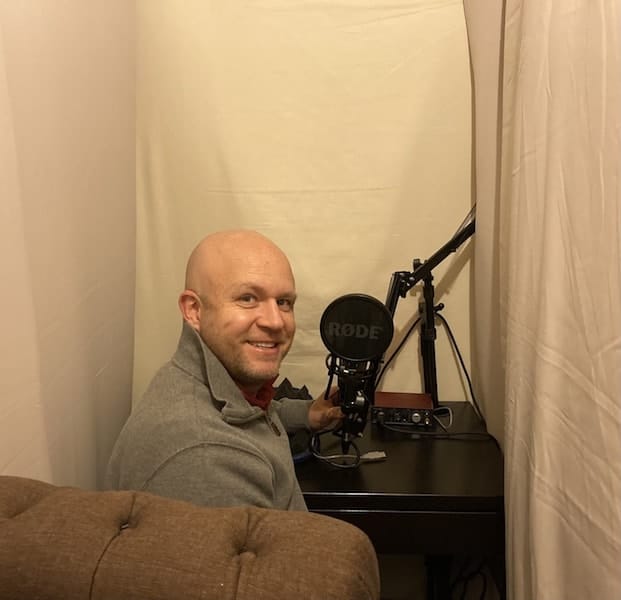
Josh Berndt ready to record in his home studio.

When Josh Berndt retreats into his home studio he asks his family to avoid walking on the hardwood floors above him. “When you’re recording you realize how every little thing can make a sound,” says Berndt.

Berndt ventured into audiobook narration and voiceover work on a friend’s suggestion. He missed being behind the microphone after leaving the world of broadcasting. Working in radio was his dream job but after ten years in the business, the constant moving it demanded was just too hard on his family.

Turns out narration work takes a whole different set of skills so he took a voiceover class and hired a coach. With the help of some noise reducing curtains and a soft chair, he transformed a spare closet into his home studio and launched his own voiceover company. “A closet is your best friend. Environment is number one, even if you have a good voice,” he explained.

Berndt mostly narrates audiobooks like biographies and business books but also dabbles in e-learning projects and voiceover work for commercials, promos, and sports. To land gigs, he relies on a couple of agents to send him auditions and also acts as his own agent scouring sites such as ACX (Audible’s meeting place for narrators) and Findaway Voices which helps match narrators to authors. “Like any gig, it takes a lot of hustle. If you want to do a book a month it is a ton of work,” said Berndt.

Josh Berndt recorded Forward, Upward, Onward by Matt Landry, available on Audible.

Although many authors narrate their own books, some try it and realize it is much more work than they thought. Besides simply reading into a microphone, audiobooks require quite a bit of preparation, proof listening, and editing. Narrators work closely with authors and authors always have the final say on how their book sounds.

To prepare himself for a new gig, he’ll read the entire book first if it’s fiction. If it’s a nonfiction book, he can usually get away with only reading a few chapters. This helps him get a feel of the flow of the book and allow him to figure out how he’ll differentiate individual voices or characters. To maintain a strong and consistent voice while recording (and avoid extensive editing work down the line), he avoids carbonated beverages, always brushes his teeth before recording, runs through a few vocal warmups, and makes sure he has plenty of water on hand.

Berndt warns that audiobook narration work can sometimes take the fun out of reading, “I will read some fast moving books for fun but when you read for hours a day and it’s sometimes boring, it is hard to keep reading.”

Berndt has no plans to leave his work as the communications coordinator at Thanksgiving Point or as a communication course instructor at Utah Valley State University for full-time audiobook reading. His narration work is just a fun thing to do for extra money and it satisfies his itch for recording.

For anyone looking to get into audiobook reading or perhaps start a podcast, he recommends investing in good equipment first and foremost. “My number one is advice is to have the right equipment – it might cost a lot upfront but your product will be something you are proud of.”


,


Join our newsletter.
Stay informed.


  • Left in a Box as a Baby: Trauma, Alcoholism, and Addiction

    A man abandoned as a baby builds a structured life in law enforcement, but unresolved trauma and alcoholism slowly begin to unravel it. His story raises a harder question about how change actually happens.


  • Cottonwood Heights Corruption Allegations: A Case That Never Reached a Courtroom

    A year ago, we here at Utah Stories recorded a podcast episode that we never published. We were revisiting corruption allegations from ten years ago. We decided not to publish the video, so it sat there on YouTube for nearly 12 months.

    Then somehow the video was published. How? We are not sure, but once it got out there, the comments came pouring in.

    Dozens of viewers, then hundreds, supported the video with their comments on our examination of allegations of police misconduct in Cottonwood Heights. The video recounts how the Police Department was reported by business owners as focusing enforcement on customers of the former Canyon Inn bar. These allegations did not result in a publicly documented, full investigation by Utah’s Justice Department nor the FBI (at least to our knowledge). So why rehash the past?

    We believe the story of The Canyon Inn (and other area business owners) vs. CHPD and Cottonwood Heights Mayor Kelvin Cullimore raises questions about what can happen when allegations surface and do not move forward through a formal legal process with state or federal oversight.

    In 2012, Cottonwood Heights business owners at the mouth of the canyons began publicly objecting to police activity whereby up to seven cruisers were pulling over 711 and Canyon Inn bar customers on their busiest evenings.

    According to those accounts, drivers leaving the bar were frequently pulled over by police and were given DUI tickets, sometimes even after passing a sobriety examination. The volume and concentration of those stops led residents and business owners to complain about the “heavy-handed treatment” of CHPD toward motorists, especially in and around the Canyon Inn and neighboring 711, and eventually the Porcupine Pub.

    Customers responded in predictable ways. Some chose not to return and avoid the area. Others went to different establishments. Over time, the owner of the Canyon Inn, Jim Stojack, stated that his revenue declined by 70% and that he believed police activity near his business was the main contributing factor.

    Utah Stories reported on these concerns by conducting interviews; gathering video documentation provided by those involved; and making public records requests. Through our GRAMA requests, we reviewed DUI citations issued by the Cottonwood Heights Police Department and examined how those cases were resolved in Holladay Justice Court. During that period, we observed a higher number based on our review of DUI cases dismissed in court due to lack of evidence compared to other jurisdictions. One DUI attorney, Tyler Ayers, went on record saying that CHPD was issuing a high volume of DUI citations that were later dismissed.

    That observation raised questions about how cases were being documented and prosecuted. It did not, on its own, establish intent or misconduct, but it became part of a broader set of concerns raised by multiple sources.

    Continue reading and support independent Utah journalism with a purchase of Utah Stories (Digital + Print) or 3 month free trial (Digital).


  • The Perfect Girls’ Day in Park City: Brunch, Shopping, Spas & Nightlife

    After a week of work, grocery shopping, meal prep, driving the kids around, housework and last minute emergencies, a day of bonding and fun with our BFF’s is just what the doctor ordered. Fortunately, one of the best getaways is just a short drive away to Park City.


  • The Stratos Project Was Already Approved. So Why the Public Meeting?

    Thousands showed up to protest. The decision may have already been made.

    When thousands of Box Elder County residents packed the fairgrounds to protest the proposed 40,000-acre Stratos data center, they thought they were confronting the people in charge.

    They weren’t.

    The county commissioners stood at the front of the room, absorbing the anger, the frustration, the disbelief. They looked like decision-makers. But by their own account, they weren’t.

    Because the decision may have already been made—long before the public ever showed up.

    The Illusion of Authority

    What happened at that meeting wasn’t civic engagement. It was something closer to theater.

    No meaningful public comment. No real debate. No clear path for residents to influence the outcome. Just a room full of people reacting to a project that, structurally, may already be locked in.

    Why?

    Because the real authority doesn’t sit with Box Elder County.

    It sits with the Utah Military Installation Development Authority.

    Once MIDA designates a project area, the rules change. Local zoning can become irrelevant. Private land stays private. Water rights remain private. And the role of local government shifts from decision-maker to facilitator.

    In plain terms: the county doesn’t decide if the project happens. It helps manage how it happens.

    So when residents showed up demanding answers, they were asking the wrong people.

    A Process That Skips the Public

    That should concern anyone paying attention.

    Because it flips the normal order of things. Instead of:

    Proposal → Public input → Decision

    We get:

    Decision → Public meeting → Reaction

    And by the time the public enters the room, the real levers of power have already been pulled.

    So what exactly was that meeting?

    If commissioners don’t have authority to stop the project, then the meeting wasn’t about deciding anything. It was about absorbing pressure. Managing optics. Creating the appearance of a process that had already moved on.

    That’s not transparency. That’s choreography.

    Follow the Missing Pieces