Millennials and Utah Work Ethics
Millennials get a lot of attention in the press: How they seem to operate by a different set of values and priorities: They place more importance on experiences and fancy cocktails, tattoos than security and things. Older generations (including Gen Xers) like to point out that many of them have spent most of their lives getting “achievement awards” while getting extreme coddling from parents, without really accomplishing anything. This has given them a sense of entitlement. Zachary Moses doesn’t feel entitled. He feels like he has a huge advantage.
Moses is a millennial who was raised in Utah as a member of the LDS Church, and he says that he found a huge advantage when he ventured outside of the confines of the Beehive State into the scary nether-regions of non-Mormon territory. He found that his “normal Utah work ethic” was actually quite exceptional when compared to the average way people in the United States work.
Thinking Outside the Box
Moses says in the past few years he has used his “exceptional Utah work ethic” to his great advantage to help save a failing travel agency, called H.E. travel into one of the largest LGBQT travel agencies, by rebranding it into He travel. Moses has learned to think outside the box, converting the agency into a technology company with a very specific target market. He conducted this work in Key West, Florida, and for the past few years has traveled between Salt Lake City and Florida. Today he has his ambitions set on repairing a lot of the problems he believes exist in Utah concerning mainly the clear disconnect he sees between “the people” [Utah residents] and our government.
Replacing Current Leaders
Moses believes that the most clear example of how our current leaders need to be replaced is how Proposition Two (Medical Cannabis) and Proposition Three (the Medicaid expansion) were treated by the State Legislature. “The purpose of passing a ballot initiative is to tell the government that they aren’t doing their job.” Moses added that the way that the State Legislature rewrote our ballot initiatives turning them into bills that scantly resembled the original initiatives, should tell us all, “That these people really need to go.” Moses then decided that he wants to pay more than lip service to his ideas.
“I decided I needed to be the change that I want to see in my community We make public referendums to tell them that they are not doing their job. When they ignore our public referendum, we need to replace them.”
LDS Church Interference
My primary question for Zach was: “How can we possibly change Utah politics if all of the members of the State Legislature brought in from the various heavily LDS districts are getting their marching orders from the LDS Church?” [See our medical cannabis coverage to see how I arrived at this conclusion.]
Zach’s answer: We need a different governor. “We don’t need to be a police state, we don’t need a theocracy, we need to become a mentor state. We need to see each other as brothers and sisters and mentor each other.”
Moses believes that the overall doctrine of the LDS Church and the Members of the LDS Church are all great for Utah; Moses believes that it is only a minority of leaders who are causing a majority of the problems in Utah politics and government. Addressing the huge affordable housing shortage that now exists in Utah he says that this is the greatest problem facing millennials and his generation.
Housing Shortage
“We are way behind with our housing. I don’t want to vilify any Church that is helping people [the LDS Church will occasionally pay rent for their members]. I want to vilify our government. Where was the planning to house everyone? We could see the huge influx of people coming in, we have the largest per-capita birth rate in the country. Why was nothing done for the past ten years?
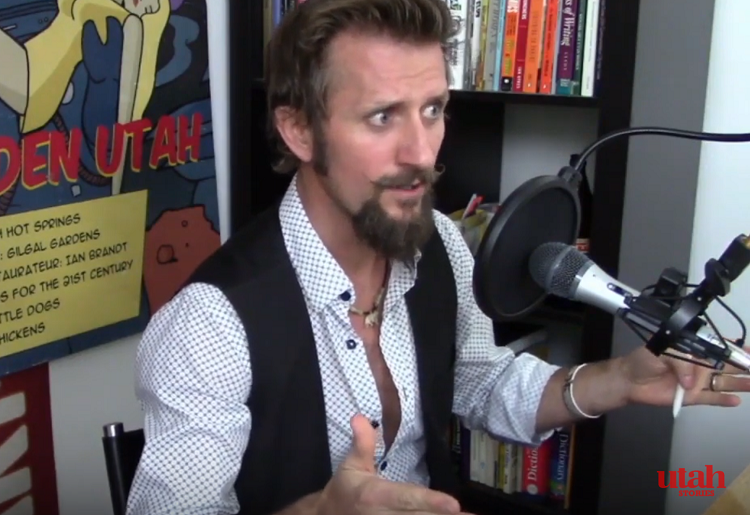
Moses offers some solutions to the problem of housing shortage. He also has ideas concerning homeless issues, the inland port and air pollution. See how Moses addresses these issues by watching or listening to the Utah Stories podcast. It was a very fun and interesting conversation.
The Utah Stories podcast covers these issues along with his views on housing, the inland port, pollution and Zach’s solutions to these problems.
Listen to the podcast below:
FOR MORE UTAH STORIES PODCASTS GO HERE.