
Utah Stories

The Suazo Business Center Offers Guidance, Education, Inspiration, & Hope

Committed to the development and empowerment of the Latino, Hispanic and other under-served communities, The Suazo Business Center, a non-profit organization, provides assistance to help existing potential minority entrepreneurs succeed and build wealth. Just as important, the center provides affordable classes as well as mentoring and guidance to help them every step of the way.

|


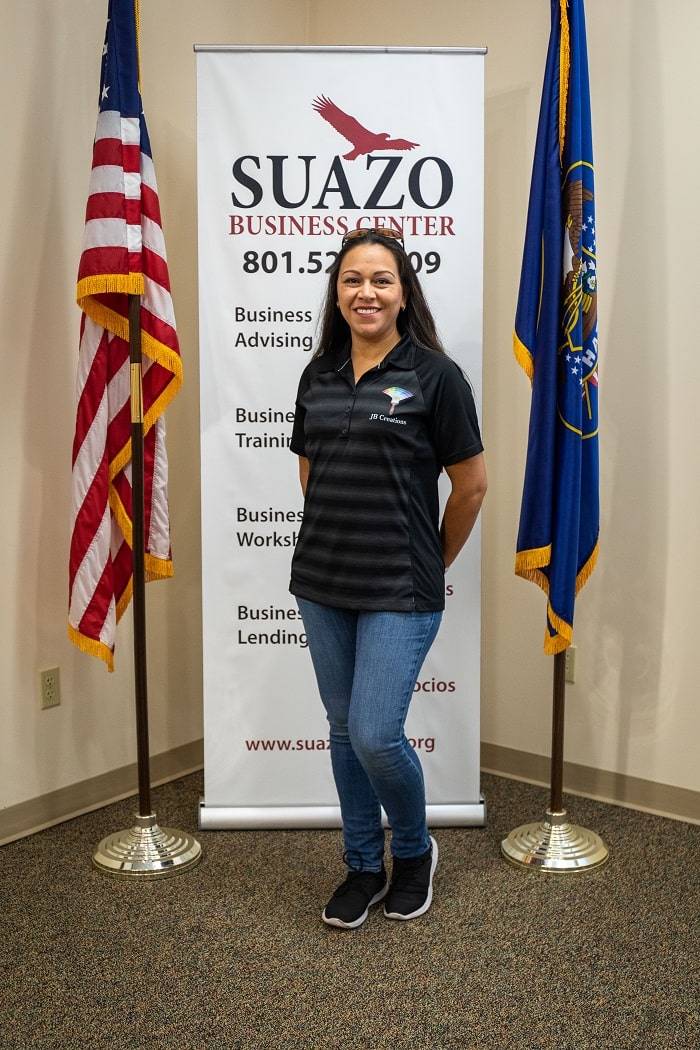
Marcela Lopez in front of the Suazo Business Center sign
Marcela Lopez used business skills gained at Suazo Business Center to open her own business. Photo by Braden Latimer.

The Story of Marcela Lopez

As Marcela Lopez skillfully handcrafts with paint and brush the look of marble above the fireplace of a customer’s home, she feels grateful for the business wisdom and expertise she acquired through the Suazo Business Center. The center, located in Salt Lake City, satisfied the tugging at her soul to be more than she was at that moment, two years ago. After being invited to the graduation of a close friend, Maria del Rosario Diaz, Lopez watched as Diaz walked across the graduation stage and received a Certificate of Completion from The Suazo Business Center.When Diaz, dressed in her cap and gown, reached for her certificate while receiving the official “well done” handshake, Lopez absolutely knew she wanted that same feeling—that same accomplishment. In November of 2018, Lopez followed in Diaz’s footsteps and began her journey. This past March, she also became a graduate of The Suazo Business Center. Lopez, along with the other graduates who gathered that day on the Jordan Campus of Salt Lake Community College, all knew one thing: they were in a much better position to be successful in life.

“It was one of the greatest things I ever did,” said Lopez, who along with her husband Juan Basilio, own JB Creations in Salt Lake City. “It felt awesome. [The Suazo Business Center] was able to teach me the proper order of what I was already doing. They were able to expand my horizons and expand my business and help me be so much more than I was.”

JB Creations, specializing in creating the look of marble or stone through both interior and exterior painting, is one of only a handful of companies in northern Utah providing this service. Without the commitment, guidance and business savvy offered at the Suazo Business Center, Lopez feels she and her husband may not be as successful with JB Creations as they are today.

The Suazo Business Center

Committed to the development and empowerment of the Latino, Hispanic and other under-served communities, The Suazo Business Center, a non-profit organization, provides assistance to help existing potential minority entrepreneurs succeed and build wealth. Just as important, the center provides affordable classes as well as mentoring and guidance to help them every step of the way. This process begins with interested entrepreneurs scheduling a session with one of the center’s advisers, typically followed by the creation of a plan specific to each individual and their goals. This plan could include assistance with obtaining a loan, a federal tax ID number, starting a website, even help with developing a name for a business should those needs arise.

Coinciding with where individuals are at with the creation or existing operation of their business, they register for either the “Business Startup” program, the “Business Growth” program, or both. Each program is six months long and requires each participant to spend Tuesday and/or Wednesday evenings attending classes which include subjects ranging from QuickBooks, personal finance, marketing, networking, social media and much more.

The cost to attend these classes is substantially lower than those offered at more traditional academic institutions or colleges. “Last year, we had close to 1,000 people complete our program,” said Operations Manager Edward Bennett. “We structure our program the way we do because we want to make sure you are 100% ready and capable of running your own business and truly succeeding.”

Beginnings & Mission

Success came for Gladys Gonzalez in 1997 when, shortly after immigrating to the United States, she desired a better and more successful life for her and her family. In that same year, Senator Pete Suazo helped Gonzalez write a business plan and obtain her first loan for the propagation of her brainchild, Mundo Hispano, a Spanish newspaper. When Suazo passed away in 2001, Gonzalez, full of gratitude for his help and guidance, found support from Senator Bob Bennett to create a center in Suazo’s name where others could receive the same type of help she did. In 2003, The Suazo Business Center officially opened its doors.

Sixteen years later, the Suazo team has helped close to 10,000 businesses get off the ground. Today, they are still ever proud and standing ready to welcome any interested qualified individual while encouraging full participation in both programs. Graduates of their programs attend a spring graduation ceremony on the Jordan Campus of Salt Lake Community College. They also receive a small business grant as well as a Utah Valley University endorsed certificate for The Suazo Business Center program.

“We are committed to thoroughly helping everyone we serve and ending cycles of poverty,” Bennett emphasized. “Our office team, adjunct instructors, business advisers, and Board of Directors want nothing more than to see our graduates grow and flourish in the communities in which they live and serve.”

Lopez couldn’t agree more. “Even after you graduate, they remember you and are still very supportive,” she said.


Suazo Business Center: 960 W 1700 S, Salt Lake City
Contact Person:
Operations Manager Edward Bennett
801-521-1709 X 102

, , , , ,

Join our newsletter.
Stay informed.


  • Artist Kate Kilpatrick Brings Utah’s History to Life Through Murals

    “I think we’re all interconnected; as individuals as well as societies,” Kilpatrick notes. Her work showcases those connections exuberantly, and whatever scale she’s working on, you can bet that in terms of energy and spirit, she’s painting large.


  • Dyslexia and ADHD in Kids: Why Some Students Struggle to Read in School

    That’s what led to my conversation with Donell Pons, a Utah-based dyslexia expert who has spent more than two decades working with students who struggle to read. What struck me right away is how often we get the problem wrong from the start.


  • Utah Youth Ice Climbers Win World Championships Thanks to Millcreek Common Wall

    Utah is home to two new World Champion youth ice climbers, and the ice climbing wall at Millcreek Common is getting credit for helping them win. 


  • Why Most People Stay Stuck in Business and What It Takes to Move Forward

    Every so often, you meet an immigrant who came here with almost nothing and managed to build something exceptional.

    Prakash Shah is the kind of man who has spent enough time around risk that he no longer treats it like an interruption.

    Today, he works in business brokerage and advisory, helping owners sell companies, helping buyers decide whether they should step in, and, when the fit is right, helping connect those buyers with private equity. He works in a world of valuations, leverage, due diligence, and hard questions that most people would rather postpone. He also operates in Utah real estate and has built a career around seeing value before it is obvious to everyone else. That is who he is now. What makes him interesting is how early that instinct started to form, and how little his life resembles the way most Americans are raised to think about comfort, career, and security.

    He grew up in Nepal in a boarding school system that would feel severe to many Americans. He was an only child, yet he saw his parents only twice a year for twelve straight years, until high school graduation. He lived inside routine. He shared space with boys from different social classes and different family circumstances. The school was structured enough that money did not buy you any special standing once you were inside. Everyone followed the same rules. Everyone was subject to the same discipline. In his case, it was an army school. Everything was measured. Everything was scheduled. In that kind of environment, you do not build your life around preference. You build it around adaptation.

    That contrast matters.

    A lot of American children are raised to search for what fits them. What are you passionate about? What do you enjoy? What feels right? Those are not bad questions, but they can create a habit of waiting for life to align itself before action begins. Prakash learned something else much earlier. He learned that life often does not align itself first. You enter the room as it is, you deal with the people in it, and you figure out how to function without making your comfort the center of every decision. He said that one of the biggest lessons from those years was tolerance, the ability to live with people from all walks of life and genuinely learn to get along with them. That is not a soft value. In business, it turns into resilience. In negotiation, it turns into patience. In career terms, it turns into range.

    When he came to the United States over 25 years ago, he did not arrive with the kind of runway that allows for a prolonged identity search. He came with two suitcases and enough money for one semester. He went to Hunter College in New York City, then to NYIT near Central Park, studying media and then media and technology management. He also studied psychology. Those details matter because they show something about his mind. He was interested in people before he built a career around deals. Even then, what attracted him was not technical prestige. It was understanding motives, behavior, and how people reveal themselves.

    But New York is merciless toward vague ambition. It demands payment in rent, transit, food, and time.

    Prakash worked constantly. He took multiple jobs. He paid tuition, paid rent, and skipped most of what Americans imagine as college life. There were no romantic years of drifting from café to concert to self-discovery. He talked about not having the luxury of dates, travel, or finding himself. He was working. Even laundry was not a small detail. In New York, he pointed out, you do not just throw clothes in a machine at home. You haul them to the laundromat, count quarters, and measure what is necessary. He also described distraction in a way that most native-born Americans probably do not think about. For immigrants, distraction is not always pleasure. Sometimes distraction is the constant pressure of competing needs. Tuition or rent. Food or savings. A better coat or another month of making do. He was not romanticizing the struggle. He was describing the arithmetic of it.

    That arithmetic did not make him cautious. If anything, it did the opposite.

    While in college, he had the option of safer analytical work. Instead, he took a sales job with Time Warner Cable that sent him into the South Bronx from 6 p.m. to 10 p.m. to knock on doors. He is not a physically imposing man. He knew exactly what kind of neighborhoods he was walking into. He described apartment buildings where people kept pit bulls, where tension was normal, where one mistake in tone or timing could end a conversation immediately. For most people, that kind of job would have been something to survive and forget. For him, it became a school in human behavior. “It’s not about talking… it’s about listening,” he said.

    One story from that period says almost everything about how he operates. He knocked on a door one night around 8:45 and found himself facing a huge man with a gun on the table, pit bulls nearby, and a half-eaten pizza in front of him. It had all the ingredients of a very bad scene.

    Continue reading and support independent Utah journalism with a purchase of Utah Stories (Digital + Print) or 3 month free trial (Digital).