Utah Stories

Why is the Teenage Suicide Rate Increasing in Utah?

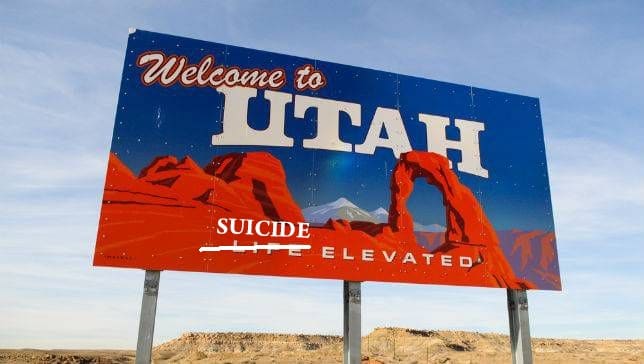
The teenage suicide rate is increasing in Utah. Suicide is becoming one of the most common forms of death of people under the age of 45. How and why are more people making the desperate decision to end their lives?

|


The teenage suicide rate is increasing in UtahThe teenage suicide rate is increasing in Utah. Suicide is becoming one of the most common forms of death of people under the age of 45. How and why are more people making the desperate decision to end their lives?

Delving into this important yet neglected topic, We talk to Kim Myers who is the Suicide Prevention Coordinator for the State of Utah. If you or a loved one is having suicidal thoughts watch this important episode. You can fast forward to 37 minutes and get the best information on suicide prevention.

The Wall Street Journal recently spotlighted Utah’s Herriman High School, when one teenager committed suicide and five others followed. We touch on this terrible tragedy and how and why especially in Utah this is a problem. Can we attribute the problem to the Church of Jesus Christ of Latter-Day Saints’ demands for perfection? Is there a growing dystopian mindset coming from the consumer-based mindset that exists in the suburbs? Or are teens just unable to handle rejection due to the emphasis on “safe spaces” participation awards and never being told that failure is a part of life?


,


Join our newsletter.
Stay informed.


  • Whiskey, Bullets & a Buried Town: Archaeologists Reveal Alta’s Wild Past

    Before Alta was known for powder days and lift lines, it was a silver mining town clinging to the side of a narrow canyon. In the late 1800s, men lived at 8,000 feet, went underground each day, and endured winters that regularly buried buildings in snow. This past summer, that mining town resurfaced — literally — during construction at the Alta Ski Area.

    To understand what Alta really looked like, you don’t begin with legend. You begin with its trash — and this time, that happened almost by accident.

    Alta Ski Area was installing underground water reservoirs to support snowmaking. Because the project sits on Uinta-Wasatch-Cache National Forest land, an archaeologist was required to monitor the excavation. No one expected the trench to produce much.

    But, It did.

    Artifacts began surfacing almost immediately. Enough that the Forest Service contacted the Utah State Historic Preservation Office for help. Lexi Little, who coordinates the Utah Cultural Site Stewardship Program, helped mobilize nearly 30 volunteers to assist with what quickly became a focused two-week excavation.

    Winter deadlines were approaching. The pipes for the reservoirs had to go in the ground. There wasn’t time for a slow, extended dig.

    “It was two weeks of digging in the dirt and helping figure out exactly what we were looking at,” Little said.

    Most of the people screening soil weren’t professional archaeologists. They were trained stewards from around Utah — part of a statewide volunteer network that now approaches 500 people. They poured dirt through shaker screens, scanning for fragments that could piece together a town long buried.

    “Archaeology is human trash,” Little explained. “Archaeologists are very into trash.”

    Alta had left plenty behind.

    https://youtu.be/hzIHzx3OGoo?si=dKcl2CEz-t6FZzYw

    Victorian-style ceramics appeared first — the kind typically used in hotels. Medicine bottles followed. Ink bottles. Hand-blown glass. A porcelain doll’s foot surfaced from the soil, a small detail that shifted the mental image of the town. Families were here. Children were here. This wasn’t only a camp of miners.

    The bottles helped establish time. Manufacturing details — whether glass was hand-blown or mold-made, whether a maker’s mark appeared on the base — allowed archaeologists to date many of the artifacts to the 1870s through the 1890s, when Alta was booming as a silver mining town.

    “That gives you that range of dates for when Alta was really booming,” Little said.

    One reusable soda bottle clearly stamped “Salt Lake City” connected the canyon to the valley economy below.

    Then something unusual rolled out of a dirt pile.

    A corked bottle. Intact. Liquid still inside.

    Continue reading and support independent Utah journalism with a purchase of Utah Stories (Digital + Print) or 3 month free trial (Digital).


  • How Horses Help Kids Heal: Inside Utah’s Equine Therapy World

    Kelty Johnson trains horses for a living, but her deeper work happens in the quiet space between animal and human. On the Utah Stories podcast, she explains how equine therapy helps children regulate emotions, build confidence, and reconnect through presence rather than pressure.


  • Angela Brown: The Woman Behind SLUG Magazine and Craft Lake City

    Angela Brown is the publisher and owner of SLUG Magazine, one of the city’s longest-running independent publications and a central voice in Utah’s alternative arts and music scene. She is also the founder of Craft Lake City, a nonprofit that has grown into one of the state’s largest platforms for local makers and creative entrepreneurs.


  • Can Utahns Still Afford to Have Kids?

    When families cannot afford homes near their jobs, the daily math becomes brutal. Commutes stretch longer. Childcare costs pile up. Mortgages consume more of a household’s income. The result is what economists call “house-poor” families—people who technically own a home but have almost nothing left over to live on.

    The obvious question is: why isn’t this being fixed?