
Utah Stories

“Are You Hallucinating?” A Visual Chat With Three Very Different Artists

Artists endeavor to express a feeling, a thought, a moment, something slightly or profoundly deeper than what life typically demands we notice or respond to.   This month’s Downtown Artist Collective works by three Utah artists focus on the use of color. Their grouped series, titled krōmə, are explorations of different points of connection to life…

|


Downtown Artist Collective
Photos by Dung Hoang.

Folding laundry. Buying groceries. Washing dishes. Necessary, routine life maintenance. Chores and to-dos consume our time and attention, but still, we have an innate desire for some kind of connection, some level of intimacy, to each other, to our shared human experience. Art offers the opportunity to experience connection, and the May exhibition at the Downtown Artist Collective, found in THE BLOCKS, in downtown SLC,  provides a touchpoint for casual community connection.

Artists endeavor to express a feeling, a thought, a moment, something slightly or profoundly deeper than what life typically demands we notice or respond to.   This month’s Downtown Artist Collective works by three Utah artists focus on the use of color. Their grouped series, titled krōmə, are explorations of different points of connection to life events, circumstances, and thoughts.

In its third year of operation, The Collective is located in the heart of THE BLOCKS, Salt Lake City’s cultural core, in a relatively low-slung brick line-up of downtown small businesses. The polished interior eschews high-brow pretense and feels authentically welcoming. Member-artists staff and run the gallery business, and the space also functions as a community resource for workshops and classes. New exhibitions of member-generated works are introduced monthly, with opening receptions scheduled on the seasonal Friday night Salt Lake Gallery Stroll.
Micah Payan
Micah Payan

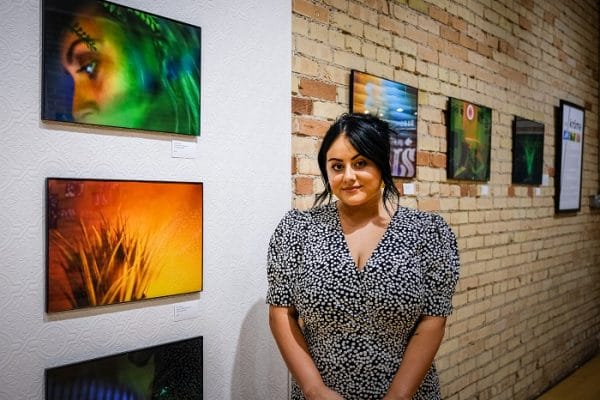
Micah Payan considers art as an opportunity for connection by providing the viewer the experience of seeing life through the lens of someone else, literally in her case. Micah’s “Are You Hallucinating?” photograph series uses vibrant, deep, jewel-tone colors to capture, as she says, “a very small moment taken to cinematic proportions.” She uses color to evoke a dreamlike impression. The images are intentionally meant to take familiar objects or moments and, through colored light manipulation and lens distortion, present photographs that are both intimate and slightly disturbing. “Photos have an intimacy,” she says, “and art forces you to see life from someone else’s perspective.”
Miroslava Vomela
Miroslava Vomela

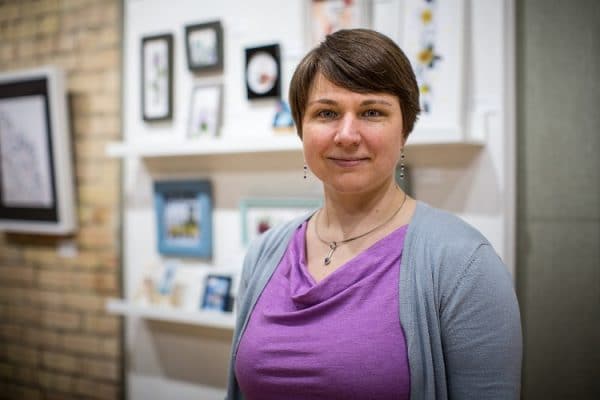
Flanking Micah’s dramatically bold prints are mostly small mixed-medium works by artist Miroslava Vomela. Miroslava’s primary source of income is through her graphic design work, so spending time in the studio balances her computer time with creative time.

In contrast to the saturated splashes of color in Micah’s photographs, Miroslava’s collage work is exacting, precise and graphically calculated. Taken in as a whole, each piece is a well-balanced articulation of color, texture, and composition. Up close, the viewer can appreciate the details of brush and pencil strokes that both ground and embellish carefully cut and arranged magazine pictures. What are static images, Miroslava reinterprets into dynamic configurations. There is movement in this collection she calls “Amoeba.” Each of the diminutive pieces uses a general color palette of one predominant color. “I am attracted to small works right now because I can try out different things and learn a lot in a relatively short period of time,” she states. Miroslava also recognizes the fact that few people have ample wall space to hang large works of art, so she’s deduced that gallery visitors can connect with her art on a practical as well as a visual level.

Celine Downen
Celine Downen

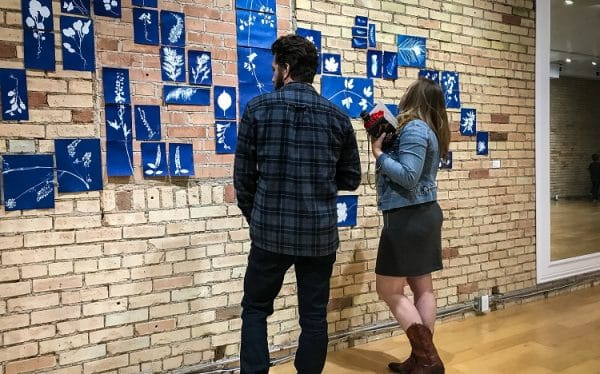
Opposite her artist-peers work hangs Celine Downen’s collection of cyanotype prints. Celine’s statement accompanying this wall of blue-backed images evokes an immediate connection to the shared human experience. Upon reading of her family’s loss of her father, the viewer is connected to a feeling state, what Celine describes as “dark blue days.”

The light-processed images are representative outlines and details of snippets of nature, some feathers, and leaves, some entire plants. The creative process, she says, was relaxing and meditative. “I wanted to give myself permission to do something simple,” she explains. The use of plant bits and pieces that she has collected over the years, and particular herbs and delicate garden flowers represents elements of Celine’s life story and connection to family. To her they are symbols, but the images are also familiar enough that she understands other people can look at the prints and may experience a personal memory.

Each artist in this month’s Downtown Artist Collective exhibition has thoughtfully generated an opportunity for an accessible visual chat, so to speak, a relatively informal and convenient way to pay attention to life experience in a new, perhaps meaningful way. Stop in. Have a look. Give yourself permission to connect.

The Downtown Artist Collective is an important fixture of THE BLOCKS’ downtown social scene, located at 100 South 258 East.  The gallery is open Saturdays, 2pm-6pm, and Sundays, 2pm-4pm, or by appointment. krōmə runs through June 14th.




Join our newsletter.
Stay informed.


  • Artist Kate Kilpatrick Brings Utah’s History to Life Through Murals

    “I think we’re all interconnected; as individuals as well as societies,” Kilpatrick notes. Her work showcases those connections exuberantly, and whatever scale she’s working on, you can bet that in terms of energy and spirit, she’s painting large.


  • Dyslexia and ADHD in Kids: Why Some Students Struggle to Read in School

    That’s what led to my conversation with Donell Pons, a Utah-based dyslexia expert who has spent more than two decades working with students who struggle to read. What struck me right away is how often we get the problem wrong from the start.


  • Why Most People Stay Stuck in Business and What It Takes to Move Forward

    Every so often, you meet an immigrant who came here with almost nothing and managed to build something exceptional.

    Prakash Shah is the kind of man who has spent enough time around risk that he no longer treats it like an interruption.

    Today, he works in business brokerage and advisory, helping owners sell companies, helping buyers decide whether they should step in, and, when the fit is right, helping connect those buyers with private equity. He works in a world of valuations, leverage, due diligence, and hard questions that most people would rather postpone. He also operates in Utah real estate and has built a career around seeing value before it is obvious to everyone else. That is who he is now. What makes him interesting is how early that instinct started to form, and how little his life resembles the way most Americans are raised to think about comfort, career, and security.

    He grew up in Nepal in a boarding school system that would feel severe to many Americans. He was an only child, yet he saw his parents only twice a year for twelve straight years, until high school graduation. He lived inside routine. He shared space with boys from different social classes and different family circumstances. The school was structured enough that money did not buy you any special standing once you were inside. Everyone followed the same rules. Everyone was subject to the same discipline. In his case, it was an army school. Everything was measured. Everything was scheduled. In that kind of environment, you do not build your life around preference. You build it around adaptation.

    That contrast matters.

    A lot of American children are raised to search for what fits them. What are you passionate about? What do you enjoy? What feels right? Those are not bad questions, but they can create a habit of waiting for life to align itself before action begins. Prakash learned something else much earlier. He learned that life often does not align itself first. You enter the room as it is, you deal with the people in it, and you figure out how to function without making your comfort the center of every decision. He said that one of the biggest lessons from those years was tolerance, the ability to live with people from all walks of life and genuinely learn to get along with them. That is not a soft value. In business, it turns into resilience. In negotiation, it turns into patience. In career terms, it turns into range.

    When he came to the United States over 25 years ago, he did not arrive with the kind of runway that allows for a prolonged identity search. He came with two suitcases and enough money for one semester. He went to Hunter College in New York City, then to NYIT near Central Park, studying media and then media and technology management. He also studied psychology. Those details matter because they show something about his mind. He was interested in people before he built a career around deals. Even then, what attracted him was not technical prestige. It was understanding motives, behavior, and how people reveal themselves.

    But New York is merciless toward vague ambition. It demands payment in rent, transit, food, and time.

    Prakash worked constantly. He took multiple jobs. He paid tuition, paid rent, and skipped most of what Americans imagine as college life. There were no romantic years of drifting from café to concert to self-discovery. He talked about not having the luxury of dates, travel, or finding himself. He was working. Even laundry was not a small detail. In New York, he pointed out, you do not just throw clothes in a machine at home. You haul them to the laundromat, count quarters, and measure what is necessary. He also described distraction in a way that most native-born Americans probably do not think about. For immigrants, distraction is not always pleasure. Sometimes distraction is the constant pressure of competing needs. Tuition or rent. Food or savings. A better coat or another month of making do. He was not romanticizing the struggle. He was describing the arithmetic of it.

    That arithmetic did not make him cautious. If anything, it did the opposite.

    While in college, he had the option of safer analytical work. Instead, he took a sales job with Time Warner Cable that sent him into the South Bronx from 6 p.m. to 10 p.m. to knock on doors. He is not a physically imposing man. He knew exactly what kind of neighborhoods he was walking into. He described apartment buildings where people kept pit bulls, where tension was normal, where one mistake in tone or timing could end a conversation immediately. For most people, that kind of job would have been something to survive and forget. For him, it became a school in human behavior. “It’s not about talking… it’s about listening,” he said.

    One story from that period says almost everything about how he operates. He knocked on a door one night around 8:45 and found himself facing a huge man with a gun on the table, pit bulls nearby, and a half-eaten pizza in front of him. It had all the ingredients of a very bad scene.

    Continue reading and support independent Utah journalism with a purchase of Utah Stories (Digital + Print) or 3 month free trial (Digital).


  • Ancient Pyramid Discovered in Sugar House Park, Salt Lake City

    A Salt Lake City resident says he may have uncovered what he believes to be a buried structure beneath a well-known hill in Sugar House Park, raising questions that have drawn both curiosity and skepticism.