BYU Beats The U at Home in Entrepreneur Challenge
Statewide Innovation Showcase
Utah’s best collegiate and high school entrepreneurs competed for $100,000 in cash and prizes at the 2019 Utah Entrepreneur Challenge (UEC) and High School Utah Entrepreneur Challenge (HSUEC) Awards & Showcase on Saturday, March 30, at the University of Utah’s Lassonde Entrepreneur Institute.
Lassonde is a nationally ranked interdisciplinary division of the David Eccles School of Business and a student hub for learning entrepreneurship and innovation. Its first programs were offered in 2001, made possible through the vision and support of Eccles School alumnus and successful mining entrepreneur, Pierre Lassonde.
All programs are open to students from any academic major or background, which might explain why the event was packed.
Winning Ingenuity from High School
It was a thrill to be among so many talented and creative people competing, but also connecting with each other, to improve the world all in one place.
20 HSUEC entrants competed for $30,000 in cash and prizes. Coming away with a $7,000 Grand Prize win was American Heritage High Schooler, Olivia Washburn for creating The Noisy NICU-Cap, a cap for newborns as protection from loud noise experienced in the NICU. Washburn said this about her experience as a young entrepreneur, “If you have an idea for a developing a business, do it because it’s always worth the ride.”
Parallel, a new parking solutions app created by Hridhay Suresh of Bingham High School increases parking efficiency. His idea is to create a commuter marketplace that connects people with available parking. “3.6 billion hours, 1.7 billion gallons of fuel and $72.7 billion dollars are leached from the economy every year in search of parking,” said Suresh. “Instead of trying to find event center parking, park at a nearby diner for lower cost, and in less time.”
James Colbert and Jacqueline Huynh from West High School won the $1,000 Judges Award for solving “big risk” problems, with a drug-adherence app called Little Healthcare targeted for use by 6 to 12 years old’s suffering from epilepsy and asthma. “1.7 million children in the U.S. have epilepsy or asthma, and 600,000 of them have trouble taking their meds,” said James. “We created an app that would relate to a child and help them remember to take their medications.”
“There are lots of medical adherence apps for adults, but not for children,” said Huynh. “This works because we’ve used a gamification strategy, so they’ll feel more motivated to take their medications as they win rewards.”
Winning Second Place at HSUEC and $5,000, was William Chang, a student attending the Waterford School. Chang is Founder and CEO of CareerRocket.io, a Spotify app that facilitates educational connections between students and industry experts. “When kids graduate, they don’t know what they could be doing or how to get there,” said Chang. “We’re going to give kids a future.”
Winning Innovators from College
And if the High School entries weren’t already impressive enough, the collegiate entrepreneurs also brought highly inventive developments and ideas to the table.
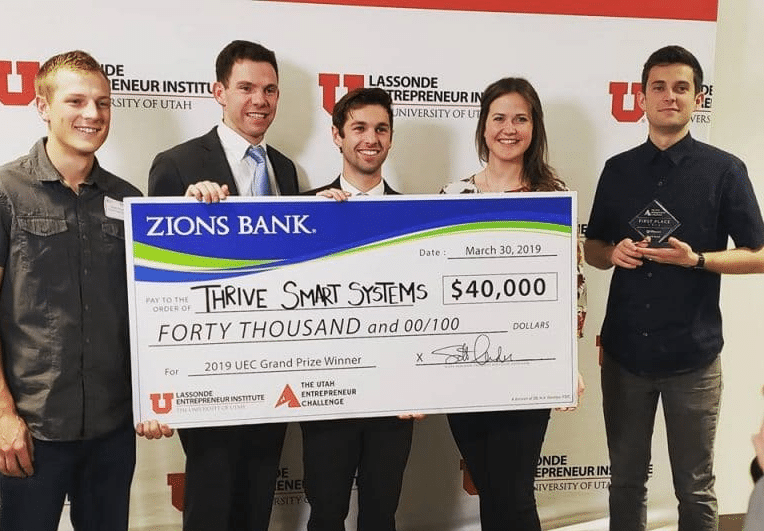
UEC victors included Grand Prize $40,000 winner from Brigham Young University, Thrive Smart Systems, for developing the first-ever wireless irrigation system.
SHERO, a University of Utah team, took Second Place along with a Sustainable Business Award amounting to $15,000, for providing women around the globe with safe, comfortable biodegradable menstrual pads with a goal to help destigmatize the menstrual period and increase access to feminine hygiene as part of a global effort to empower and equalize women in a $35 billion global feminine hygiene market.
Snow College’s DeGraw Custom won the $5,000 Third Place prize in addition to receiving Technology ($3,000) and Bootstrap ($2,000) awards for its high-quality, custom manufactured agricultural products.
Winners also included Blue and White Collar for creating sustainable, high-style performance dress shirts; and PreOv for a device that gives women fertility control without hormones. Freyya was among the top 20 teams for creating a new device for measuring pelvic muscle force. Grip’n’Strip also made the list for developing magnetic water bottle sleeves.
Lystant a University of Utah company won as one of the top 8 teams for a new platform that connects people with saleable items (owners) to local freelance sellers (sellers)
Beacon Sleep Solutions won the People’s Choice Award of $1,0000 for developing the only device capable of directly treating the 22.6 million people in the United States who suffer from sleep paralysis and helping an additional 38.8 million people in the U.S. with related disorders such as chronic nightmares, and sleeping disorders related to PTSD.
Thrive Smart Systems Operations Officer, Bryan Brittain, was sold on entrepreneurship the moment he heard it described as the application of all knowledge by a guest CEO speaker during a lecture series.
“Being an entrepreneur means creating something that wouldn’t be there had you not existed, and the greater the thing created, the greater the entrepreneur,” said Brittain. “It undoubtedly means risk-taking. You’re betting on yourself. And the harder you work and the more you learn, the higher your chances are of winning.”
Listen to Utah Stories podcast with the winners from Thrive Smart Systems below: