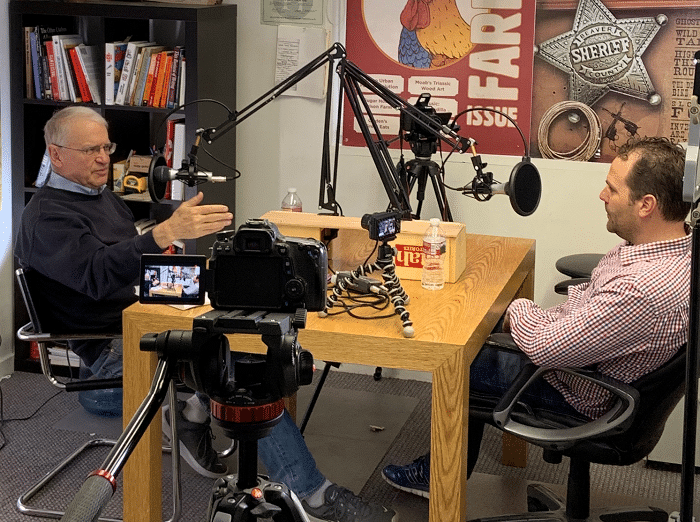
“If it bleeds, it leads.” That’s the mantra you have to follow to attract viewers in the local TV news business said local news stalwart Rod Decker when I sat down and spoke with him for our Utah Stories podcast. I suppose I agree. Not much blood in this story, mostly because the heart has been removed from local news.
Rod Decker was a very young reporter working for the Deseret News when he was sent to Lebanon to report on the escalating crisis concerning the trade of hostages for arms.
At that time so many reporters were coming from America and spending so much money that the taxicab drivers in Lebanon were getting rich. This is a far cry from where SLC news is today. Not long ago I saw a local TV reporter reporting on a crash site without a cameraman, using his small camera like a tourist with a selfie stick. Drastic measures to save money.
Decker was a fixture for 37 years at KUTV News. He witnessed the dramatic changes in the local news business. For many years George Hatch owned KUTV News as well as KALL and the Ogden Standard-Examiner. “At that time,”Decker says, “owning a local TV station was essentially a license to print money.” George Hatch’s TV and newspaper empire eventually collapsed. KUTV was later bought out to become a part of a national conglomerate under Sinclair Broadcasting. Sinclair owns outright 154 stations nationwide and is known for its conservative political leanings.

But Decker has only words of encouragement regarding the “if it bleeds it leads philosophy.” This practice has become more commonplace for good reason. “As the audience became more segmented, they had to find a way to attract viewers and keep advertisers.” Thus seeking the bloody has become the norm in local TV news.“They do a good job,” Decker says of his former station and colleagues.
Growing up watching the local news, I remember Decker’s program called Take Two, where he sparred with political leaders and asked them excellent hard-hitting questions, thus making for interesting debate. But times have way changed.
Today the formula for local news is to seek out the dancing Big Buddhas, what I would call fluff. I’m not saying Big Buddha isn’t entertaining, he is, but why did dancing become such a fixture in local news?
Reporting the heart and truth of matters are ideals I always appreciated most about the news. There is an essential belief a journalist should abide by. Journalists should attempt to find the truth. Journalists should then use and hold “the truth to power.” Is this ideal long gone and disappeared? Is this a Utopian, nostalgic view of the news? I asked Rod Decker. His response to this concerning the Trump/Russia collusion coverage was excellent. Listen to the podcast to hear it.
Journalism has the power to build community. It operates in this function by informing enough people about the entrepreneurs, and locals who are shaping, changing and building our city. If instead the only way people feel connected to their community is through Facebook, Instagram, and Google, then we are destined to reach a point where the fabric of our society is torn out from under us.. Rod Decker presented the social fabric of Utah through man-on-the-street interviews and stories that defined Utah. He also epitomized for me what a good journalist should be producing. Be sure to watch a Rod Decker classic about choosing Utah’s State song.
MORE UTAH STORIES SHOWS
Single-Payer Healthcare in Utah
Growing Utah’s Cities and Communities to have A Strong Local Economic Tax Base
Utah Liquor Laws: 3.2 to 4.8 % ABV
The Gut-Brain Connection: Overcoming Depression and Addiction Naturally
Utah’s Air Policy and why won’t our leaders do anything about industrial pollution